
Why “calories in, calories out” is flawed
The Japanese alternative for healthy but joyful eating
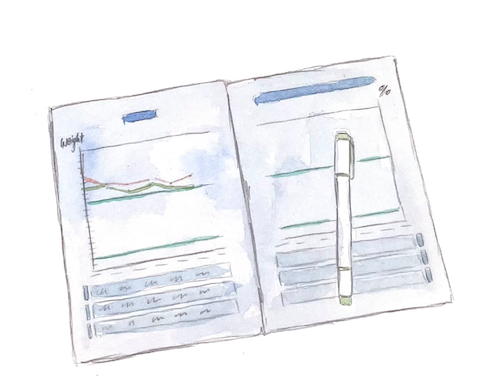
I believe that calories are a helpful tool when it comes to understanding how much you’re eating, but it doesn’t tell the whole story.
There are many interesting things that we can explore when we talk about the idea of “calories in, calories out” — like gut microbiome, metabolism, how our bodies adapt to weight and composition changes — but I’m actually going to set those topics aside for now.
Because even without these considerations, there is something fundamentally flawed about using calorie tracking as the foundation of our health goals.
“What’s wrong with counting calories?”
If you consume less calories than your body uses, you will lose weight — that’s true! But let’s examine how we determine these numbers.
In scientific terms, a calorie is a unit of energy — 1 Calorie (or kilocalorie, kcal) is the amount of energy needed to raise the temperature of 1kg of water by 1 degree Celsius.
Back in the old days to measure food calories, food would be placed in a sealed container and submerged in water. The food would then be heated up until it effectively disintegrated, and then the rise in water temperature would be measured. Our bodies don’t metabolize food like this.
Nowadays they don’t even measure each food item, but using the Atwater system, assign values to fat (9 kcal/g), protein (4 kcal/g), carbohydrates (4 kcal/g), and alcohol (7 kcal/g). If a cookie has 10g of fat, 3g of protein, and 15g of carbohydrates, we essentially have a cookie that is labeled to be 162 calories.
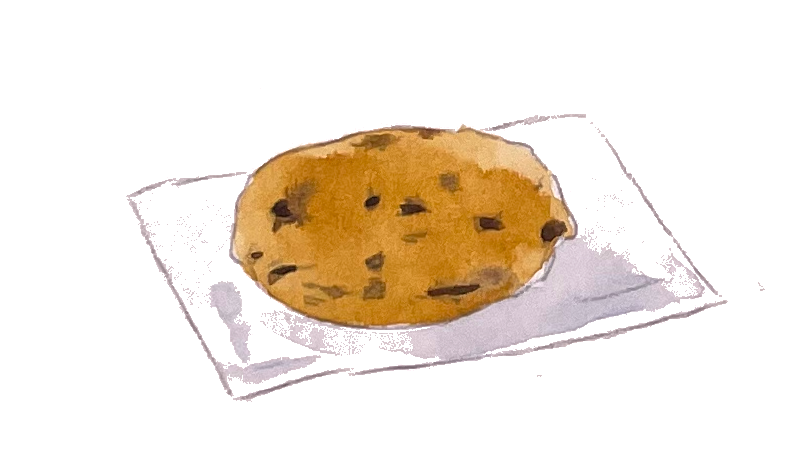
But because of this averaging system, calorie labels are allowed to be up to 20% wrong — so your cookie could actually be around 195 calories. Doesn’t sound too bad, but if you’re tracking to eat 2000 calories a day, you could actually be eating up to 2400. Compounded every day, it’s a significant discrepancy, and it may be why someone struggles to meet their health goals.
“But all of the weight loss/dieting/fitness apps out there are telling me to count calories to reach my health goals.”
Consider this: Even if the calorie labels on food were 100% accurate, the healthiest foods for us — fruits, vegetables, and home-cooked meals — are not packaged, and therefore we don’t know how many calories they contain.
You could of course Google “calories in an apple”, but there are over 7500 varieties of apples in the world, and infinitely more sizes. If you make a hearty vegetable soup for dinner, with carrots, potatoes, onions, tomatoes, and chicken, it would be impossible to measure the calories in each of the ingredients.
But these foods are good for you! And will undoubtedly support your health goals.
I believe that looking at calories is helpful when you need a broad estimate for something new — it can be helpful to know if a cookie has 100 or 400 calories — but it’s not something that we need to track.
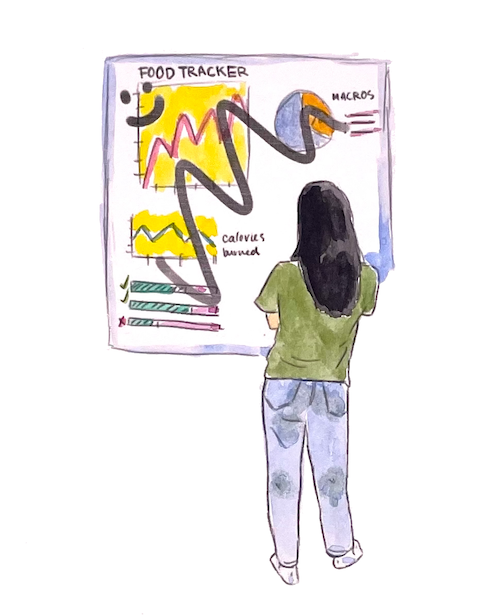
“Okay, this makes sense to me, but what should we do instead?”
I often speak about health in terms of balance, and any health journey as a re-balancing act. Because what do you do when you lose your balance? You slowly shift back.
For example, if you’re a little heavier than you’d like to be, there are two main strategies that you can use to rediscover your healthy balance — 1. Eat more fruits and vegetables, 2. Eat less in general. You don’t need to do both at once, and you don’t need to do it to any extreme degree. Choose one, start slow, and build on it.
And choose something that fits your lifestyle! If you don’t really know how to cook with vegetables, focus first on eating more fruit. If you’re time-strapped and busy, focus first on just eating less.
You don’t need to obsess over the numbers, just lean back towards your healthier balance.

“The idea of fruits and vegetables/eating less makes me stressed and not excited…”
Totally understandable. If you grew up in the US (or any health-stressed environment) there can be such a lack of joy when it comes to eating well. But it doesn’t need to be that way.
Life in Japan has shown me that everyone enjoys being healthy. Japanese people are not particularly health-conscious or disciplined when it comes to health. We enjoy snacking, drinking, and eating desserts as much as any other human being.
But what I realized is that as much as we enjoy eating “unhealthy” food, nobody really wants to do that every day of their lives. It doesn’t feel great to be bloated and overstuffed all the time. By nature, we like to eat whole, fresh, and seasonal foods.
And Japanese culture recognizes that: Meals are often well-balanced and varied in vegetables. Eating in moderation is seen as something embedded in a lifestyle, rather than a restriction.
There is joy in health, when we do it for the right reasons: the simple way it makes us feel good.
Healthy eating and joyful eating are not mutually exclusive — they can be the same thing! The key to building a lifelong healthy lifestyle is discovering the changes you’re willing to make, starting small in the adjustments, and building up from there.
It’s not dependent on calorie-counting.
Warmly,
Kaki
Learn to be healthier, inspired by life in Japan:
I teach about health inspired by simple Japanese philosophies and lifestyle practices, so you can learn to find peace, fulfillment, strength, and health in your own body.
Stay in the loop and get access to free resources: Sign up here!


