
Why Buying a New Car is a Bad Idea
Do not fall into this trap
Many people dream of buying a new shiny car. It’s pretty; it’s brand new; it makes them feel good. I get it! But purchasing a new vehicle isn’t always a good idea. Most times, it’s a lousy investment that can potentially cost you a ton of money. To understand why it’s the case and how to avoid it, let’s review the data and use real-life examples.
What Buying a New Car Entails?
There are benefits to getting a new car. If it’s new, it won’t require serious maintenance for a long time. No one drove it before you, so you know exactly what you’re buying. If you treat the car right, it can serve you many years, and possibly even decades.
However, the downsides often outweigh the advantages. Here are the negatives:
- Spending a tremendous amount of money, which most people don’t have. The only reason they can afford it is credit.
- Loan repayment terms. You’re essentially getting yourself into a 5 to 8 years of debt that will also include interest payments.
- Interest. Even if you received a “super special promotional rate” of 0.99%, it would add up quickly.
- Car loan equals liability. You are receiving something that depreciates rapidly. The rule of thumb is: the car loses 20 to 30% of its value in the first year and 15 to 18% the year after that. Remember: you are still paying off the original price for a brand new vehicle as it depreciates.
The rule of thumb is: the car loses 20 to 30% of its value in the first year and 15 to 18% the year after that.
Real-Life Example: Buying a New Car
Let’s look at an actual example. I selected 2020 Honda Hatchback to run the numbers for this section. Honda isn’t a luxury brand, yet it’s not the cheapest one on the market. The 2020 Honda Hatchback is priced at $25,976 in Canadian Dollars, which is a reasonable price for a new car.
Naturally, once you start building the car, it becomes more expensive. I can’t drive a stick, so we’re going for the automatic transmission. I also don’t need any extras or additional warranty — no frills. The final price for a basic car ended up being $31,038.50:
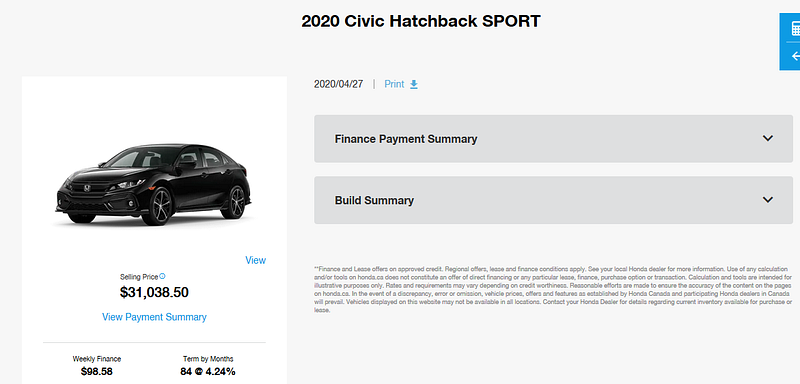
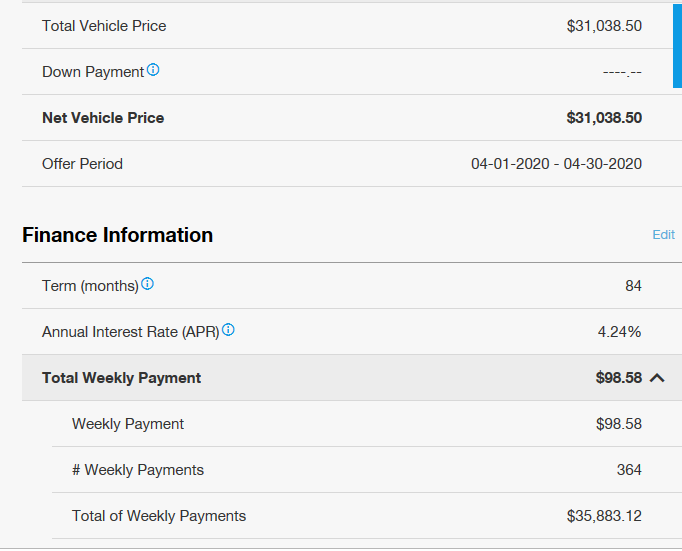
At a weekly payment of $98.58, you will pay off this car in 7 years. The cost of borrowing — as in accrued interest — will add up to $4,844.62. Therefore, your final price for this car is $35,883.12:
Alternative: Buying a Used Car
Now, what if you chose to purchase a used car? Honda sells certified used vehicles as well. The cheapest car I found was a 2017 Honda Civic Hatchback for $15,995 with 63,000 km (45,000 miles) on the odometer:
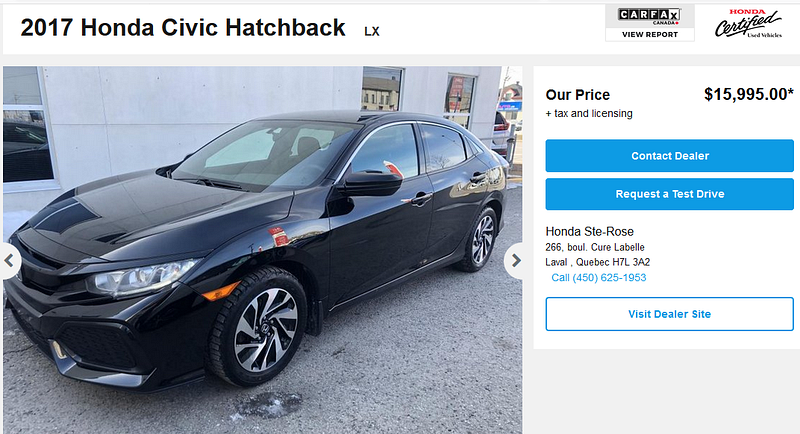
It’s located in the province of Quebec in Canada, so we need to add a 9.5% sales tax. It would increase the cost to $17,475. There is also a licensing fee, but no amount provided. Let’s round the price up to $18,000.
So, we have a brand-new car for $35,883, and a 3-year old used one for $18,000. The new car ends up costing twice as much.
Alternative: Buying a Car Off an Action
The buyer has one more option: buying a car using a car auction website. According to Autohitch.com, it can save you $1,000 to $2,000 on average. You might also get lucky and buy a car much cheaper if no one bids on it. Auctions are unpredictable, and it’s sometimes a gamble.
Best Alternative: Don’t Buy a Car at All, or Get an Old One
A car isn’t always a necessity. If you have no other way to get around or if a vehicle makes your life ten times more accessible — by all means, get it. But often you can get by without one, or purchase an older car. It will cost you a lot in repairs, but most likely less than $35,883 or even $18,000.
If you are fortunate enough to survive without a car, save your money. There are many ride-sharing companies such as Uber. Kevin O’Leary, a.k.a. Mr. Wonderful has the best advice regarding this unnecessary purchase:
“You’re thinking about buying a car. Let me give you a new idea: Don’t, Cars cost a fortune in maintenance and insurance and just the amortization, which means as they go down in value, you’re losing money,” O’Leary explains. “Let’s say I pay $25,000 for it. Two years later, it might be worth only 12 thousand dollars.” — CNBC News
You can also watch this interview on Youtube:
Invest Your Money Instead
The best alternative is to invest the money you put aside for the car. If you contribute $99 per week to a 7% investment fund for 7 years, you will end up with a $46,426.98:
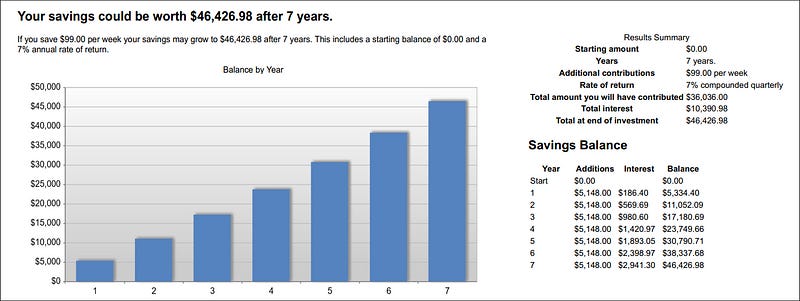
Instead of getting the brand-new Honda and wasting $35,883, plus insurance, plus gas, plus other expenses, you can work on growing an asset. Allocate it towards a down payment, or reducing your mortgage, or education, or some other significant purchase.
My Own Experience with Cars
I’ve been postponing getting a car for many years. I live in the city, so owning a vehicle isn’t necessary. The public transport is accessible, and since Uber came around, I have another alternative.
The first time I needed a car was when I turned 25 and would have to commute to another town for work. Instead of wasting my money, I’m sharing a car with a family member. It makes more financial sense to me: even though I don’t own the vehicle, I cover my gas, half of insurance and half of expenses. It costs me the same amount of money as if I used public transit.
So, why burn through money? If you have other options — explore them. Money looks much better while growing in your bank account.
This article is for informational purposes only not all information will be accurate. This should not be considered Financial or Legal Advice. Consult a financial professional before making any major financial decisions.