
Why Book Burning Destroys the Most Vital Tool Of Humanity
If you want to break someone’s spirit, take away their books

On the night of May 10th, 1933, the smell of smoke was in the air in Germany. 40,000 people gathered in the town square of Opernplatz to watch the blaze of thousands of books deemed ‘un-German’, symbolically cleansing Germany by fire. Throughout the country, students held huge bonfires, throwing book after book into the flames, lighting up the night.
Through setting fire to books, the Nazis were setting fire to freedom of thought. Literature was devoured by the fire of hatred, building the perfect foundation for The Third Reich and the crimes against humanity that went along with it.
In The Book Thief by Markus Zusak, the story centres around an obsession with books by the main character Liesel. It is no coincidence that a book about Nazi Germany would centre around the love of books. Liesel is stealing fragments of humanity, pieces of her life before everything changed. She protects them as the precious gifts that books are.
Illiteracy as a Form of Control
Throughout history, keeping people from reading was a way to suppress them. In the antebellum South, only about 10% of enslaved people could read.
By keeping black people from literacy, slave-owners and white supremacists kept information from spreading about freedom and the oncoming war with the North. It kept the justification for slavery alive, keeping enslaved people oppressed and illiterate, so they appeared unintelligent.
In 1833, an anti-literacy law was passed in Alabama to fine anyone who dared to teach a slave how to read. The law stated:
“Any person or persons who shall attempt to teach any free person of color, or slave, to spell, read, or write, shall upon conviction thereof of indictment be fined in a sum not less than two hundred and fifty dollars.”
Despite the best efforts of white people at the time, black people still found ways to learn how to read, which allowed them to communicate with those who could lead them to freedom.
In the novel Kindred by Octavia E. Butler, literacy becomes a tool to the main character who travels from the 1970s to the antebellum South. Using her literacy, which was unheard of for a black woman of that era, she forges documents of freedom to survive and help her ancestors.
The Literacy of Women
Throughout history, women in many cultures and societies have been kept illiterate. Men feared that women who could read would start getting ideas about their rights, and they didn't want that. They wanted women to remain subservient and stay in their place as homemakers and mothers and believed the ability to read and write would deter that.
The Middle Ages
Literacy in the Middle Ages was a luxury afforded by the rich. Only 10% of the European population could read, and only 1% of women could read. There’s a reason this part of history is called the Dark Ages. Women who could read were seen as a dangerous threat to humanity.
King Phillip III of Spain himself stated:
“Women should not learn to read and write unless they are going to be nuns, as much harm has come from such knowledge."
Only nuns were allowed to read and write, and many of them created beautiful works of literature. Hildegard of Bingen was one of these women, and throughout her life in a convent, she created many biographical works, poems, and compositions. Her work gives us a rare and unique view into 11th-century life as a woman.
Setting Flame to Free Thought
Every instance of book burnings throughout history marks the beginning of an era of oppression. Through centuries and across the globe, burning books took place as a form of control and totalitarianism.
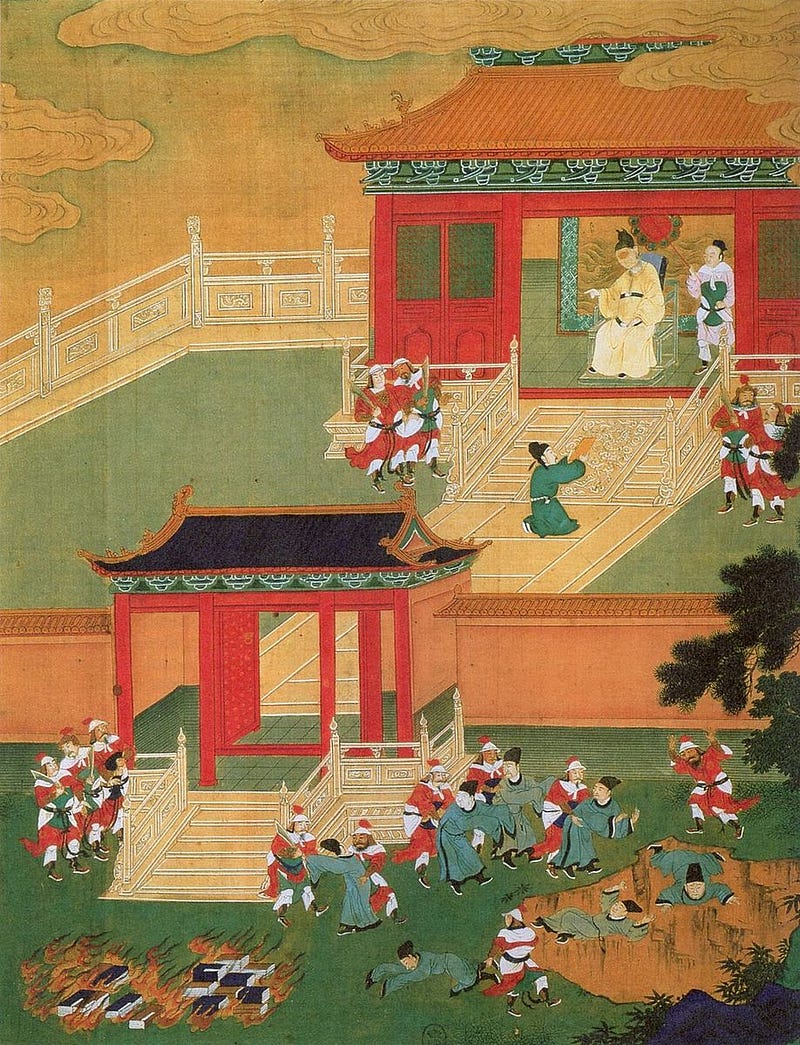
The burning of books and burying of scholars
One of the earliest incidents of a public, government-mandated book-burning occurred in 238 BCE by the Chinese Emperor Qin Shi Huang. Suggested by the emperor’s chancellor Li Ssu, the goal of the mandated burning was to strengthen the control of the Qin State.
“Li Ssu proposed that all histories in the imperial archives except those written by the Qin historians be burned; that the Classic of Poetry, the Classic of History, and works by scholars of different schools be handed in to the local authorities for burning; that anyone discussing these two particular books be executed…”
Fahrenheit 451
One of the most important works of literature to capture the importance of books is Ray Bradbury’s Fahrenheit 451. This novel illustrates the dystopian world created if there were no books, and the title references the temperature at which paper burns. Cold and meaningless, the citizens of this world move through life without independent thought or feeling, and therefore, without joy.
Perhaps the most pertinent scene in Fahrenheit 451 is where Guy Montag responds to a call as a fireman. In his world, firefighters exist to start fires and burn books, not to put them out. In this particular call, he’s responding to an old woman who had kept a secret stash of books from the time before they were banned. She chooses to be burned along with the books instead of living without them.
Conclusion: Literacy Is a Gift That Must Be Protected at All Costs
The woman who decides to be burned alive with her books is a symbol that perfectly illustrates the importance of reading. If you destroy books, you destroy humanity. If you take away the right to literacy, you take away a person’s freedom entirely.
Literacy is a human right that is still being taken away from people all over the globe. It is for these reasons that I treasure the gift of literacy that I have and express gratitude to every great story I have the privilege of reading.
Further reading:


