
Why Blue LED Earned a Nobel Prize if Reds and Greens Already Existed for Decades?
Red and green LEDs already existed for a few decades when the efficient blue LED was invented in 1989.
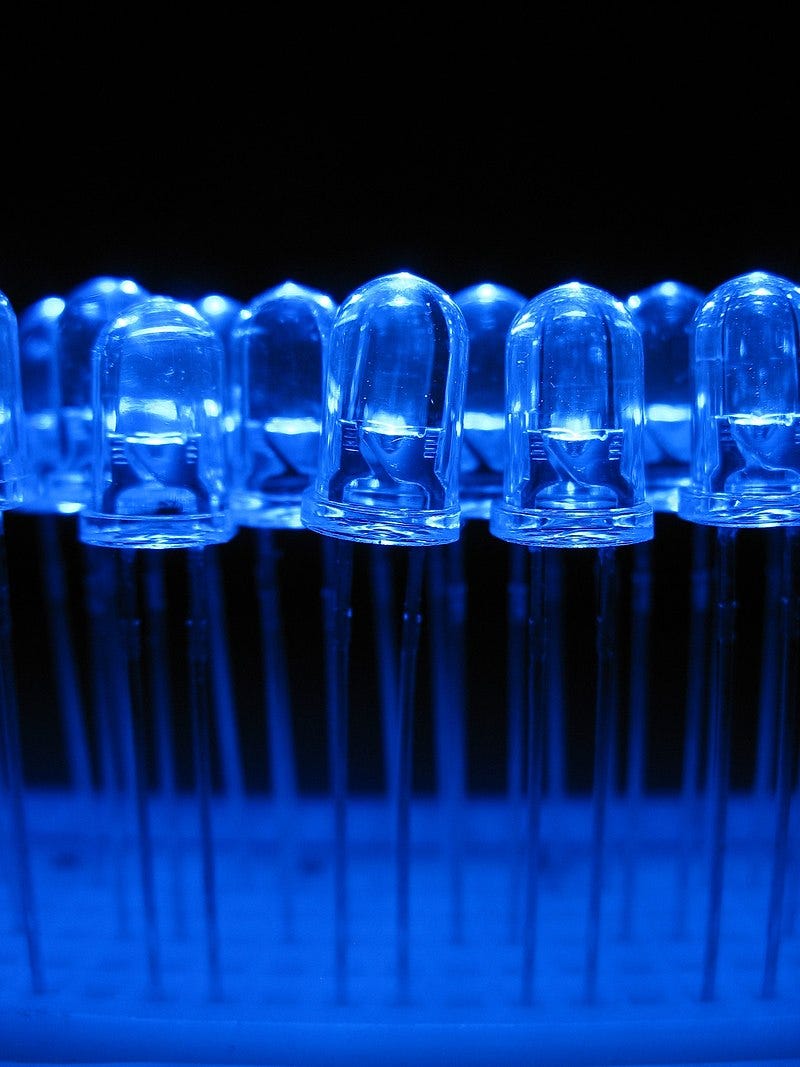
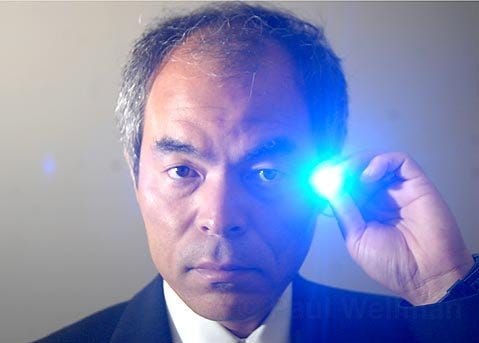
For the discovery of a bright blue LED engineer Shuji Nakamura and physicists Hiroshi Amano and Isamu Akasaki were awarded the Nobel Prize in Physics in 2014.
Strong blue LEDs led to the development of some new technologies based only on blue LEDs. More importantly, blue LED completed the RGB spectrum, allowing for the production of visible full-color LED screens and white LEDs. The Nobel prize was presented with a statement:
Incandescent light bulbs lit the 20th century; the 21st century will be lit by LED lamps.
But what was so special about the blue LED that its discovery deserved a Nobel prize?
High-brightness blue LED was a long-awaited milestone, important for advancing LED technology. Even though it was not until the early 1970s that color television in North America outsold black-and-white TVs, a color TV using cathode-ray tubes was introduced in the US in 1953.
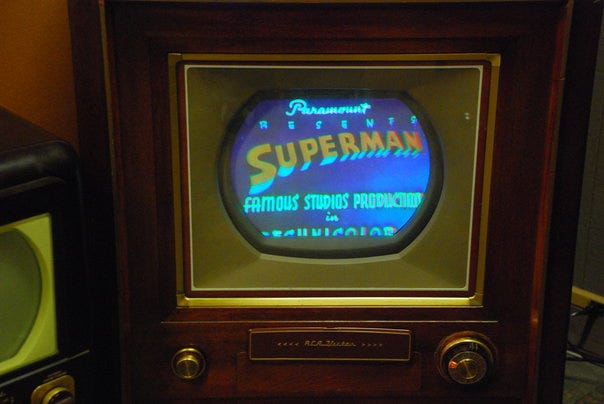
Early after the release of cathode-ray color TVs, back in the 1950s and 1960s green and red LEDs were discovered. Radio Corporation of America (RCA) saw an opportunity and was pushing for a technological replacement of the bulky cathode-ray tubes in color TVs. LED TV was seen as the natural next step.
The scientists working on developing blue LED at RCA at the time had practically an unlimited budget for their research.
The physicists and engineers at RCA actually managed to produce a tinkering blue light in 1972 for which they were awarded a patent two years later. Soon, however, they were forced to stop working on it when the financially struggling company shut the funding for the blue LED research in 1974.
The history of LED lights
A light-emitting diode (LED) is a semiconductor device that emits light when a current flows through it. The first commercially relevant semiconductor was silicon carbide (SiC). In the mid-1920s, self-educated Russian scientist Oleg Losov was the first one who looked deeper into the spectrum of light emission from SiC. Picking up on his work, Kurt Lehovec, Czech by birth, found in 1952 that adding different impurities and tuning their amount, can change the light from blue to greenish-yellow and to pale yellow. The process is today known as doping the semiconductor.
Semiconductor doped with electron-rich impurities is called n-type semiconductor, where n stands for a negative charge. Similarly, a semiconductor enriched with electron-poor impurities is called a p-type semiconductor. A p–n junction is a boundary between p-type and n-type semiconductors. LED is a particular p-n junction that emits light.
The first infra-red LEDs at low temperatures were discovered in 1951 by a group of scientists at Bell Labs in p-n junctions of germanium and silicon. Prospective new material for emitting photons was, however, another semiconductor, gallium arsenide (GaAs). The first GaAs LED was discovered accidentally in 1961 by scientists working for Texas Instruments on a laser diode. It was an infra-red LED, so it had no practical use with its range beyond the visible spectrum.
Turning to General Electric, American engineer Nick Holonyak, Jr. was already at the time experimenting with the same material. After seeing their demonstration, he came up with the visible red LED a year later, in 1962. He produced a red LED in the first compound semiconductor device, a combination of semiconductors gallium phosphide (GaP) and gallium arsenide (GaAs).
For his invention, he was named “father of the LED”.
Holonyak afterward joined the University of Illinois, where he was a supervisor to an aspiring young researcher George Crawford. After his Ph.D., Crawford was hired by the Monsanto Company, and in 1968 Monsanto became the first to start the mass production of affordable visible LEDs based on GaAs. The primary markets were electronic calculators, digital watches, and digital clocks.
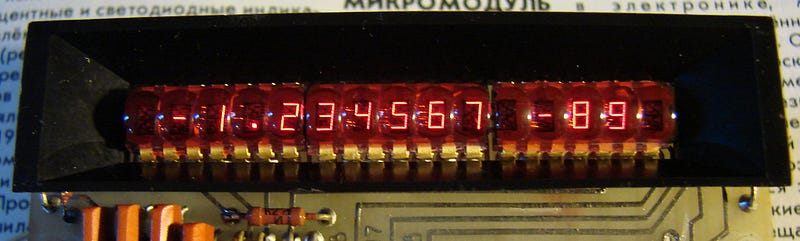
In the mid-1970s, pure gallium phosphide (GaP) was used to make LEDs that produced the green LED.
Besides the color, another important thing for LEDs was achieving a good light intensity.
The first generation of super-bright red, yellow, and green LEDs came in the early 1980s. In 1987, green and red LEDs were bright enough to replace light bulbs in vehicle brake lights and traffic lights, making it the first time LEDs displaced incandescent bulbs in a lighting application.
Blue LEDs
After the success with LEDs in GaAs and GaP, in the late 1960s, it was expected that LED made of gallium nitride (GaN) would emit blue light, based on where nitrogen falls on the periodic table (right above phosphorus and arsenic). Americans James Tietjen and Herbert Maruska working at RCA were figuring out a way to synthesize GaN. Making this semiconductor was challenging and took some time. They were experimenting with different methods to make the samples and managed to get the first samples of GaN in 1969.
This caused lots of excitement in the semiconductor industry and led other American companies putting efforts into producing the samples of this material.
The biggest challenge for the material was that while it was now quite easy to produce an n-type semiconductor GaN, a p-type semiconductor was needed for a p-n junction. RCA hired well-known material scientists, Jacques Pankove and Edward Miller. The obstacle was a difficult one and they decided to try to circumferent it, making a less efficient device with a different approach that didn’t require a p-type semiconductor. The first blue LED from layered GaN in a metal-insulator-semiconductor sandwich, was engineered in 1972. The issue was that the light was very dim, while the problem of making a p-type GaN semiconductor was still open. Unluckily, the research into GaN and blue LEDs at RCA was completely abandoned in 1974 when the company faced financial problems.
Even though a dim blue LED was discovered in 1972, a challenging material science obstacle lead to basically everyone in the US abandoning further research into the GaN blue LEDs.
Across the Pacific, however, Japanese engineer and physicist Isamu Akasaki started working on GaN in the late 1960s at Matsushita Research Institute Tokyo, developing a new method of sample fabrication. In 1981 he joined Nagoya University and further developed his method for growing high-quality samples of GaN. His group, including his graduate student Hiroshi Amano, tirelessly worked on the process of p-type doping GaN that could lead to an efficient blue LED. They finally managed to make p-type GaN. The p-n junction they produced in 1989, emitted high-power blue light, just about when Akasaki had turned 60.
Their method, though, was still too complicated for mass production. Engineer Shuji Nakamura, working in the Nichia company managed to build on the work of Akasaki and Amano and developed a practical method for producing GaN. In 1991, he published his efficient process for obtaining clean samples of GaN, but only after his draft was returned three times for poor English.
As almost everyone else at the time was giving up on GaN and the only available blue LEDs used were made from SiC with the efficiency of no more than 0.03%, Nichia in 1993 was able to produce 100 times brighter blue LEDs with the efficiency of 2.7%.
This new development revolutionized LED lighting and remained the basis for all commercial blue LEDs and laser diodes today. Nichia stayed the world’s largest supplier of LEDs.
Summary
Producing blue LED was the long-awaited goal and has led to various technological advancements. While red and green LEDs have already been around for nearly half a century, many scientists and engineers tried to manufacture blue LEDs, but no one succeeded for 30 years. Even though it conceptually didn’t differ much from other LEDs, producing bright blue LEDs ended up being quite challenging and required lots of hard work, perseverance, and skills in material science and engineering.
While RCA had the first blue LED light in 1972 and scientists working on it knew what were the exact issues already in 1969, the unfortunate lack of funding resulted in the group scattering and abandoning their research. Three Japanese scientists were awarded the Nobel Prize for their work in 1989 that succeeding in solving the issues on which everyone else gave up. They managed to produce p-n junction GaN LEDs and obtained a blue light of high-brightness that could be mass-produced.
The application of LEDs these days includes mobile phone displays and backlights, automobile headlamps, torches, streetlights, and TV backlights, with the devices used today still being based on p-n junction GaN LEDs. The next goal of the LED industry is to overtake incandescent lighting completely. The efficiency of the LED devices continues to rise, making it just a matter of time.


