
Why Black Holes Are Actually Not Black
From numerous science fiction and popular science sources, it is well known that there is an event horizon around every black hole — a boundary beyond which the escape velocity exceeds the speed of light. Because of this, even light cannot escape from a black hole, and, actually, this is why scientists called it black. However, black holes are not entirely black in reality.
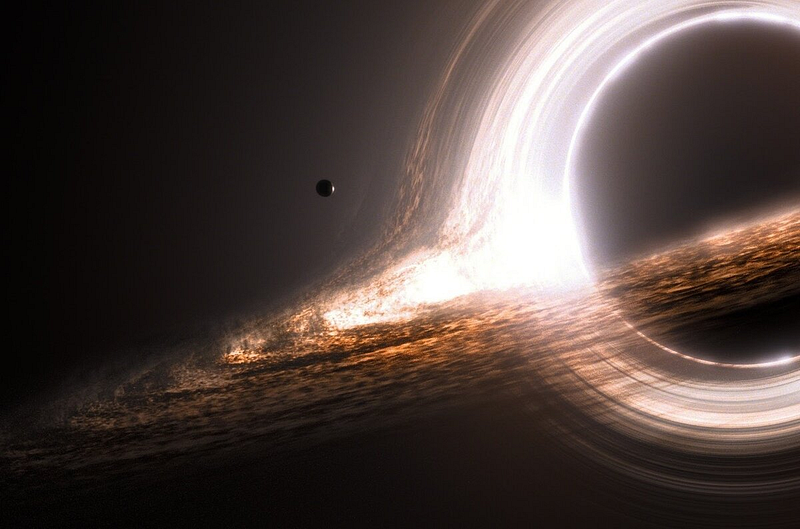
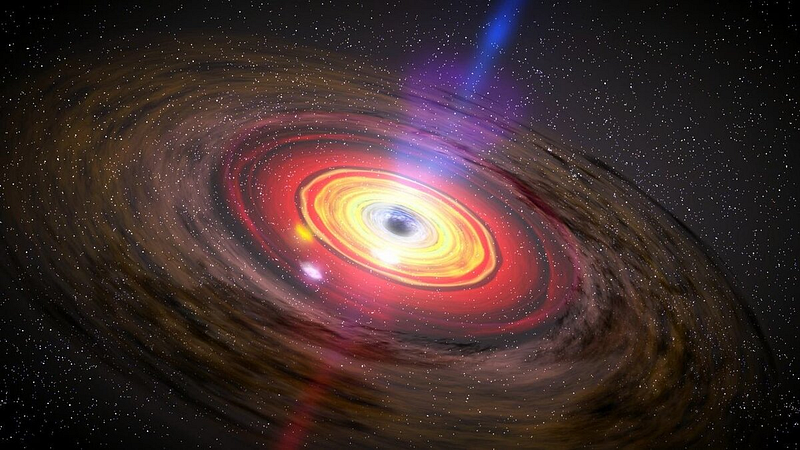
Outside the event horizon of a black hole, any matter is attracted to it. Still, collisions between particles and electromagnetic interactions can change the direction of the particles’ motion in any direction, including away from the black hole itself, before they fall under the horizon. Once particles fall inside the event horizon, they can never return unless they can accelerate to speeds more significant than the speed of light. The interacting, falling particles form a bright accretion disk around them.
Can We See an Object That Has Fallen Beyond the Event Horizon?
Consider a body falling into a black hole. As you observe its fall, the light it emits first becomes red and then increasingly dim as the body’s position shifts toward the event horizon. Continue to observe the weak photons emitted by the body in the radio spectrum. We can see them continue their motion toward the event horizon, and the photons are stretched in space, infinitely increasing their wavelength. Over time, the light from the object would shift from visible to infrared, then to microwave, then to radio frequencies, and so on… But in any case, it would never disappear.
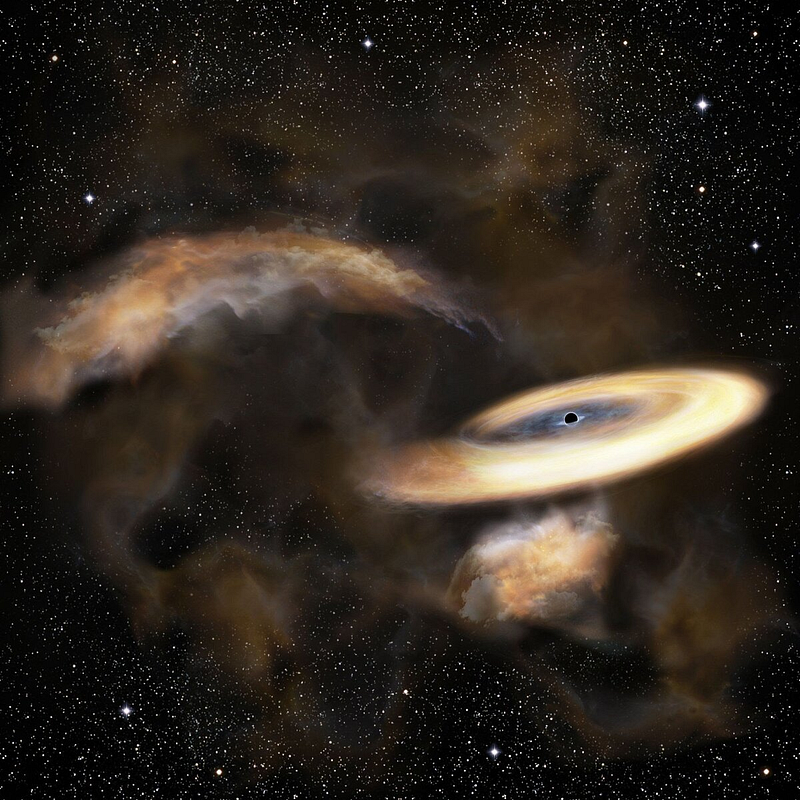
Even with photon quantization, there are no limits to how low their energy can be. With a sufficiently large telescope that is sensitive to long enough wavelengths, you will always be able to see light from everything that falls into a black hole. Hence, we can conclude that when something falls into a black hole, its light never completely fades away.
Hawking Radiation
The principle of uncertainty suggests that the vacuum is not empty. In it, pairs of virtual particles and antiparticles constantly birth and annihilate. According to this principle, such particles can exist for a very short time and, under normal conditions, cannot interact with ordinary particles. Still, conditions are not ordinary near the event horizon of a black hole.
If we consider a situation where such a pair arises very close to the event horizon of a black hole, then one of the particles of this pair can be pulled in by the black hole’s gravitational field before the particles manage to annihilate. In this case, the other particle from this pair may remain outside the event horizon. Thus, it may seem that the black hole emitted this particle to an observer outside the black hole.
In 1974, Stephen Hawking provided a theoretical justification for this radiation, which was subsequently named after him.
Considering the above, we can conclude that black holes are not entirely black in reality. First, the light from a body falling into a black hole will shift to the red spectrum and gradually dim, but it will never completely extinguish. Second, a black hole constantly emits Hawking radiation.
To date, Hawking radiation has not been detected due to its extremely low intensity: a black hole with a mass equal to three suns would emit at a power of only 10^-29 watts, which is insufficient for detection with modern equipment.
Clape if you want to see more articles about space in your feed!
Subscribe to our channel and ask your questions, which I will answer in the following articles.