
Why Billionaires Invest in The Final Frontier
It’s time to mull over space exploration
Imagine you could travel to the moon and beyond in a spaceplane. Imagine you could own a piece of land on Mars. Imagine you could book a capsule in a space station.
Everyone must have reflected on these thoughts. The mega-wealthy, Elon Musk, a serial entrepreneur and Founder of Tesla and Paypal, stepped out of his comfort zone and set out in the quest of turning these dreams into realities by creating a private spaceships manufacturing company, SpaceX.
SpaceX on Saturday, 30 May 2020, sent skyward its rocketship Falcon 9, carrying two American astronauts, Doug Hurley and Bob Behnken, from the Kennedy Space Center, Florida towards the International Space Station (ISS). This operation brought NASA back, for the first time since 2011, in the business of launching astronauts from U.S soil and paved the way for a presumably new epoch of commercial space exploration. “We need to repeat these missions and have this be a regular occurrence,” said Musk after the launch of SpaceX rocketship in the hope of prospective human spaceflights.
To shed some light on what SpaceX has attained so far, SpaceX’s Falcon 9 is the world’s first orbital-class reusable rocket. Reusability allows SpaceX to refly the most expensive parts of the rocket, which in turn drives down the cost of space access. SpaceX has successfully accomplished 83 total launches, 44 total landings, 31 reflown rockets, and hopes that soon people will be able to plug space in their travel destinations agendas.
Odd enough, Elon Musk is not alone to be fascinated by space. Jeff Bezos and Richard Branson as well are keeping a close eye on space exploration though in its infancy. The reasons range from humanitarian to lucrative.
On the humanitarian side, Jeff Bezos expressed his intention of building earth-like colonies on the Moon and the possibility that new substances could be excavated. However, Elon Musk is rather interested in Mars. He wants to build colonies as well and he believes that Mars would be a place to flee to in the events of wars and natural catastrophes.
The revenue generated by the global space industry may increase to more than $1 trillion by 2040
Lucratively, space is promising a wealth of opportunities for investors such as human spaceflight, satellite communications, and imagery, and data analysis. The space industry is expected to generate up to $1 trillion by 2040 according to Morgan Stanley.
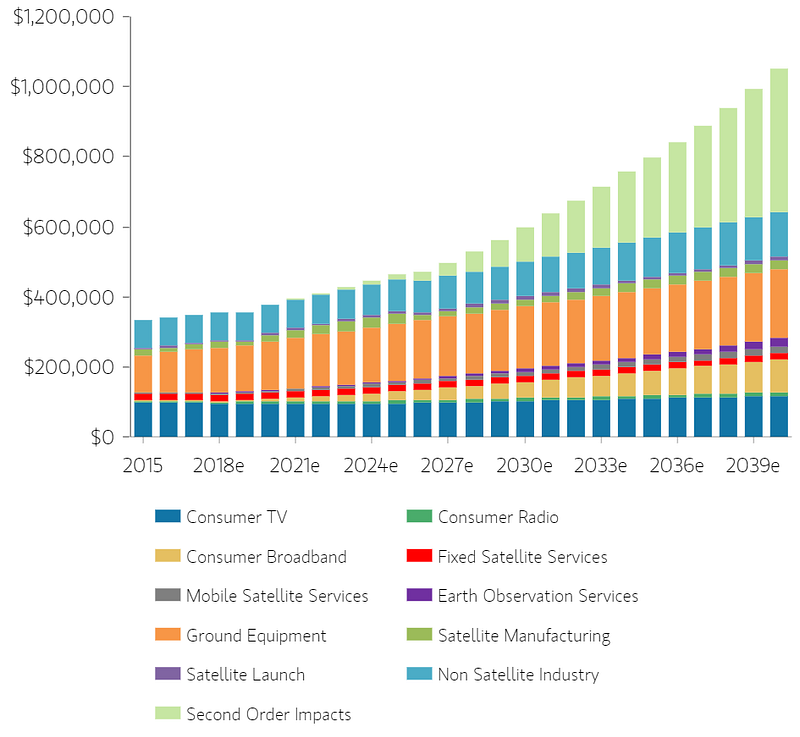
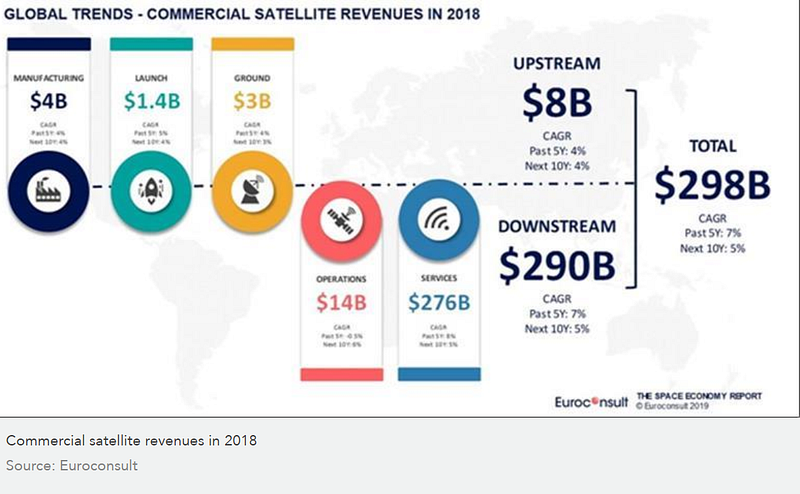
Particularly, the satellite industry alone is quite profitable. In 2018, the industry reached a total revenue of 298 Billion $.
Across the US, space is luring more and more investors. “It’s absolutely a viable industry to invest in, just like software,” Tess Hatch, ex- SpaceX employee and Vice president at Bessemer Venture Partner, told CNBC. Wall Street’s consensus projects that space will become a multitrillion-dollar economy in the next 10 to 20 years — a view investors today are banking on. Besides, space investors, had they been able to achieve the loftier space dream, would have altered the course of mankind's lives.
Additionally, billionaires envision space as a doorway to new markets in the long run. Who would want to miss the chance of floating in the Outerspace if they could pay for it? Obviously, companies offering such services would charge exorbitant fees and thus those investors would be the major winners. Therefore, incentivized by the breakthroughs achieved in astronomy so far and spurred by space exploration potential gains, billionaires regard the final frontier as a worthwhile investment.

While the space industry is expected to revolutionize technology such as addressing cyber threats, artificial intelligence, and surveillance vulnerabilities, the space tourism dream is still out of reach. Research suggests that Mars, the planet, which is a good replica of Earth in terms of temperatures and sunlight, is not hospitable to human life due to radiations and an atmosphere of a small amount of Oxygen, 0.16%.
Equally important, it is unknown whether space territories belong to Earth governments or finders keepers would apply.
Fair enough. Most investors are still reluctant when it comes to investing in the space and understandably prefer traditional investment schemes that would impact their portfolio in the short run. This is why space investment appeals exclusively to the very few affluent titans who want to change the world.