
Why Believing in Santa Claus Can Lead You to a Better Life
It’s not (only) for the gifts.
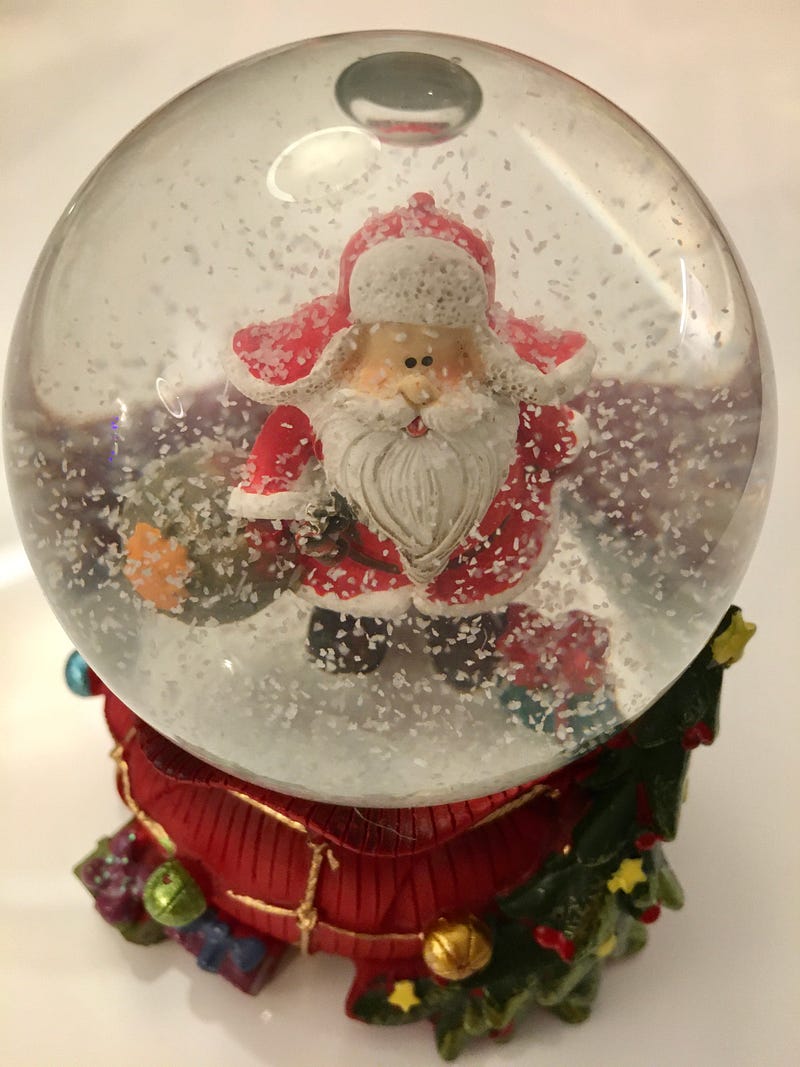
You know how they say to look at the world through the eyes of a child?
Well, 85% of American kids believe in Santa Claus. Time for you to believe in Santa (again)!
I can’t ask my six-year-old daughter what the benefits of believing are. She wouldn’t understand the question. Santa Claus exists. There’s no such thing as believing in something that exists.
But I can guess what she would answer. For sure, she would mention the gifts and likely add that Santa Claus is kind and forgiving. You can behave badly at the beginning of the year. The most important is to be good closer to Christmas. A bit like yearly performance reviews at my company.
Believing in Santa isn’t only about the material presents. It’s also about spiritual gifts. Santa Claus is someone to look up to for advice and strength, someone who forgives you, and someone who cares about you.
Someone to look up to for advice and strength
Santa Claus is the ultimate accountability partner. You can’t cheat him. He knows, hears, and sees everything!
Trying to maintain a healthy lifestyle, I set a cut-off time for eating. It’s a sort of intermittent fasting. After 8 PM, I can drink (herbal tea or water, of course), but cannot eat. And certainly not chocolate candies. Especially since after I need to explain to my daughter why her favorite treats disappeared one more time. Better to avoid this usually tense conversation.
On the days I feel like eating chocolate ice cream just before going to bed, or when I feel like skipping a workout, I turn my mind-eye to Santa and ask him for advice. It wouldn’t work if I were asking myself. I already decided I wanted to eat or that I had a lazy day, didn’t I?
But Santa is a sort of external advisor I can consult on these topics. He’s very consistent in his answers. With him, it’s always no to candies and yes to training.
I’m not as consistent when it comes to following them, but sometimes I do. So, overall, it’s a win. Thanks to Santa I’m skipping fewer workouts and keeping my eating discipline more often.
Of course, I know he’s only an idea in my head. But it’s an idea with scientific back-up.
My method is based on modular mind theory (see Robert Wright’s course on Buddhism and Modern Psychology). According to this theory, we are made of different modules continuously competing for control.
No CEO has the final word nor sets a clear direction for the next planning period. An executive committee governs us. A group of key managers permanently discuss what the next actions should be. They all have the same seniority and unquenchable ambition.
None of them can convince others for more than a limited period. Sometimes for as little as a minute. If my “gluttony module” sees chocolate candies forgotten on the kitchen counter, it seizes control of my mind and body and forces me to eat them. Really! Unless Santa is fast enough to stop me, of course.
Giving a face as vivid as Santa Claus to my self-control module might sound strange. But since I did, its performance markedly increased.
And when I fail, Santa knows how to show understanding.
Someone who forgives you
As Jordan Peterson said in this lecture, to improve your life, you need “to negotiate with yourself, and not tyrannize yourself.” In other words, set yourself achievable goals, and be gentle and forgiving if you don’t make it.
Santa Claus is personifying that kind part of my brain. He reminds me that skipping a workout day is ok.
He’s like the famous language application owl, Duo from Duolingo, giving me a streak freeze. This means that even though I didn’t practice my Spanish today, it’s not yet time to say “adios” to my 184-day streak (as long as I will finish a lesson tomorrow).
As with dieting, having “cheat days” is a good way to keep the pressure at reasonable levels. When I’m too tough on myself. When I’m “all work and no play,” Santa Claus is a shining reminder for me not to be “a dull boy.”
He’s always the first one to forgive the acts I’m not so proud of. Even before my mother. And we all know how prone to forgiving mothers are.
Santa Claus is always the first one from the many modules in my head to take responsibility, which is the first step to self-forgiveness.
Someone who cares about you
Knowing that someone cares about you enough to bring you gifts (or a bonus) each year is very comforting.
Like the doll (or teddy bear) we were desperately holding onto as a toddler, Santa Claus can bring us solace in times of distress. I know I’ll always find him, somewhere in my imagination, ready to open his arms and hug me. I can stay in his embrace and cry myself to sleep in the direst times.
Real hugging increases levels of oxytocin, the “love hormone.” True enough, it’s more needed for children than adults. And even more beneficial to them as several growth hormone levels increase following the release of oxytocin.
However, we all have these moments when we feel helpless and want to be a child again. Maybe we just got fired, or someone ate all the chocolate candies we had left on the kitchen counter. In these moments, we long for the simplicity of our childhood, when we could ask our parents for a consoling hug.
A (mental) hug from Santa Claus might be all the placebo effect we need to feel better then.
To paraphrase Emily Dickinson describing hope, Santa Claus is “the thing with [a long white beard], that perches in the soul, [and keeps] so many warm.”
Final words
Believing in Santa is making (part of) us a child again. It’s not about being dependent and powerless. It’s about having the opportunity to be our own loving parent. A parent who knows us inside out and wants only the best for us. A parent whose happiness depends on ours.
I hope your holiday season will be full of energy and self-improvement. May Santa Claus lead you to a better life!


