
Self
Why Being the “Poor Guy” Didn’t Stop Me From Being Happy
Getting a front row seat to gentrification reminded me not to worry about fancy things.

My front porch’s jagged wooden planks were eager to trip guests. My interior floors creaked and groaned as I walked in. The roof was on its last legs. My AC could barely keep the house cold in the blistering throes of summer.
Doors hung askew throughout the house and my office door was unable to close at all. There’d been two separate rat infestations, one I resolved with a magnificently ruthless black cat. The other, with a few traps, but not before snapping my fingers on accident.
I spent 13 years riding this dusty saddle on the slow descent into disrepair. Candidly, the house probably scared off a few potential girlfriends. My current partner, Laura, later admitted, “Don’t be mad. But I almost didn’t date you because of your house.”
Yes, I could have easily bought something bigger and nicer, but I liked saving money and socking it away into investments. My property tax was only a paltry sum that didn’t induce soundless rants about the government as I paced my hallways. My electric bill was three Netflix subscriptions and not a dime more.
In this short 13 years, my neighborhood underwent radical changes. New mansions sprung up beside me, rising up over the bulldozed remains of prior shanty home I rubbed shoulders with. Quite quickly, and through rapid gentrification, my house lost his “friends” to play with.
A few fresh divorced middle aged folks added floors to homes and parked their BMWs out front. Every humble home disappeared and that’s when the odd vibes began: the prolonged, pained stares by neighbors as they walked by with designer dogs costing more than many people’s cars, the oddly toned questions at neighborhood parties, “So…how long have you lived in that house?”
A change of direction
I heard a knock on my door one day, and went to answer it. There was a 60-something couple standing there, smiling. The silver-haired husband was tall, and had a large frame and air of confidence that gave the impression he was an executive of some type (he was). His wife had defied her age, perhaps with a surgeons hand, perhaps not, I wasn’t judging.
They were my new next door neighbors and nice ones at that. We got to talking, and she cut to the chase, “Have you thought about selling your house?”
Odd as it seems, I’d never even considered the notion. Which was foolish considering I was literally the only small house left.
“I have not, actually, but that is certainly a good question,” I said, and then scrunched my eyes and I rolled around the possibilities.
“Have you thought of naming a price?” She asked.
I wasn’t prepared for her directness and said, “I haven’t. I do enjoy living here. But if I change my mind, I’ll surely let you know.” They looked disappointed. We talked a bit more and parted ways. I later learned, from one of my many gossipy neighbors, that the husband had sold a company for millions of dollars and retired in his 50s. I suspect they wanted to expand their house into a compound using my lot.
Two years later, my partner and I talked about living together. She made it clear from the start, “I can’t live in that house you are in.” Which I didn’t expect her to. So I began the plan to build a new house with my savings. And I gave that same couple dibs to make a deal on the house.
They stopped by again and we had a similar conversation, with her saying, “Have you thought of a price?”
And I had — which they agreed to pay. I had the pleasure of watching a new townhome being built, a 2700 square foot home that would be fitting for two people, and which had an upstairs nook for me to write in, and look out the window at all that happened around me.
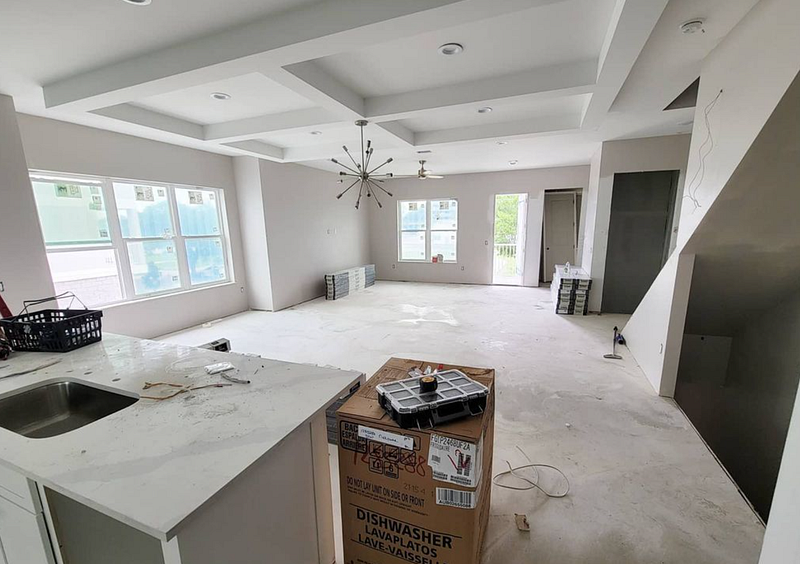
In the years since moving it, I’ve reflected a ton on the two lives I’ve lived in these two houses.
I surely love this house: it is functionally perfect for us. But I can’t say I’m any happier than I was before. There was a massive dopamine rush when I moved in, and I thought, “Holy cow? This is my house?!”
But over time, I went back to my mostly happy demeanor, with the usual bad days sprinkled in between. Today, as I look back at my life in my “Status League” neighborhood — I saw so many unhappy people, and so much competition over their belongings and nice cars and seeing who could own the prettiest dog and whose kid could go to the most elite school.
They’d fallen into the trap of making social comparisons — which are proven to cause more anxiety and depression. Why? Because ultimately, there is always someone with a nicer car, a nicer house, a seemingly more-perfect family. Any single thing you anchor value in through contrast, is bound to be devalued through contrast.
Psychology professor, Dr. Sonja Lyubomirsky, had two groups of participants — happy and unhappy — take part in a series of puzzles. At the end, they were told of a peer who finished the puzzles much quicker and more accurately. The unhappy participants had far more negative mood shifts after learning of the better participant. While the happier people reacted with minimal mood change.
In short, the happy people gave minimal weight to social comparison information. The study showed that for a happy life, it is key to acknowledge other’s successes without envy, while taking little satisfaction in their downfall.
Fortunately, and in spite of my other flaws, I’ve mostly dodged this social comparison problem. As I showed up at those rich folks parties, the scrub in the ugly small house, I was blissfully ignorant of their status game, but still happier than most of them. Yet I knew how easy it was to get caught in that net.
In my early 30s, in the aftermath of my divorce, I went into this frantic rush to level up every aspect of my life. I started grad school and started exercising and working on my tan and buying nice clothes. Unwittingly, my whole identity became about raising my currency with society and, specifically, the opposite sex. While some of those changes were valuable, I eventually realized I’d lost the plot.
The push to define yourself through singular characterizations is an exercise in self-objectification and, per Dr. Anat Talmon, a form of dehumanization. This dehumanization happens again when we value others based on singular attributes and objects. This comparison, yet again, leads to disappointment and depression.
Abd Al Rahman III, the caliph of Córdoba in 10th-century Spain, had an incredible anecdote that summed up his fantastically wealthy life at age 70: “I have now reigned above 50 years in victory or peace; beloved by my subjects, dreaded by my enemies, and respected by my allies. Riches and honors, power and pleasure, have waited on my call. I have diligently numbered the days of pure and genuine happiness which have fallen to my lot. They amount to 14.”
There is no known object or amount of power that confers unlimited happiness. There is no triumph of the riches that will deliver lasting contentment. Beware of social comparisons and attempting to climb the wrong ladder in life.
I know well that there are many places to find fulfillment, but comparing my belongings, family, and stuff to others is not one. Being “the poor guy” in that neighborhood didn’t stop me from being happy.