
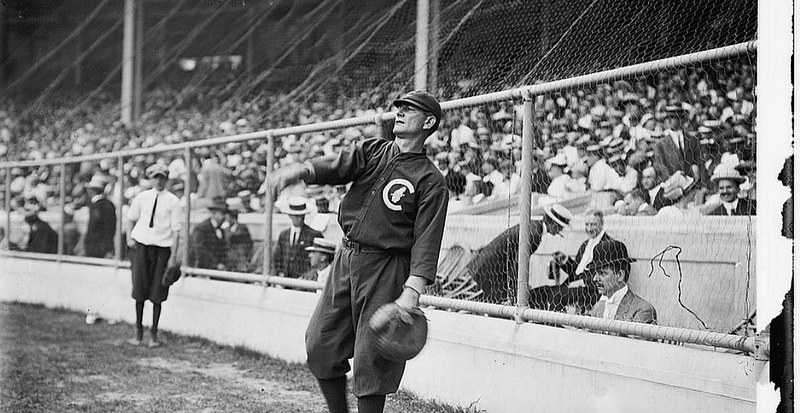
Why Baseball Catcher Tom Needham Had To Choose Between His Job And His Fingers
Spoiler allert, the long-time MLB player did not choose his fingers
Baseball catchers take an absolute beating behind the plate. Swinging bats, errant pitches and bull-rushing runners all contribute to the dangerous environment. During the earlier days of the game, sparse and less effective equipment made playing the position even more of a hazard. Former backstop, Tom Needham, who spent more than a decade getting abused at the big-league level, was dedicated to his craft, but in later years found that his hands were ruined to the point that he was ashamed to even look at them.
Born in Ireland, Needham was a classic all-field and not hit catcher. In 11 seasons (1904–1914) with three different teams, the right-handed batter hit an anemic .209 with eight home runs and 119 RBIs in 523 games. He was much better with the glove, especially valued for his handling of pitchers, which was parlayed into a coaching career during his final days as a player and beyond.
While certainly not a star player,. Needham was valued for his wisdom and ability with a catcher’s mitt. Playing during some of baseball’s roughest times, he took more than his fair share of abuse, which he recounted in the waning years of his playing career. Speaking with the Courier-Journal (Louisville) in a story that appeared June 3, 1910, he detailed the physical travails of being part of the catching brotherhood.
The degree to which Needham’s hands suffered from his years behind the plate was shocking. All the bruises, breaks and everything in between were so severe in accumulation that even he was incredulous at their deterioration:
“When baseball fans discuss the various players with perfect hands, few stop to consider the backstops who have been in the game year after year without sustaining injuries other than slight dislocations. But the doctors and surgeons have been a busy lot of me affixing finger splints and binding up the tape since baseball was adopted as the national pastime. Speaking of the disabled catchers, it happens to be my lot to register among the badly bent species. Ten years ago I had two perfect hands. Save for scars which bore mute testimony to my greenness as a tamer of white rats and a group of freckles, there wasn’t a blemish on either mitt. Now I am shamed to look at them.”
While there were almost too many to count, Needham kept track of his “greatest hits.”:
“Foul tips, the bane of all catchers, have altered the general appearance of my paws. The fingers of my right hand have been maimed or splintered to often I can scarcely cite all the instances. It was one of George Mullin’s fastballs accompanied by a foul tip that smashed the little finger of the pegging hand years ago when I was connected with the Grand Rapids club of the Interstate League. Charles Pittinger, now dead, broke the first finger of the same hand in 1904. The gnarled effect of my index finger speaks for the speed of Oscar Street. That happened while I was catching with the Wheeling club.”
Being injured was not a general excuse for not playing for catchers. Needham recalled suffering a badly hurt finger and having little recourse besides continuing to play if he wanted to keep his place on the team:
“Oftentimes catchers, though severely hurt, are asked to work daily under fearful conditions. That happened to me after Vic Willis, now of the St. Louis Cardinals, had smashed the little finger of my throwing hand in 1900*. While playing on the Fort Wayne club of the Interstate League under Manager [Doggie] Miller. I had the misfortune to break one finger. The club was up in the pennant race and Miller refused to give me a lay off until the finger recovered. Instead, he compelled me to work fourteen games under penalty of a discharge.”
*Needham actually played for Fort Wayne in 1901.
Catchers take note of their brethren and swap war stories about their experiences. Needham could barely keep track of all his wounded comrades, especially those with serious injury problems. His list of backstops who were able to generally maintain good health wasn’t a long one:
“Catching at all times is the most dangerous position on the ball field. Take the case of Jack O’Neill, the old Chicago player. His hands were all shot to pieces in years of service, but the hardest blow came when a foul tip crashed through his mask, blinding him in one eye. This accident drove O’Neil from the diamond. Among the catchers who have been more or less fortunate, I would mention the names of Roger Bresnahan of the Cardinals; Pat Moran of the Cubs; Charley Dooin of Philadelphia Nationals; [George] Gibson of Pittsburgh; Admiral Schlei of the Giants; Billy Bergen of Brooklyn, and Johnny Kling. None of those catchers have been seriously hurt behind the bat. Larry McLean, Jimmy Archer, Billy Sullivan, Joe Sugden and Frank Bowerman belong in my class as regards hard luck. [Frank] Chance, of the Cubs, who held down a catcher’s job for ten years before going to first base, is another of the unlucky players.”
Needham went on to help start two minor leagues after his playing days were over. Unfortunately, his trail of physical maladies continued to the end, as he suffered a stroke that proved to be fatal shortly thereafter when he was just 47. The old catcher was finally felled after taking so many hits over the years.


