
Why aren’t you making your own yogurt?
It’s easier (and greener) than you think
During the pandemic, some of us obsessed over sourdough. Others religiously followed Youtube fitness gurus, constructed birdhouses, sewed crafty-looking face masks, or discovered the lost arts of shoe cobbling and basket weaving.
As for me, I chose trash.
Each night of the lockdown, I channeled all my COVID anxieties into rummaging through our recycling and waste bins to figure out what were we throwing away, how often, and why.
We had a decent starting point, since we already used washable mesh bags for produce, bought in bulk whenever possible (nuts, beans, etc.), and carried our own to-go containers for snacks, drinks, and lunches. After reading Michael Moss’ Sugar, Fat, Salt, I also stopped purchasing packaged foods. (This last change also brought the unexpected bonus of fattening my wallet and narrowing my waistline).
Yet one packaged product continued to plague my plastic bin: yogurt.
After all, I love yogurt. It’s the perfect food, the stuff of gods. I wouldn’t be remotely surprised if the Ancient Greeks had some deranged myth about an angel masturbating off Mount Olympus and some mortal collecting the tart perfection from below. (Besides, with all the incest, cannibalism, and bestiality, it wouldn’t even be one of the racier myths.) Γιαούρτι from the Greek word yō, traditional salutation of a Greek god, and ghərt, from the Ancient Greek root for semen.
Whatever the story, yogurt is my manna. It works double-time as both my guilty pleasure and — real talk — elixir of bowel regularity. It brings me breakfast when no other food can. Sure, avocado toast with a poached egg and a side of freshly cut fruit sounds like a dream, but I just can’t bother before 9 am. Even cereal is too much to handle: you need to procure a clean bowl, then pour cereal into the bowl, then pour milk on top of the cereal. That’s two steps too many before noon.
Hence yogurt, something I can shovel into my mouth with minimal hand-eye coordination and no opening of cabinets.
Hence single-use containers plaguing our recycling bin each week.
At first, I didn’t take action on the yogurt container crisis. After all, we were almost zero waste already: is one vice really so bad? Then, what according to the notches scratched into my bedside wall was the fourth Friday of lockdown, I got bored of both seeking new patterns in the ceiling cracks like it was the next Da Vinci Code and fantasizing about the sight of a stranger’s bare lips in public. I started to do the yogurt math.
I eat one 125-gram container each morning. My partner eats two. We then occasionally have a second later in the day as a snack or an after-dinner dessert when I haven’t bothered to make anything. This means that we were tossing between twenty-one and thirty-five cup-sized containers and their aluminum lids each week.
That’s up to 1820 plastic containers per year. For two individuals.
Sure, we recycle them, which makes us feel less like we’ve directly contributed to filling the ocean with more plastic than fish, but the sad and dirty truth is that all plastic food containers require virgin plastic. A plastic yogurt container (or water bottle, fruit cup, hummus tub, or whatever else you buy in plastic) will never be recycled back into a plastic container. It can only be downcycled into weaker fibers, like a car carpet or a microplastic shirt.
Once that microfiber plastic is used, it can’t be recycled at all. Recycling plastic is a big, fat, oil-industry pervaded myth. Plastic can only move downwards in one direction.
So how could we flatten our mountain of plastic yogurt containers? At first, I tried to renounce yogurt. I’d already given up meat — twenty-five years ago, to be precise, when my big sister pointed at an adorable nut-brown calf cuddling with her sister in a field and shouted “that’s my hamburger!” More recently, I stopped buying cheese, too — partly for all the usual ethical hoopla but mostly because I can’t digest lactose anyway. So why not just throw in the yogurt towel, too?
This worked until, one morning, my eyes still crusty with sleep, a single-serving yogurt descended from the cool refrigerated heavens and answered all my probiotic needs. I finished it in an altered state of consciousness, only realizing what I’d done when I heard the crackle of plastic as it crammed into the recycling.
It was time to buy a yogurt maker.
What is yogurt?
So, it turns out that the actual etymology of the word yogurt is not ‘ejaculate of the gods,’ but rather the Turkish work for ‘coagulate’ or ‘curdle,’ yoǧurmak, incorporated into English in the 17th century. Yet this is not to imply that Turks were the first yogurt connoisseurs: many cultures and countries have unique and ancient words for yogurt: dahi or lassi in India, leben in Arabic countries, kumys, kummiss and kefir in Slavic countries, skyr in Iceland, yakult in Japan, and many, many more. We don’t know who first intentionally soured their milk with the right microbes, and we probably never will. The greatest heroes walk in the darkness so that we can see the light. I think Batman said that once when eating a yogurt.
Yogurt requires two ingredients: milk and bacteria. The bacteria (which people often call probiotics or microbes to avoid the negative connotation of the word bacteria, even though there are many friendly, health-inducing bacteria in our food and in our bodies) occur naturally pretty much ubiquitously: you can find them on plants, in animals, in people, and inside intestines.
While we don’t know exactly who or when, someone at some point likely forgot their milk inside a goat-stomach pouch (or some other animal’s stomach, since they’re naturally choc-full of enzymes to digest and ferment milk), leaving it to bake under the hot sun all day. By the time this ancestor of ours remembered about the milk, bacteria had turned it sour and viscous. Out of desperation or sheer jackass-level stupidity, this ancestor of ours decided to eat the thick, sour milk anyway and discovered it didn’t taste horrible or cause an agonizing death. In fact, it tasted so good that they decided to leave their milk under the hot sun in a stomach pouch the next day as well.
How does milk become yogurt?

Like Instagram girls in summer, a warm climate likewise activates bacteria and gets them feeling frisky. And just as those girls start snapping selfies to feed their egos and energize them, bacteria start snapping up lactose sugars in milk to feed and energize them. More specifically, they break up lactose into the much more digestible sugars glucose and galactate, which they can then transform into pure energy (ATP and NADH, for those of you who didn’t nap through chem class).
During these breakdowns, they also produce a useless byproduct called lactic acid, which the bacteria don’t really care about and just leave behind.
But we care about lactic acid. We care about it immensely. Because this sugar-transforming waste product known as lactic acid — along with many others that give yogurt its unique flavor — makes the milk much more acidic, lowering the pH from about 6 to 4, which gives it a delightfully tart flavor while creating an inhospitable environment for other bacteria. In fact, the yogurt stops fermenting precisely because of this acidity, which is even too acidic for the yogurt bacteria themselves to keep playing and feeling frisky.
This lower pH also affects the proteins in the milk. Think about the milk proteins like electronic cables in a junk drawer. In fresh milk, the cables are all wound neatly into organized little spools and there’s plenty of empty space in the drawer. But when the milk heats up, all the cables start unspooling and soon they become a giant mess of cables that takes up so much space that you can barely close the drawer shut. That’s the effect of lowered pH: it makes the cables all loose and disorganized so that they start intertwining in a way that tangles them together, creating a web that makes yogurt thick and gelatinous.
How do you make it?
I’m mashing together all these mixed analogies to simply explain that yogurt is a naturally occurring phenomenon of pure bacteria magic.
All you need to do to have your own delicious yogurt is add your favorite bacteria into some milk and make sure that their house is comfortable and cozy to grow their bacteria families.
Since making my own yogurt, I only recycle one milk container every 10–14 days. If I buy my milk from our local producer who refills glass containers, I don’t even have that waste.
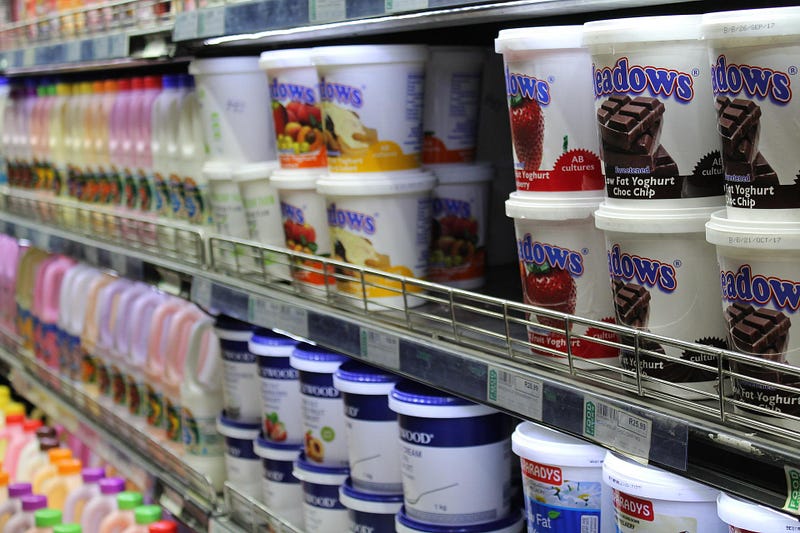
Now, however, I’d keep making yogurt whether or not it’s greener. Now I do it just because it tastes so much more delicious than the store-bought stuff on those long refrigerator shelves, which often have extra (not harmful, but completely unnecessary) ingredients thrown in like corn starch, potassium sorbate, pectin, and vitamin D3, while my homemade yogurt has only the highest quality organic milk and bacteria cultures. Not to mention that I get to enjoy this mind-blowingly delicious, high-quality yogurt for the price of one liter of milk.
Making my own yogurt also allows me to create my own yogurt to my exact preferences. With the touch of a button, I can control the acidity and thickness with precision, allowing me to obtain the sourness and consistency that I prefer. If I want something slightly creamier than “regular” yogurt but not as thick as Greek, I can make it happen. Or if I want a super thick, stick-to-the-spoon Greek blend, all I need is a wire mesh strainer or a cheesecloth (or even a coffee filter or a paper towel if you’re in a pinch) and it’s done.
If I’ve convinced you to start your yogurt journey, check out how to get started.