
Does your favorite TV show have an Arab character?
Why are Arabs underrepresented in pop culture
The U.S. census considers Arabs white and this is alarming

Netflix can be a blessing. I usually spend the late hours of the day on my laptop while Netflix is playing some series in the background. I mostly choose to watch a light-hearted comedy series or sitcoms because they are easy to follow and I do not have to be fully concentrated.
After watching many series this way, I couldn’t help but notice that there were no Arab characters in any of the series I’ve watched so far. This made me wonder when was the last time I’ve seen an Arab character in any of the TV series?
Are there any Arab characters in TV shows? Genuine Arab characters, that are depicted living among us normally. Arab characters, who are portrayed as neighbors, friends, work colleagues, or students and not terrorists, FBI informants, or agents! I’ll exclude shows that are based on Arabs, for example, Ramy, or Muslim communities from this list.
Let us be clear, new shows are being more progressive in this regard. However, the Arabs’ underrepresentation is still visible.
Arabs on TV shows
Series and TV shows are a great opportunity to build a relationship between the audience and the characters. Therefore, true representation (outside of terrorism and violence) is important. However, it seems that Arab Americans are still underrepresented in TV shows.
I researched the characters of Netflix’s “13 Reasons why”, which is a show about kids in high school. I thought to myself, there must be at least one character of Arab decent, right? The answer was a clear no! Not a single character was of Arab descent! Some students were shown in a headscarf though. Let us say they tried their best.
I know of two TV main characters of Arab descent, Sayid Jarrah and Abed Nadir. I added a bonus character too.
- Sayid Jarrah is one of the plane crash survivors in Lost. He is Iraqi. Sayid is the first main Arab characters in a TV show. His character is given the same depth in its backstory as the other main characters. Sayid’s storyline is however linked to terrorism. He used to be an interrogator for the Iraqi army and he infiltrated a terrorist cell in Australia for the CIA. His backstory is centered around violence and war.
- Abed Nadir is a community college student in the TV show community with a psychological condition that makes it difficult for him to interact with people or relate to them. He has a complicated relationship with his Palestinian father. Abed is arguably the most revolutionary Arab depiction in American series. His entire storyline and backstory are not linked whatsoever to terrorism or violence.
- Shani Abboud in Orange is the new black is a side character with Arab descent. She is from Luxor, Egypt. At the age of 12, she suffered from female genital mutilation. When her parents discovered she was homosexual, her father said that he wouldn’t do anything about it himself but wouldn’t stop any of her relatives from honor killing her. She fled to the United States in fear of persecution for her sexual orientation.
United States Census and Arab’s representation
Arabs are a minority in the United States. However, the past censuses did not include a question to identify Arabs. The census classified them purely based on their race.
According to the 2010 census of the United States, the population by race is as follows:
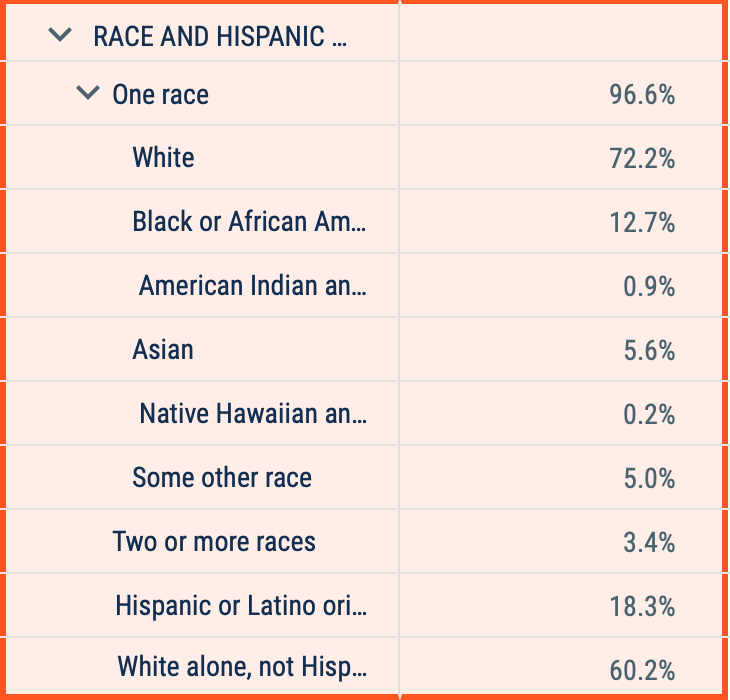
The census does not count Arab Americans and therefore, Arab Americans are misrepresented. They are misrepresented in politics, services, and also in media. Arabs from the MENA region (the Middle East and North Africa) are considered White according to the past censuses.
As an example let us discuss Dearborn, Michigan. As of the 2010 census, 89.1% of the population in Dearborn, Michigan were White. However, 41.7% of the population is of Arab descent. The census states that Arabs and Iranians are White. Nevertheless, the majority of these communities will disagree. The Arab community in the U.S. blames depriving them of basic services and educational grants on this misrepresentation.
The Arab American community, as well as the Iranian Community, rallied to change the race question in the census. President Obama announced that the race question would be modified.
The Census Bureau tested adding new categories to the census. One option was MENA (the Middle East and North Africa). The bureau found out that if given the option, Arabs will check the MENA box. Otherwise, they will opt for White or “some other race”.
The race question in the 2020 census is different. Under white, people can now write their origin, Egypt and Lebanon are among the provided examples.
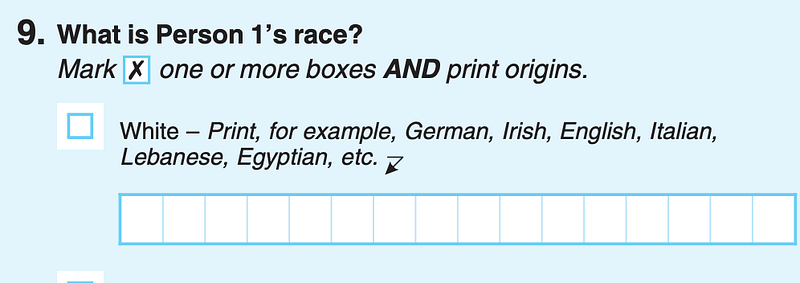
With better census data the community can only hope to have better representation also in media, TV shows, and movies.
It is a generation issue
Young Arab Americans are always told by their parents to be proud of their heritage. They are always reminded by their parents that they are different and that they should be proud of that. The same parents tell their kids to fill in White as a race, whenever asked.
This is a generation issue. The first generation of migrants sees themselves as White. They do not view themselves as people of color. They are from the Caucasus Region and therefore they are Caucasians. Identifying as White was their American success. They just wanted to fit into society.
The younger generation sees it differently. They are proud of their heritage but they witnessed “post 09/11 America”. They realized that society does not view them as White, even though the government does. They feel unheard, unrepresented, yet cannot argue that they subject to discrimination. It is a simple as that, if you are White you cannot claim to be discriminated against!
With the 2020 census and the new race question, the representation of Arab Americans might change. Nearly 3.5 million Arab Americans reside in the United States according to The Arab American Institute. Accordingly, they comprise nearly 1.07% of the American population.
TV show makers might rely on census data to determine the ethnic background of the characters in their shows. Arab American kids and youngsters do not feel represented in the media or TV shows, especially that Arabs are not portrayed as typical American families living in regular neighborhoods. Let us hope the next big-time lawyer or Sitcom character is of Arab descent.
Sources:
- https://www.latimes.com/projects/la-me-census-middle-east-north-africa-race/
- https://www.census.gov/
- We are not white (2017) — Documentary by Amer Zahr.


