
Why (And How) I’m Deciding to Give More
A new plan to motivate myself and raise my energy
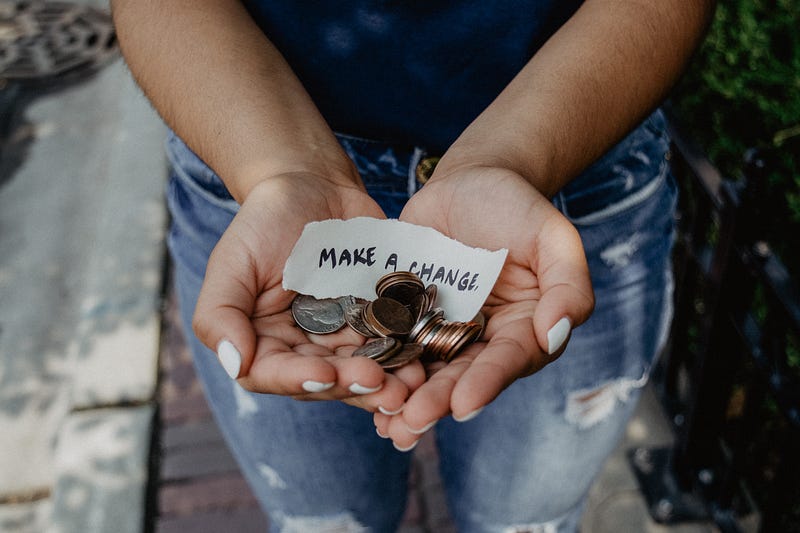
“You always have enough for a tip.”
That’s what I tell myself when I leave my house and I plan on eating or drinking somewhere.
“It doesn’t matter how expensive it is or where you choose to go. You always have enough for a tip. They may not deserve it, and you don’t have to tip, but you should always have something to give.”
I told myself that to feel like I was doing the right thing. But then I started taking cash advances because suddenly I was paying almost $50 a week on coffee and I’ve begun to avoid restaurants entirely because gratuity transformed a transaction into an investment.
That’s when I decided that it wasn’t smart to give gratuity at all or a small amount which as somebody who started in the service industry, is arguably more insulting.
I’m getting flashbacks to when I was tipped 3 cents for a lunch rush.
Or when I was tipped whatever spare change they had in their pocket after they ordered one of everything on the menu.

But there was something that always felt paradoxical to me in college when I was studying entrepreneurship and business management. It was a philosophy:
The wealthiest people were also the most giving.
My new-to-the-game self was so confused by that idea, or I would prolong it that I never acted upon it.
“Well, they had money to give,” I thought to myself. “I’m a struggling college student. I’ll do that once I have the money to spare.”
Then I graduated.
All that changed was I began to say “I have to negotiate with my landlady on paying rent every month. You’ll have to fight me for that money!”
About a year and a half later, while taking a road trip, I was scrolling through my Audible selections and I found a book that I downloaded in college after it was requested to me by my professor but never got around to:
The Go-Giver.
A parable by Bob Burg and John David Mann is about a man who wants to be successful so he follows his mentor’s guidance to visit highly successful people and study how they give back.
Then he starts giving himself and that’s when things begin to change.

Not to overly subscribe to the Law of Attraction, but I am a firm believer in the concept of You are what you think.
A lot of times, I’ve seen people who are penny pinchers but always seem to be in panic mode about their money.
They never enjoy life because they’re waiting for financial Armageddon to make sure that they actually have enough money.
I especially see that a lot in first-time entrepreneurs.
I once knew a man who told me his philosophy of “Live like a rat for 7 years so you can live like a king for the rest of your life.”
And if that’s your cup of tea, I support your choice.
For me personally, I would be mindful if mentally it‘s as helpful as you think because for me, as a hypnotherapist, if you tell your subconscious:
“I need to save money because I don’t have it yet”
…what it’s saying back to you is:
“Okay. We must be thinking this because we don’t have money. Therefore, that’s our identity: someone without money.”
So we don’t take action as someone with money. We take subconscious action as someone who doesn’t have it.
The philosophy of money to me was realized by Tony Robbins when I read his book Awaken the Giant Within. He identifies money as a “medium of exchange”.
Meaning, that the very nature of money is to be exchanged.
To come and go.
To give and take.
I’ve been thinking about this lately. Maybe it’s because it’s January or maybe it’s because it’s time that I try evolving my relationship with money.
I’ve begun to wonder if the reason why my relationship with money has suffered in the past is because I’m not identifying it as a medium of exchange.
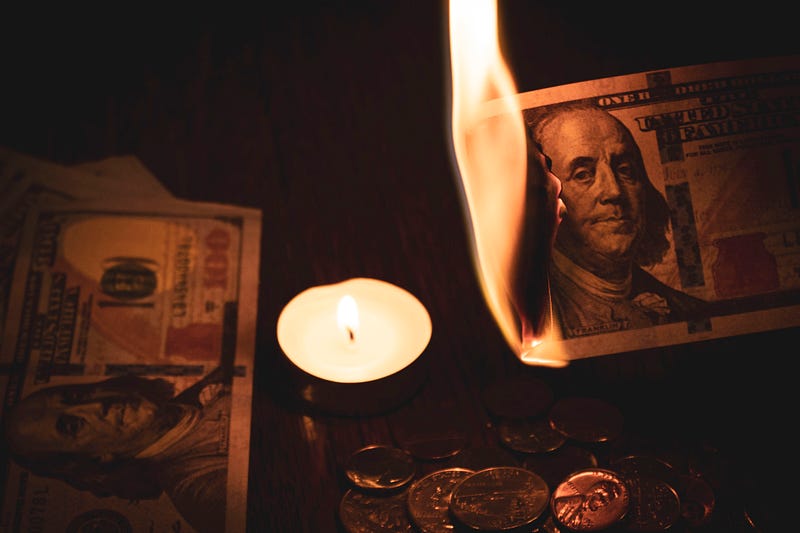
But instead, a medium of survival or necessity. Like oxygen or food.
And if I do it that way, my subconscious is saying “We need money or we won’t survive.”
Which is true. I’m no vagabond or couch surfer, but when you do this, your subconscious will tell you “We need this because we don’t have it.”
When you recognize that, you have the option to change it to “We can give it away because we do have it and won’t be coming from a place of lack.”
I wonder, if as someone with many ideas for projects/side hustles and working towards a career I’m happy about, that’s why I’m struggling. My subconscious is saying:
“You need to work for these projects, because you’re not where you want to be.”
or
“You have to overwork to create the career you want because you don’t have that career.”
When translated, those mean:
“You’re not where you want to be.” and “You don’t have that career.”
Ouch.
I see no progress in that future.
Now that those have been cleared, this article is something of an announcement: Starting February 1st, I will aim to use and treat money as a medium of exchange and document my journey.
Here’s what that means:
- Changing My Mind About Money
By changing what I identify money as, I believe that that will change my behavior with it.
I’ve used money as a medium of survival for a long time. But what happens when I use money to exchange something for another?
What if instead of saying to myself:
“Money lets me survive by giving me a place to live.”
I begin to tell myself:
“Money gives me a place to stay with electricity, heat, and good people.”
Pretty different, right?
- The Art of the Investment
I feel like in many circles, “investment” is a dirty word. It’s either so complex that people get scared, or it’s a great way to get scammed and lose money.
But if I’m changing my understanding of money, I also am going to change my understanding of an investment.
Not that I’ll put down my life savings hoping that Blockbuster will make a comeback (that’s how I got a D in my 8th grade financial investment project), but rather understand what I’m exchanging the money for.
If I buy a meal at a restaurant, is that a good investment for my body?
If I buy this shiny toy, is it a good investment for my projects?
If I donate to this charity, is it a good investment on my values?
That last question leads me to the last point:
- Earn & Provide
I feel like there’s two kinds of people who give to charity: the politician and the empathizer.
The politician donates to charity to raise their stock and make people think Y’know what? Maybe he’s not that bad of a guy.
Then you have the empathizer who does it for the cause. They aren’t afraid to get their hands dirty or to truly understand where their money is going.
Mr. Beast is a textbook example of that.
In the past, aside from not having the money, I feel like I haven’t donated to charity because I haven’t found a cause that I believed enough in to feel comfortable giving my money to.
Recently, thank God, that’s changed.
So, I will also be enforcing what I call a tithing clause (named after my days growing up in the LDS church): 10% of everything I make monthly from my side hustles, projects, and growing therapy practice will be donated to the American Foundation for Suicide Prevention.
What I’m hoping this will do is give me something and someone to fight for. It’s one thing to do something for yourself; it’s another thing to do it for someone else.
By donating to people who will put in the research and resources to help others and literally save lives, I believe this will help me work harder and smarter.
Getting to where I want to be by helping people get to where they want to be.
This isn’t an article to brag at all, but rather to announce an experiment and generate some accountability. By thinking to myself Well, I’ve decreed it; now I must see it I know I’m the kind of person to take that seriously.
If you’d like to see this journey, subscribe to get up to date information on this experiment!