
Writing is a powerful tool
Why and How Do You Write?
Writing is a powerful tool that can set you free, help you face the challenges and difficulties in your life, and get you away from situations where you feel stuck.
You can change your life through writing.
Not only through having a big success with a published novel.
No, already the fact that you write can help you a lot.
The ability to write
Not everyone feels they have the ability to write. I believe they are wrong if they give in to that feeling.
Everyone can write. And everyone can profit largely from writing, on many levels!
Even if you don’t have the time for it, writing can help you to become the master of your arts and your life.
Writing this, I realize I am in a very lucky position just now, because I have retreated after my 40 years of full-time work in the education sector. I am very lucky not having any serious illnesses I know of, and I also have a lot of time I can spend on my own.
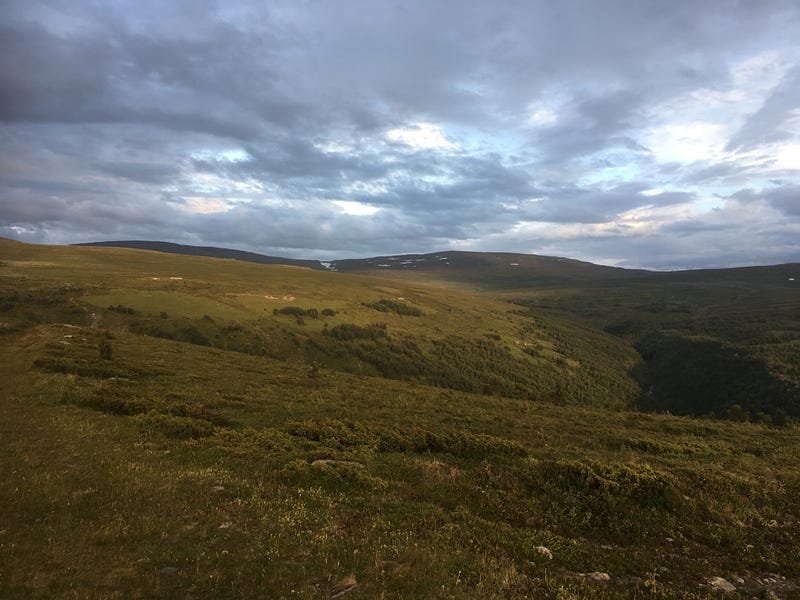
At present, I have become the possibility to spend ten July days alone in our mountain cottage, where my primary task is to mow the grass and keep it tidy and net around the cottage, waiting for when my wife, our family, and friends next month come here for a summer visit.
These days I have also the time to write!
The benefits of writing
Why write? Frankly, I don’t know exactly. I just know that it is good for me, writing helps me stay alive and active in my mind and feeling less lonely.
First
Staying alive — yes in the extended sense of the words: feeling that I live, that I do something meaningful — I search for meaning! — I have a purpose in my life.
Second
— which is closely connected to the first — writing urges me to be active in my mind. I have read that being mentally active is very important advice for older people. Of course, there are many other ways than writing where you can be mentally active.
Did you know that being mentally active for instance through learning a new language can be very good for you?
Learning a foreign language is smart!
According to research, language learning has only advantages, and some of them directly concern your mental health:
-Better memory -You become more observant -You strengthen your job opportunities -You get to know new cultures, new people -You see the world with new eyes -You ward off Alzheimer's and dementia!
Third
— I feel less lonely when I write. That’s perhaps not true for everyone and in every writing situation. I imagine easily that when writing a poem on solitude, both I myself and many other writers can strongly experience the sense of loneliness.
But certainly not all the time. Not when having in mind a reader or readers for whom you write this piece.
Formulating and expressing ideas and feelings through words can be a powerful tool to reach others and experience community and closeness to others — even if those readers are sitting on the other side of the globe!
And now, to the topic in the heading:
Why and How Do I Write?
Writing is for me a lot of different things. A quite banal aspect of writing is to write to remember — like when I write down names and numbers in the calendar to remember birthdays or schedule meetings. Behind each name or meeting note, there are of course a lot of associations and information, and each word can in a sense be the key to an entire untold story.
Writing is for me also to remember people, situations, episodes, feelings I’ve experienced, things I want to achieve — and much, much more!
Ideas
Typically, I get my writing ideas in the mornings. I don’t have to do anything special to make the ideas come. My ideas are not always ideas for writing, they can also be ideas for other projects, like creating an online course, making something in the garden, etc.
But essentially, I collect ideas for writing, because that’s what I am interested in doing.
Sometimes I wake up in the middle of the night, and from time to time — very rarely — I then get out of bed and grab my iPhone or start my Mac. And I go ahead of writing. Only notes, words, ideas. Then later, in the morning, before or after breakfast, I work on the drafts and finish them.
The other night I experienced a kind of creative eruption. I stayed up late in the night and I wrote and published four poems on medium.com. That was a huge and uplifting experience!
I see that many writers on Medium write about difficulties to start and finish writing, talking about procrastination. I believe procrastination is a problem for many writers and a challenge that should be taken seriously, but personally, I am in the lucky position that I rarely experience procrastination.
When I sit down to write I many times rapidly write down the first words that come to my mind. I write until I stop. Then I go back and take a little glance at what I’ve written, and I make minor adjustments. Then I continue if there’s more to come.
Here’s below a print screen of some of my notes for this story.
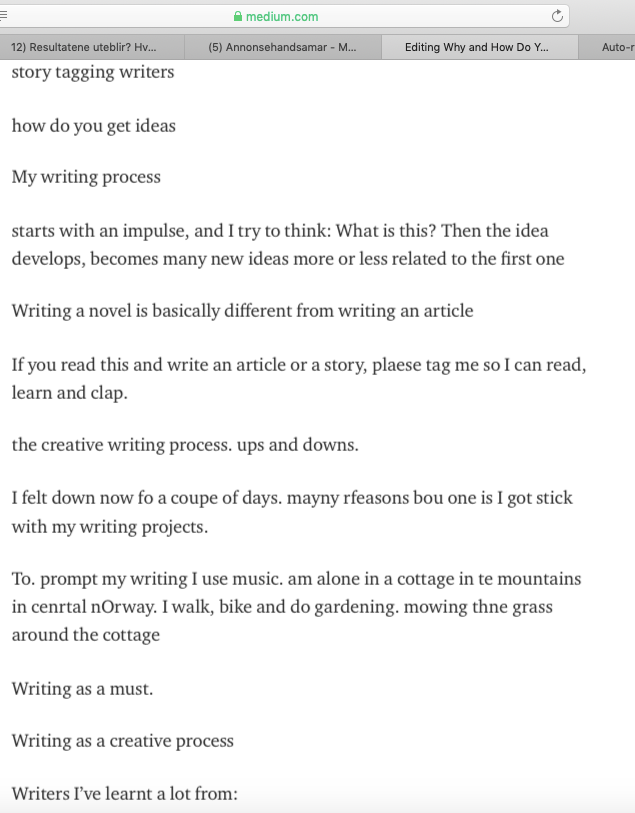
This morning I sat down and just let my fingers run on the keyboard of my Mac.
I didn’t pay attention to language errors, just let the letters come to the screen and form words and sentences that are more or less intelligible. In this phase, I don’t pay much attention to anything else than to get down words so I can remember.
The next work phase consists of writing the text and create structure. I change the succession of the ideas and try to create a logic and consistent whole.
My writing process starts with an impulse, and I try to think: What is this?
Then the idea develops, becomes many new ideas that are more or less related to the first one.
I try to gather what I have, and discover the potential of what I’ve written so far.
Sometimes I discover new angles when working on a paragraph, and sometimes I also discover that I am going in a different direction from what I initially thought. That’s not a problem. That’s a gift, an additional resource that I will try to exploit and develop, at present or later.
I will not hide that me too, the creative writing process is a bumpy path with up and downs.
For several reasons I now for a couple of days felt down, lacking energy and joy. There may be many reasons for that, and one of them is that I got stuck with a few of the projects I am working on these days.
I knew what was happening because this is me as a creator in a nutshell: To feel creative and happy I must also admit that I sometimes can be at the opposite end of the scale. So I tried to do things that I know can help me coming back to my preferred mode:
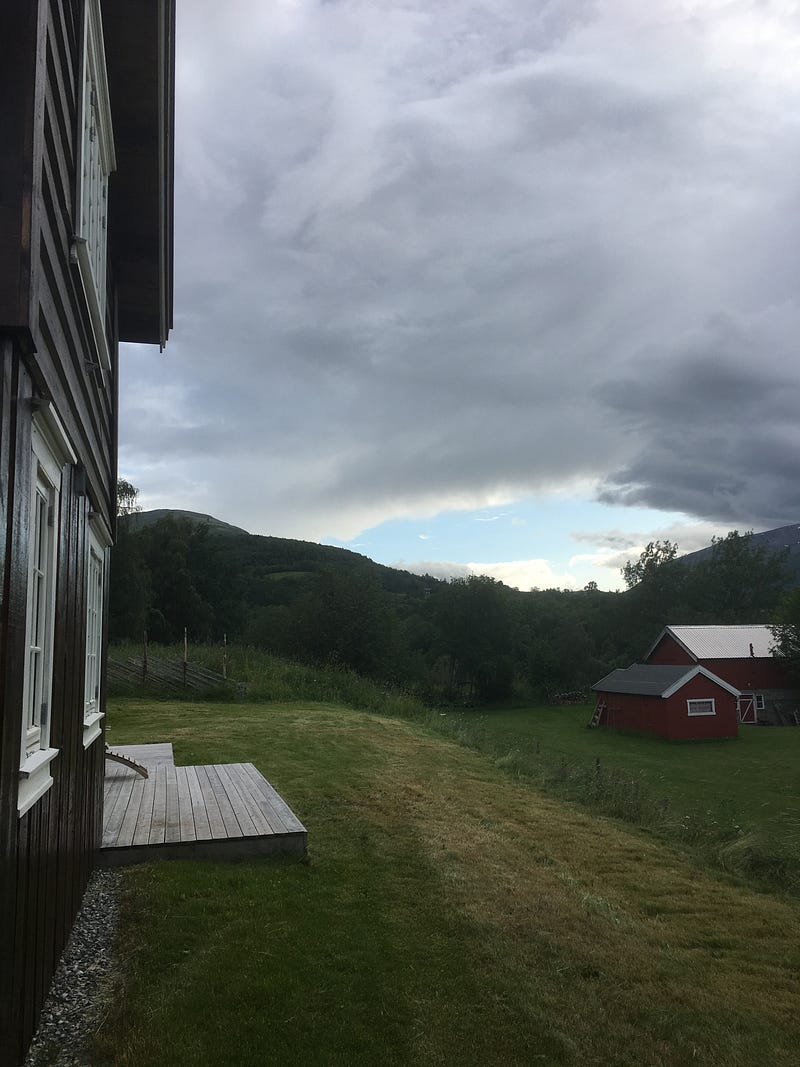
- Mowing the grass around the cottage
- Taking the bike for a ride, or waking uphills to the mountain above the cottage
- Practicing yoga for half an hour
- Reading a book, novel, and finally, my number 1 when I need to reset mentally and in my feelings:
- Listening to music, soft, slow music like Enya and Tangerine Dream (Ricochet, Part 2), or in some situations, heavy music, hard rock, Rammstein, Scooter or similar, or popular pieces like Springsteen, Mumford & Sons, and other.
- It can be of great inspiration for me listening to artists singing beautiful song texts. Sometimes I come across poems written by excellent poets and sung in exciting versions by great artists, like Thåstrøm, Tom Waits, or Norwegian and other Swedish song singers. Just now I was listening to two beautiful songs, Daniel Norgren - Everlasting Friend and Daniel Lemma’s powerful performance of Swedish poet Karin Boye’s poem: Jag vill gärna stå på gatan.
When I pick up a line or a verbal image in this type of songs, sometimes I get inspired to write a new text, poem or story — based on that line.
Writing is a must
To me writing as a must. It is like I imagine poets all over the world have thought and written at all times:
Writing is breathing
I believe that for many creative writers the writing experience is like this: Once you’ve started you don’t want to stop. You cannot stop.
Writing a novel
Writing a novel is basically very different from writing an article or a poem.
Writing a novel is a long term creative work and a long-distance run, patience demanding, suffocating, exhausting, grueling, back-breaking, draining, killing and sometimes also a very pleasant creative process.
Writing a novel is an endurance test. When I wrote my first novel I forced myself to work day and night, resting and sleeping as little as possible. It was very stressful and strenuous, but I was encouraged by the feedback from the editor, and that helped me a lot.
Many years after I published my debut novel I made up my mind to write another novel. In this story, the action takes place in my home town in the first half of the 20th century. I wanted to write a thick book, a story of a family and other people who worked in the smelter. It is a book that took me almost a year to write, with a lot of realistic details from life inside and outside the smelter.
I had to prioritize the work on this novel before much else in my life during that year of writing. In that period I also worked a full-time job, so it goes without saying that I had to have good self-discipline and be very strict with the time spent. I made a lot of research because I wanted my novel to reflect and report realistic details from life in the smelter and in my home town from 1906 to 1945.
The creative process
Whether you write a poem or a novel, the creative process is much the same: Severe focus on the idea, the story, and the language, on how to make the words express the ideas and the feelings you want to communicate, in an artistic, literary form.
Basically, creative writing is about writing and editing. And keeping the focus where it has to be, all the time during the creative process.
I am curious to know about other writers’ experiences. How they get and develop ideas, and how they turn the writing ideas into captivating and beautiful stories.
If you read this and write an article or a story on your own writing process, please tag me so I can read, learn and clap.
A big Thank You! to writers I’ve learnt a lot from:
George J. Ziogas, Steve Spring, Maarten van Doorn, Owen R Thornton, Francine Fallara,Thomas Plummer, Danny Forest, Ayodeji Awosika, Steve Campbell, Nicole Bianchi,Silver Lining, Randy Shingler, Vincent V. Triola, Michelle Muses, Giovanni Sonier, Guérin Asante, Elle Rogers, Martine Weber, Adam, Diabetic Cyborg, Harry J. Stead, Danny Forest, Anna Rozwadowska, Tre L. Loadholt, Shringi Kumari, Niña Traviesa, Hans Yngvar Olsen, Marta Mozolewska, Jo Ann Harris, Carol Dixon, Writing River, J.C., John Mashni, Anthony Moore, Lukasz Yoder, Dana Sanford. Gene Smith, Susan Brearley, Arif Nawaz, Steven John, Lisa Renee, Anna Lynch, Dora Emig, Nick Wells, Regina-Lee Dowden, Flavio Sbriglia, Lucy King, Miss Wren, Christian Bager Bach Houmann, Laura Gulbranson, Jennifer Nicole, Regina-Lee Dowden, Lucy King, Jagrit Singh, Natalie Frank, Ph.D. (Clinical Psychology), Arthi Ramesh, Nick Jones, Kevin Weatherman, Richard Leighton Dixon, Iain Fraser, Kathy Braun, Aaron Griffin, Mark Charlton, Jesus bautista, Lidia Eira, Kevin E. Pittack Jr., Shaunta Grimes, Nate B, Sean Coulson, G Seaton, Alyssa Phoeur, Dani Buckley, Simon Ternyik, Petra Ivanigova, Manish Rajguru, Rick Divorne, Anil Taneja, jesus bautista, Lidia Eira, Stephen Sovie, Brian Rowe, Vanessa Torre, Agnes Louis, Jo Ann Harris, Glenna Gill, Williams Oladele, Sohan Thakur, Ruth Stewart, Nikki Tate, Holly, Carole P. Roman, Darius Foroux, Jim Dee, Christine Stevens, Rosie B., Shelly Fagan, Owen Lloyd, Jacqueline A, Toni Koraza, Rusty Alderson, Rev. Ione Burlingame, Lorelei Weldon, Michelle Monet, Jesse Wilson, Donna Barker,
@and many more…
Øivind H. Solheim is a novel author and a nature photographer from Norway who loves writing fiction, essays, and articles helping others understand life, other humans, and themselves. He has published five novels, two non-fiction books, and a poetry book.
Visit Øivind H. Solheim’s profile
Become a Medium member, read thousands of writers and support my writing.
“Make Your Dream Be Your Future”