
Why a Vector is NOT Something With Magnitude and Direction
A Basic Introduction to Linear Algebra and Vector Spaces
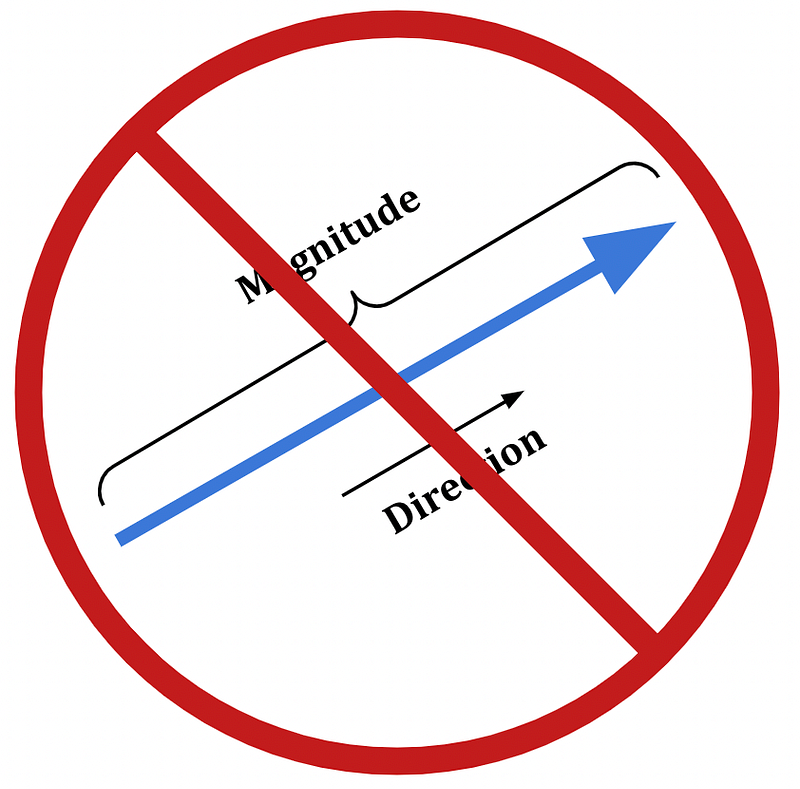
A common misconception that some high schoolers make is that a vector is “something with magnitude and direction”.
Unfortunately, this is not always true.
In this post, I would like to explain why this is the case by introducing the proper definition of a vector and exploring other types of vectors than the ones we are already familiar with. For those who are already acquainted with linear algebra, there will probably be nothing new to learn here, but if you are interested, feel free to continue reading.
Vectors Spaces
Before talking about vectors, we must first understand what a field is.
A field, in simple terms, is just a set where operations such as addition and multiplication are defined and satisfy the following field axioms for some elements a, b, c in our field:
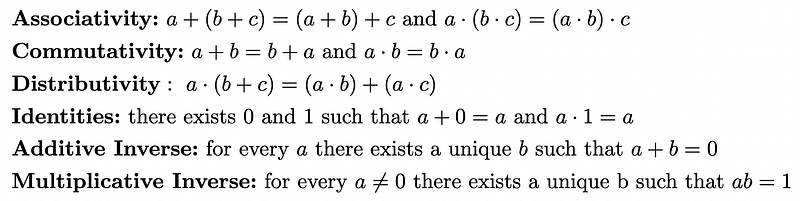
Hence, sets such at the set of all real numbers, R, or the set of all complex numbers, C, are examples of fields and we can label the arbitrary field as F.
Now, with this in mind, we can define something known as a vector space.
A vector space, V, over a field, F, is a non-empty set in which two operations, addition and scalar multiplication, are defined and obey the following axioms for u, v, w in V and a, b in F:
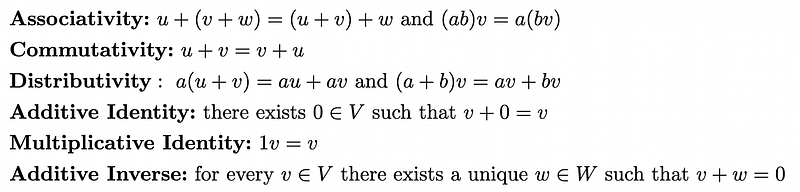
It is important to note how similar these requirements are to the field axioms (although they are slightly different).
Finally, we can define what a vector is.
A vector is just defined to be an element of a vector space.
Hence, if we have a well-defined vector space that satisfies the above requirements, any element of the vector space is considered to be a vector. Notice how in this definition we made no reference whatsoever to the ‘magnitude’ or ‘direction’ of a vector and those just happen to be convenient properties of certain types of vectors.
In fact, we can confirm whether vectors with a physical implication are indeed vectors according to our new definition.
For this, all we have to do is check if R³ is a vector space, where R³ is the set of all lists of length 3 where each element is in R. For example, (0, 0, 0), (-3, 4, 19), (0, 1/2, -π) are all elements of this set. It is clear why these would represent physical vectors since we could assign a coordinate to each element in the list in the form of (x, y, z).
Now, we can define addition on R³ by (u₁, u₂, u₃) + (v₁, v₂, v₃) = (u₁ + v₁, u₂ + v₂, u₃ + v₃) and scalar multiplication by a(u₁, u₂, u₃) = (au₁, au₂, au₃). If we now look at the required axioms, it may be clear that all of these get immediately satisfied from the fact that each element in the list and the scalar we multiply by are elements of R. Since R is a field, it satisfies the field axioms from which the requirements for the vector space follow automatically.
Hence, R³ is a vector space, and every element inside it is considered a vector.
However, not all vectors have this simple physical interpretation as we will see next.
Other Examples of Vectors
Now that we know how vectors are properly defined, we can explore other types of vectors.
1. n-dimensional lists
Let’s begin with perhaps the most obvious one.
n-dimensional lists are clearly vectors since the way we showed that R³ was a vector space had no dependence on the length of the lists.
But do such vectors really have a direction?
Although we could create a mathematical generalization for the direction of such vectors using our formula in R² and R³, it would not have the same physical implication that we are familiar with since dimensions above three do not make sense in the context of our physical world that is three dimensional.
2. Matrices
Interestingly enough, matrices are actually vectors too.
For example, consider the set of all possible n by m matrices where each element in the matrix is real. By the same logic we used for R³, it is relatively easy to show that this set is indeed a vector space. Hence, these matrices are also considered vectors.
Now, could matrices possibly have any physical attributes such as direction?
Certainly not. Yet, it is still considered a vector since it is an element of a well-defined vector space.
3. Functions
Yes, even functions can count as vectors if we are careful with how we define them.
As long as we specify the domain the functions are to be defined on, satisfying the requirements for a vector space turns out to be quite easy. For example, the set of all functions, f : A → F, on some domain A is a well-defined vector space.
How is this Useful?
Now, you may be wondering why we should care about this abstract definition of vectors and the fact that there exists vectors other than ones with physical interpretations.
This is because our definition of the vector space leads to an incredibly rich subject known as linear algebra that mathematicians have been studying for centuries, and many of the findings from there can be applied to most vectors.
In fact, if we take functions for example, in the field of quantum mechanics, functions are viewed as vectors since viewing them in this way tends to be very convenient. Thanks to the study of linear algebra, if we do this, many already existing discoveries from linear algebra can be borrowed and applied to our study of quantum mechanics. If you are curious why considering functions as vectors is so convenient in quantum mechanics, feel free to read this post I wrote a while ago:
As such, although saying ‘vectors are objects with magnitude and direction’ is correct in very special contexts, it is important to recognize that this does not apply to all vectors and viewing vectors through this abstract definition leads to an entirely new and interesting field of mathematics.
Thank you for reading.


