
Why A Japanese Immigrant Became A Civil Rights Advocate
He was the Lil Tokyo Reporter
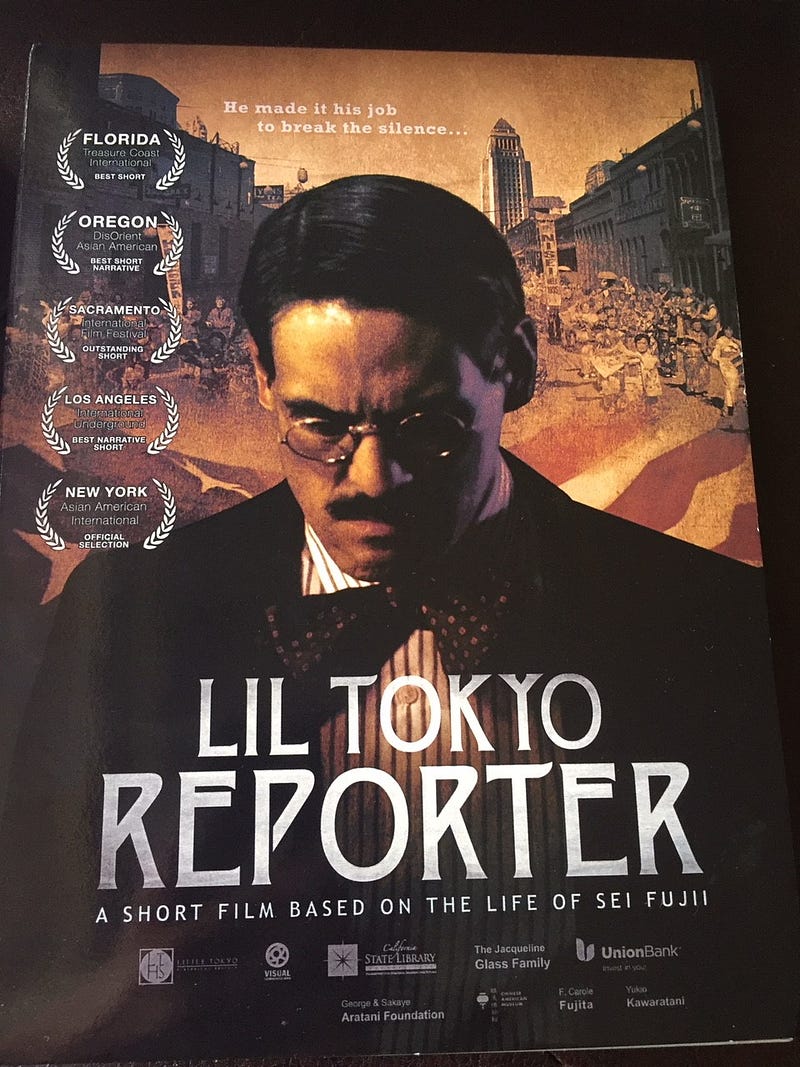
This was a man who worked hard for civil rights
Some years ago while I was working in Washington D C, I was invited to the screening of a film called, “Lil Tokyo Reporter”. It was a pleasure to meet the director, Jeffrey Chin, and others who worked on the short film. I was recently contacted by Chin and asked to write a statement about the principal of the film, Sei Fujii. It made me think that this is a person who should be remembered so I decided to share information about him.
Sei Fujii was born in Japan in 1882. He dropped out of Yamaguchi High School and moved to the United States in 1903. He studied law at the University of Southern California and graduated from the USC Gould School of Law in 1911. He was unable to practice law because he could not get a lawyer’s license. A law existed at that time that prohibited citizenship to any Asians, so he was not allowed, as a non-citizen, to take the bar and acquire a law license.
That experience caused him to fight against discrimination for Japanese immigrants. He became a civil rights’ advocate because of the injustice against him.
Fujii worked in the Los Angeles Japan town area called Little Tokyo (Lil Tokyo,) in the newspaper business. He became known as the Lil Tokyo Reporter.
Following the Japanese attack on Pearl Harbor on December 7, 1941, Fujii was arrested by the FBI as were many leaders of Japanese descent in the United States. He was imprisoned in the Tuna Canyon Detention Station, and was then sent to a detention camp in New Mexico, before ending up at an Army facility. He was not released until 1946.
“Lil Tokyo Reporter,” is a film inspired by the true story of Fujii. He was an influential civil rights activist before, and after World War II.
He helped to overturn the California Alien Land Law which had prevented non-citizens from purchasing property or owning homes.
He was instrumental in influencing a U.S. Supreme Court ruling that allowed doctors to build a hospital in Los Angeles to serve the Japanese community.
He used his newspaper to help the community, and he also had a radio program.
The law which did not allow Asians to become American citizens, was judged unconstitutional in 1952. Fujii finally became an American citizen at the age of seventy-three. He died of a heart attack just fifty-one days later.
California’s top court decided unanimously in 2017 to grant Fujii a law license posthumously. It was sixty-three years after his death. There have only been a few such cases where people were granted law licenses posthumously.
The 2012 narrative short film about Sei Fujii was exhibited at the Los Angeles Asian Pacific Film Festival. It won more than eighteen awards throughout parts of the United States. The film is available online.
[Source: Wikipedia, Film: Lil Tokyo Reporter, Little Tokyo Historical Society www.littletokyohs.org]