
Why 1 + 2 + 3 … = −1/12, from Physics
The math doesn’t add up! What about the physics? Here’s why the equation actually makes sense

It may be one of the most ridiculous equation ever popularized:
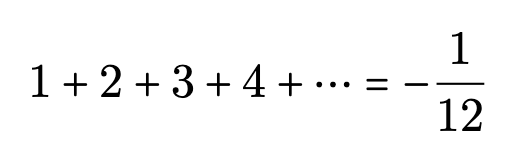
It’s got some glaring issues:
- The left hand side should sum to infinity
- The left side contains all positive terms, the right side is negative
- The left side contains integers, the right side is a fraction
So how can it possibly make sense? Yet it turns out, this equation is actually quite useful in physics. Here’s how to make physical sense out of it.
Vacuum Energy
When does this infinite sum appear in physics? This happens when one calculate some sort of vacuum energy (i.e. string theory). In quantum physics, energy comes from vibrations of various fields (i.e. electromagnetic field or matter fields). Since the vacuum energy is proportional to the frequency of these modes, we end up with equations like this

However, since physics is a scientific discipline, it deals with things that are measurable. If we accept that the vacuum energy we are computing is a measurable quantity, and since we cannot measure infinity, the answer then cannot possibly be infinite. So there is a contradiction, because the sum obviously diverges! So something is wrong here, there must be a mistake…
Understanding ∞
In order to proceed, we must take a slight leap of faith and accept that our equation is missing something.
Why? One possibility is that our models are not yet complete. So while our models can compute results, these results may only have a limited domain of validity.
This is analogous to how a calculator is capable of multiplying small numbers, but when we plug in very large numbers, the result becomes a nonsensical overflow.
So in order to make sense of the infinite result, we need to quantity our ignorance. This step is called regularization.
Taming ∞
So we need to parameterize our mistake in the formula. But this parameterization needs to make sense physically:
- The parameterization should treat each term in a similar way, So that it respects the symmetries of the physical world
- The parameterization should taper off for large n to properly tame ∞
- The parameterization should be adjustable so that we can turn on/off smoothly and see its effects
In terms of equation, we are introducing a regularizer R(n, N) that represents our ignorance in the physics. This regularizer should be between 1 and 0, that tapers off when n is large. Also N controls the amount of ignorance/regularization. We can then rewrite our sum in the form:
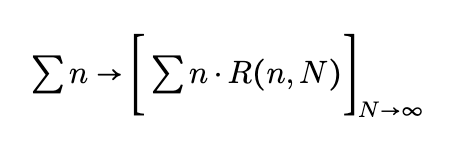
This is all a bit abstract, so let’s look at an explicit example
- Exponential regularization

The regulator exp(−n/N) works because when N is large, it doesn’t affect the terms very much until we get to very large n. Furthermore, the beauty of this regularization is that the sum can be computed exactly!
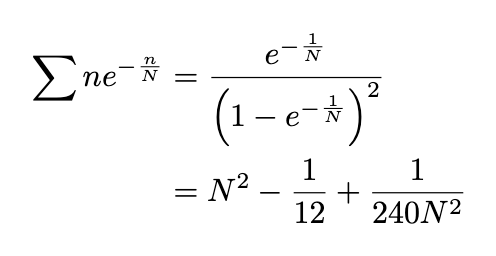
Now we can see the behavior when sending N to ∞. If we ignore the infinite N² terms, we get −1/12. So when we say 1 + 2 + 3 … = −1/12, we really mean equal except the ∞.
But all this feels like cheating. How can we just ignore the infinity? It seems like there is a lot of ambiguity in our procedure. How can we guarantee that we get the same results when we modify our procedures?
Uniqueness
Fortunately, physics allows us to justify ignoring the infinity: because the answer is an observable, and so it has to be finite! Infinity must have shown up because of our incomplete theory and inadequate mathematical prowess. Since physics’s goal is to model nature, we can literally add a −∞ to our theory and accept this procedure as part of our way of modeling the world.
What about the mathematical side? It turns out that we can actually guarantee the answer to be unique, as long as we satisfy our physically driven requirements for regularization. Prof. Terry Tao’s blog has a rigorous proof for this fact.
If all these theoretical justifications still seem shady, physics has an ultimate trump card for settling the debate: experiments. It is possible to measure the attractive forces caused by the vacuum energy that we’ve calculated, and here’s an example experimental paper — the conclusion is, it works! (although it’s for a different but similar sum)
Epilogue
In summary, we see that in order to make sense of something that is infinite, we need to accept our ignorance and rectify our answer. Luckily for us, there is a consistent and sensible way to fix the mistake and get a finite answer.
Perhaps nature is offering some life lessons to us: that as long as we stay humble and grounded, there is always a way to make the impossible, and the non-sensical, sensible.
Appendix
A lot of sloppy articles might draw parallels of the infinite sum to the definition of the Riemann zeta function ζ(s), defined as
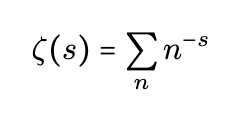
And simply substitute in 1 + 2 + 3 + … = ζ(−1) = −1/12. While this gets the right answer, it creates more confusion because the above definition only works when s > 1 (or real part of s > 1). A more rigorous calculation would require complex analysis. For instance, this can be done by applying the Abel formula
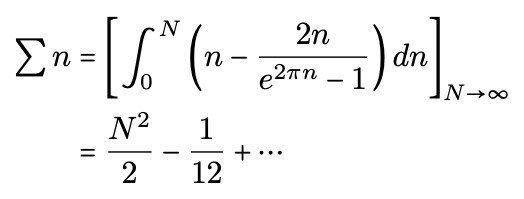
So the summation is converted into an integral, and regularization becomes a cap on the integral. This complicated trickery gives a similar answer as the exponential regularized version, and the finite term can be related ζ(2), which is related to ζ(−1) through zeta reflection identity.


