
Who’s Watching You?
Distance learning may be too remote to matter
When Sting and the English rock band the Police captivated us with “Every Breath You Take” in 1983, we probably thought of a passionate relationship, but maybe they were on to more than just obsession and love. Maybe they were describing the intensity of the observer effect and how it can change reality. Watching, observing, isn’t just the stuff of romance, but reality itself.
“Every breath you take and every move you make
Every bond you break, every step you take, I’ll be watching you
Every single day and every word you say
Every game you play, every night you stay, I’ll be watching you”
I’m not a scientist, but I like reading about science and discoveries that affect my world. Recently, I became interested in the observer effect. This is the idea that the behavior of something changes, slightly, minutely, incrementally, when there is an observer present. Our reality is directly affected by whoever or whatever is watching. Philosophers, scientists, and mathematicians have explored this concept with quantum particles. This was an explanation given in the Science News article, “Quantum Theory Demonstrated: Observation Affects Reality” :
“In a study reported in the February 26 issue of Nature (Vol. 391, pp. 871–874), researchers at the Weizmann Institute of Science have now conducted a highly controlled experiment demonstrating how a beam of electrons is affected by the act of being observed. The experiment revealed that the greater the amount of “watching,” the greater the observer’s influence on what takes place.”
Physicists explain this concept with rather long, intricate explanations involving electrons, but to me, it only makes sense when I apply it to my world. As an adjunct instructor and a teacher, I found this concept to be fascinating. I started thinking about a typical high school.
Let’s say there are about a thousand students in grades 9–12 and at least 50–100 faculty, 50 administrators, 20 district office personnel, secretaries, custodians, and visitors on any given day. By applying the observer theory, each person behaves slightly differently depending on who is present. The observer influences what takes place.
I know, it sounds rather obvious, but it is an important concept that we need to consider when schools are increasingly moving to a remote learning mode of instruction. Is it possible to teach kids how to interact appropriately with others, morals, academics, etc. without seeing their teachers or their classmates? Is the visual specter on a Zoom screen enough?
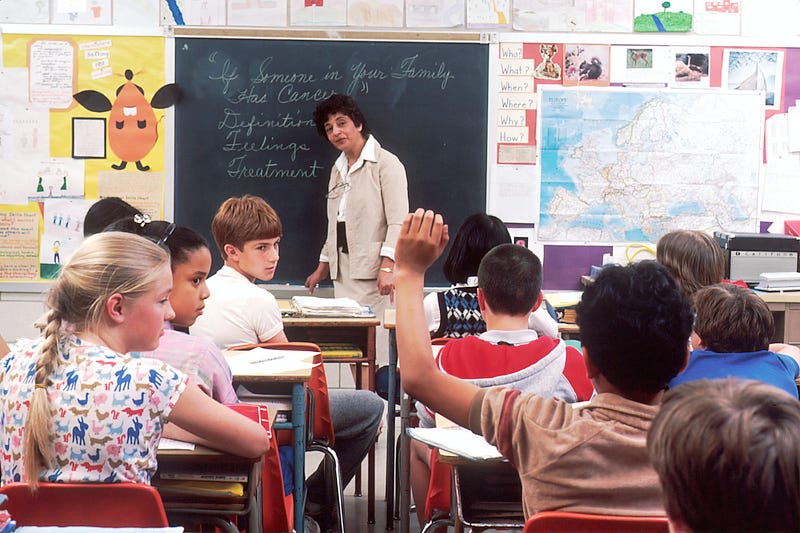
This concept is really obvious when a teacher is absent. Kids hardly ever take the lesson seriously. Even though substitute teachers (there’s a special place of honor for them somewhere) try to carry out the lesson plan, kids understand that the teacher responsible for the grade is not there to watch their shenanigans. So, the beleaguered substitute is left with a classroom full of kids who are affected by the observer, in this case, the substitute teacher ho has very little power over their grade, their behavior, or their success in the class. Is it any surprise that the day becomes a “free” day with little accomplished? One of the reasons I was rarely absent when I taught high school was because I knew absolutely nothing would get done in my absence. This was not because I hold myself in high regard, but just because of the observer effect. The kids didn’t have an observer they respected.
How does this concept apply to parenting? We’ve all heard the adage of kids will emulate what you do, not what you say. The observer effect is evident here too. Whenever parents attended conferences with their kids, I got a front seat view of the parenting dynamics in the home. Parents tried so hard to help their kids succeed and always wanted to know how they could motivate their kids to do better. I would produce a checklist of strategies and suggestions, but in my heart, I knew most of them wouldn’t work because the kids needed to see the qualities the parents wanted to instill in action.
They needed to observe parents who read, worked hard, took pride in their work, treated others with respect, showed concern for the welfare of the less fortunate, etc. However, many parents wanted a shortcut, a simple way to make sure their kids became everything they were not willing to be. So, there were parents taking cell phone calls during conferences who looked up to tell me their kids were hopelessly addicted to cell phones. The observer effect was alive and well at these meetings.
Kids observe and emulate so much more than we imagine. If we want a better, more compassionate society we must become better, more compassionate people ourselves. As a parent, I didn’t always succeed, but my kids watched me trying every day, and that went a long way towards making them young men I am proud to say are my sons. A great country song from 2007 that shows the observer effect in parenting is “Watching You” Co-written by Atkins, Steve Dean and White:
Yet again, we can see the observer effect in action in the cafeteria and the classroom. I can’t tell you how many times kids would ask for passes to the library so that they didn’t have to eat lunch in the cafeteria if the friend they sat with every day was absent. The absence of one student changed the way the student felt about sitting in a crowded cafeteria and eating his lunch alone. The observer was missing and so the observed changed his behavior.
This phenomenon is true in the classroom dynamic as well. A cursory glance at attendance for the period would usually give me a good idea of how smoothly the day’s lesson could be carried out. If a new student from another school district, a private school, or from another country arrived, the entire balance of the class would shift as kids were curious about the new entrant.
If the class clown was absent, there would inevitably be another student who tried to be just as funny and charming as the absent student. If a girlfriend was absent and her boyfriend was in class, he was less likely to participate or more likely, depending on the relationship. However, one constant was that behavior changed because of who was present.
In a college classroom, the observer effect is also important. Older students may not be as influenced by their classmates’ behavior, but I noticed a dramatic decrease in the types of questions students asked when we switched from face-to-face instruction to remote learning.
Suddenly, students who were curious and inquisitive, asking about motives and etymology grew silent. Everyone just wanted to complete the assigned work and get a passing grade. Anecdotes about their lives disappeared; there seemed to be no interest in sharing them. After all, who was observing?
Perhaps this was just because the Zoom technology was new to students, but somehow, I don’t think it will make a difference even when Zoom becomes more commonplace. Some questions only come to mind because there are observers, other students whose presence matters.
I also missed hearing random insights and quips that lead to humor, inspiration, or empathy. In the absence of real observers, the whole paradigm of the class discussion changes.
I wonder how this observer effect will continue to play out in remote learning. Will kids on Zoom develop a strong enough relationship with someone on a screen?
Does it matter who the teacher is? If everyone they see is virtual, do they observe any behavior they want to emulate? Is the class clown affecting anyone’s behavior? Are we seeing the shy kid in the back row? Does he even turn on Zoom?
Thanks for speculating with me. If you enjoyed this article and want to read more, you can find me here on Medium and at my website: writingforeverydayliving.com


