
Whore! How Music has Helped Transform the Insult
And yes, you can apply it in your daily life
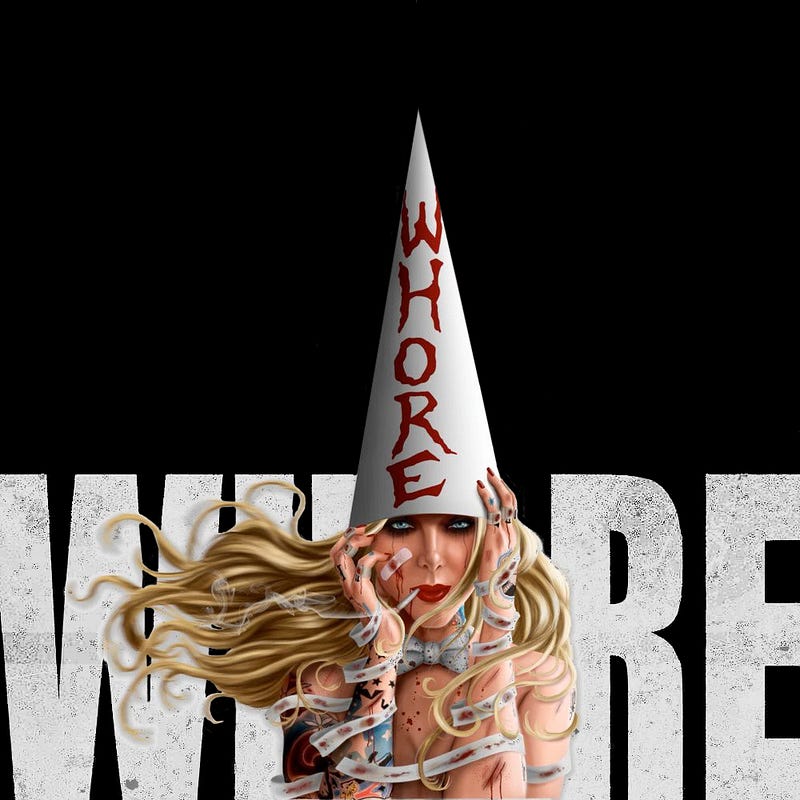
“I can be your whore! I am the dirt you created I am your sinner I am your whore But let me tell you something baby You love me for everything you hate me for”
Whore: Lyrics By In This Moment
I chose these lyrics from In This Moment — an exceptional band— to head the article because I refuse to put the examples that are most abundant today: trap or reggaeton. These are genres that I’ve never tolerated, so linked to awful and sexist thoughts.
Even so, specifically in those musical genres, I see more and more how there’s a tendency among female singers to give a new meaning to the insult “whore”. They’re trying to equate it to a compliment.
I find it very interesting to analyze why this is happening and see how we can apply it in our daily lives. Because you can learn from any corner, even those you don’t like.
WHORES AND SLUTS
Without wishing to make any historical analysis in this regard, all of us know how "the oldest profession in the world" has been used as a repudiation, insult, and degradation to any woman.
Interestingly, whether these women were historical or fictional characters — Mary Magdalene and Lilith are my favorite examples — their symbolism is always linked to liberation, critical thinking, and courage. Attributes that certainly bother.
I’m sure that if someone calls you a prostitute, you’re not unworthy but full of courage and independence. The prostitute has always been the counterpart of the perfect wife, chaste (until the man tells her otherwise, of course), dependent and faithful.
All that rebellious women were labeled as prostitutes, whether they were or not. Or, when religion had more power, female demons.
The sad thing is women still continue to receive insults at the slightest sexual display. Or worse, when simply by breathing, others interpret sexual intentions in us. It seems that society has conditioned us to put up with it and shut up, but when this comes from our families, it hurts a lot, because programming is already too important: it’s ancestral. And unfortunately, it’s not the sons but the daughters who usually bear the brunt. It’s also curious how in the English language there are even two quite similar adjectives to be able to insult according to preferences:
- Whore for the woman who receives money for having sex.
- Slut for the one who behaves promiscuously and has sex for free.
Perhaps many songs confuse this, but the important thing is that many women have grown tired of receiving unsolicited assessments and have realized that a good way to defend themselves is by appropriating what society throws at them.
“Society” has no gender here: women themselves are sometimes more misogynistic than men.
I see this social phenomenon more as a form of protection than to romanticize a dangerous and cruel way of life, but it should also be noted that the debate is open. Are we going too far by identifying ourselves with women whose stories we can only imagine, appropriating their reality?
FROM INSULT TO COMPLIMENT
To begin with, we must know that social identity theory (Tajfel, 1970) explains the minimal group paradigm:
“Mere categorization is enough to elicit intergroup behavior.”
What does this mean? That the mere perception of belonging to two different groups (let’s say women vs men) is a necessary and sufficient condition to produce discrimination. Which logically entails a bias within the group and the identity is damaged (woman=whore vs man=perfection). If the identity of the group (women) were reinforced there would be no problem. But the identity of the women group, when compared to men and their privileges, resulting in being “whores”, is damaged. This has made us move in search of a better identity. To achieve that, there are 3 mechanisms (Tajfel and Turner, 1979):
1 - Individual mobility: leave the group and try to move to a more suitable one.2 - Social competition: overcome the outgroup in the same dimension.3 - Social creativity: redefine the terms of the comparative situation, through...a) Adopting a new dimension of comparison.
b) Modifying the values associated with certain group attributes.
c) Changing the outgroup with which the comparison is made.It is clear that starting to use the insult "whore" as a compliment is a modification of the associated value. What men — and some women — used to harm us, we make it ours so that they remain unarmed. It’s rather a reaction to countless years of suffering to express our sexuality and femininity.
HOW WE CAN USE SOCIAL CREATIVITY IN OUR DAILY LIVES
Maybe you don’t feel comfortable asking to be called a whore as a compliment. It’s understandable. But don’t forget that social creativity can be used for any insult.
How many times have there been people who have tried to make you feel bad by highlighting a flaw, whether real or imagined?
- “I didn’t imagine you were such a bad person.”
- “You’re very unpleasant.”
- “You make me feel bad.”
- “You don’t remember anything.”
How about we respond to it with...?
- “I’ve never denied it. We all have our good and bad parts and I accept mine.”
- “If that’s assertiveness and sincerity for you, yes, I’m unpleasant.”
- “Obviously. I’m not going to feel bad so that you always feel good.”
- “Can be. Not always, but many times yes, I should improve my memory.”
People who insult expect one thing: that you deny and continue fueling the discussion. They never expect acceptance and security from you.
That’s what you must give if you want to return insults in an intelligent and original way. You can accept it at 100%, at 50%, re-label misconceptions, and switch sides giving responsibility back to the other… there are many options to explore.
And for closing this article, here goes the song that inspired me to write this. Enjoy!


