
Who Would Make 4th Team All-NBA? Or 15th Team or 30th Team?
Why stop with just three All-NBA teams? Let’s rank them all!
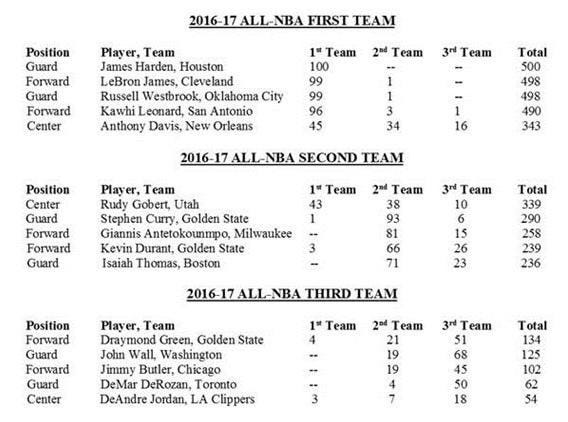
The NBA released its 1st, 2nd, and 3rd All-NBA teams this week and the results were about as expected. The 1st Team was nearly unanimous with Russell Westbrook, James Harden, LeBron James, and Kawhi Leonard, and there were no real surprises anywhere on the list other than a stray missing vote here or there. (Seriously, who voted LeBron 2nd Team?)
Some raised an eyebrow at the inclusion of names like DeMar DeRozan and DeAndre Jordan; others acted surprised when Paul George and Gordon Hayward missed the cut. Draymond Green found a way to whine when Klay Thompson didn’t make it. You know — the usual.
But why stop with just three All-NBA teams? Why not name a 4th Team All-NBA and a 5th and a 6th? What about the replacement-level 15th Team All-NBA or the league-worst 30th Team? Everyone in the league deserves to be ranked and judged equally, so I went about the yeoman’s work of doing it for you. Without further ado, your complete 2016–17 All-NBA teams…

4th Team All-NBA — The Snubs
Chris Paul Kyle Lowry Gordon Hayward Paul George Karl-Anthony Towns
Hayward and PG are the guys everyone is talking about. Both were fantastic this season, yet both fell short of making All-NBA and are ineligible to receive the designated player extension both teams would love to offer. Either or both could head toward new teams soon because of it. And yet, neither is really a snub. Hayward and PG were great — but LeBron, Kawhi, Giannis, Durant, Draymond, and Butler were better.
You can make a pretty good argument that Towns was better than First-Team center Anthony Davis this year. Brow was certainly better defensively and had three more points per game, but KAT just put up a 25/12/3 as a 21-year-old. He was even better after the break, with 28 and 13 a game on absurd 60/43/84 shooting splits. That’s a 67% true shooting percentage, which would’ve led the entire league. Towns was much better than DeAndre Jordan this year, and so were a few other centers.
Chris Paul and Kyle Lowry continue to be criminally underrated, both losing their spot to a Raptor that isn’t even the best guard on his own team. CP3 and Lowry both missed some time to injury but were awesome when they played. CP3 is one of the all-time great point guards, and pre-injury Lowry was putting up numbers that rivaled 2015 MVP Steph Curry.
6th Team All-NBA — How Are These Guys 6th Team?!
Kemba Walker Kyrie Irving Otto Porter Kevin Love Nikola Jokic
Look at this list. It would be a believable list for 3rd Team All-NBA next season, and none of these guys were even top-25 in the league this year.
Irving and Love lose some points for degree of difficulty but both put up incredibly efficient seasons either way. Kyrie just joined Steph, KD, Dirk, Bird, and Allen as the only players in history to average 25 points a game while shooting 40% from downtown and 90% from the line. If you add in his 50% two-point shooting the list gets even shorter: just Steph, KD, Bird, and Kyrie. Love was nowhere near as good but still had his best season as a Cav, averaging an efficient 19 and 11.
You might not think Porter belongs but he was top ten among forwards in advanced stats like BPM and WS/48 with an incredibly efficient 13/6 and a near league-leading 43% from behind the arc. Porter’s going to get something close to the max this summer, and he’s going to deserve it. Do the Wizards have the third or fourth (Clippers?) best trio in the league?
Kemba Walker might be ready to take Mike Conley’s most underrated player in the league title. He moved into the upper echelon of point guards this season with 23ppg and career highs in every shooting percentage including 40% from downtown.
Nikola Jokic is a true (cringes) unicorn, a point center through which the entire Nuggets offense ran. Despite limited minutes, he still put up a 17/10/5 with a deadly mid-range and an incredible array of passing skills. As Denver pushed for the playoffs their final twenty games, those numbers increased to 19/12/6. The only guys to do that for a whole season are Wilt, Oscar, and KG.
Could you win an NBA title without a top-25 player? This team lacks in defense but man would they put up points in a hurry.
10th Team All-NBA — We Got Next
Ricky Rubio Gary Harris Andrew Wiggins Tobias Harris Myles Turner
As stacked as the early All-NBA teams are, the level really drops off around 7th Team. Wouldn’t the 6th Team be a double digit favorite against this squad? But part of that is just not realizing how good all these guys were this year.
You probably think one of those Timberwolves is too high and the other is too low, and you’re right — but not the way you think. Rubio was fourth in the NBA in assists behind only Russ, Harden, and Wall with a career-high 54% true shooting percentage. He’s still terrible from downtown but adds so much everywhere else that you can live with it. His 16/4.5/10.5 post-All-Star-Break with LaVine out was fantastic. He was without question the second best Minnesota player this season. Wiggins had a high-usage 23 ppg with a lower true shooting than Rubio. His three-pointer improved to league-average this season but he’s still a poor man’s DeMar DeRozan. He’s really good at scoring and contributes nothing or negatively almost everywhere else. 10th Team is quite generous if we’re talking winning basketball. Still, Wiggins is one of 13 in history to average 23.5ppg at age 21 or younger. Even if he ends up being the worst player among LeBron, KD, Melo, Barry, Cummings, Brow, Iverson, MJ, McGrady, Shaq, and King, that’s a fun group to hang with.
10th Team NBA doesn’t mean Rubio is a top-10 point guard. He’s the fifteenth point guard on my list, basically a league-average starter. But that means Gary Harris had a top-5 shooting guard season, with 15/3/3 and sizzling 50/42/78 splits while being the only real plus defender for the Nuggets. The other Harris led the Pistons in scoring, even though he came off the bench for half the season. His inclusion here probably says less about Tobias and more about the dearth of top forwards in the league comparatively to other positions.
Myles Turner — not Porzingis, Booker, or Russell — has been the second best player from the 2015 draft so far. He really broke out this season with big improvements everywhere as a shooter and became Indiana’s second go-to guy. The Pacers hope to keep PG around, but Turner looks like a pretty great building block if they need to rebuild.
Would the 10th Team All-NBA make the playoffs? Probably, but it’s pretty tough to imagine them winning a series. Would they have beaten 6-seeds like the Bucks or the Grizzlies? Maybe. It’s encouraging that you can build at least a moderately good team without a top-40 player, but this team would probably get swept by the Spurs or Rockets, let alone the Cavs and Warriors.
15th Team All-NBA — Replacement Level Starters
Elfrid Payton Victor Oladipo JaMychal Green Andre Roberson Mason Plumlee
Fifteen is halfway between 1 and 30, so this is your All-Average team. It turns out league average is not very good. These are the sort of guys that tend to get played off the court against good playoff teams.
Plumlee, a center, probably had the best season on this list. The league is flush with talented big men. Consider that Valanciunas, Gortat, Capela, Adams, T.Thompson, and C.Zeller were all 15th Team “snubs.” You can make the case for any of them here, but that’s not the point. Plumlee had a top-10 BPM among centers and a nifty 10/7.5/3.5 line with good shooting.
Elfrid Payton is a name you’ll hear used as a derogatory term over the next month, the “Eww, not him!!” floor outcome for De’Aaron Fox, a point guard with similar speed, hair, and lack of shooting skills. Payton had five triple-doubles this year, fewer than only Russ, Harden, LeBron, and Jokic. He’s become a decent NBA player.
J-Myke probably had the best season among players casual fans have never heard of. His counting numbers aren’t too impressive, but had the second best point-differential on the Grizzlies behind only Conley. He’s a good defender and his 38% three was vital opening up the Memphis offense. He’s one of the more intriguing free agents this summer.
And then there’s the two Thunder (Thunders?). Oladipo is the definition of replacement-level. He’s average at everything. Roberson is the opposite. He’s worthy of First-Team All-Defense recognition but poison on offense. These are the top two teammates Westbrook had this season — not a single above-average teammate. His team really was that bad. What record would the 15th Team have over 82 games? Would they win 30? That’s the team Westbrook just dragged to 47–35 and averaged a triple-double with all season.
What if you replaced one of the forwards with LeBron instead? This team wins at least 50 games, right? The Celtics went 53–19 — do LeBron and the replacements win the East? They make the Finals, right? LeBron is absurd.
30th Team All-NBA — Worst Starters in the League
Emmanuel Mudiay Rajon Rondo Solomon Hill Luol Deng Joakim Noah
These were the worst starters in the NBA that played at least half the games. Mudiay is still only 21 but shows no real signs of improvement so far. He doesn’t shoot well and his assist rate dropped this year. His minutes are probably why the Nuggets missed the playoffs. It’s a surprise seeing Rondo in this group after the two great playoff games he had for Chicago but he gave the team all sorts of internal trouble and really set things back. Solo Hill was played out of position at the three all year and struggled to contribute as the Anthony Davis sidekick he was brought in to be. He had an 8.0 PER and shot only 38% field goal percentage and way too many threes.
Noah rebounded well but his defense was nowhere to be found and his free throw rate plummeted to 44% before missing half the season to injury and drug suspension. His old Bulls teammate Luol Deng was similarly beaten down after those tough Thibs years. He played the worst defense of his career and was too banged up to help much on offense. Worst of all, Noah and Deng blocked playing time for better younger players all season.
Mudiay is at least still on his rookie deal. The other four signed for a combined $219 million in free agency just ten months ago. Woof.
31st Team All-NBA — First Team All Bench
Patty Mills Lou Williams Andre Iguodala Joe Ingles James Johnson
These were the best bench players in the NBA this season, and you’ve seen how valuable they are in the playoffs.
Iggy is the most valuable 6th man in the league and a vital piece of a Warriors team that has won 248 games the past three seasons (and counting). Patty Mills carries a similar value for the Spurs and has helped them carry on without missing a beat after the Tony Parker injury. Lou Williams slowed down a bit after being traded to Houston but still scored over 17ppg on 12 shots a game, an awesome 59% true shooting percentage. He was the rare bench gunner who put up numbers and was efficient.
Ingles and Johnson’s contributions were muted in the box score but readily apparent anytime you watched the Jazz or Heat play. Ingles has insane advanced metrics. He was near the top of the league at 44% threes, was only 28 assists away from leading Utah, and played good defense. Johnson posted career highs in virtually ever stat, added a three-pointer, and played point center on offense and Draymond Lite on defense.
These five might be “backups” but they probably contributed more to winning basketball than even the 15th Team guys above.
60th Team All-NBA — The End of the Line
Malcolm Delaney Randy Foye Jeff Green Mirza Teletovic Meyers Leonard
These are the five worst guys playing regular minutes (at least 1000) off the bench across the NBA.
Meyers Leonard is the opposite of instant offense for Portland. He takes 5+ shots in 16 minutes per game and makes only 39% of them. Teletovic takes it one shot further and 2% worse. The two are faux stretch bigs, neither playing big nor stretching the defense. Foye is a journeyman who wasn’t much worse than his usual but managed 40 starts for the Nets anyway.
Jeff Green signed for $15 million last summer then effectively took a dump on the Orlando Magic, like he’s done at most of his other stops around the league. When I typed J.Green into my notes, my computer turned it into http://J.Green for some reason. Don’t click Jeff Green — it’s probably a virus.
Last of all is poor Malcolm Delaney, a 27-year-old rookie who toiled in Europe for five years before finally getting his shot for the Hawks this year. He was abysmal running point for Atlanta with the worst BPM in the league, a 41% effective field goal percentage, and a 92 offensive rating.
But hey, Delaney and the others are still in the NBA. That still makes them 1-in-8-million, and a heck of a lot better at basketball than me or you.

Follow Brandon on Medium or @wheatonbrando for more sports, humor, pop culture, and life musings. Visit the rest of Brandon’s writing archives here. Thanks as always to Basketball Reference for the many numbers.



