
Who Were the Mysterious Sea Peoples Blamed for the Bronze Age Collapse?
They came from the sea, laid waste to civilization, and disappeared!
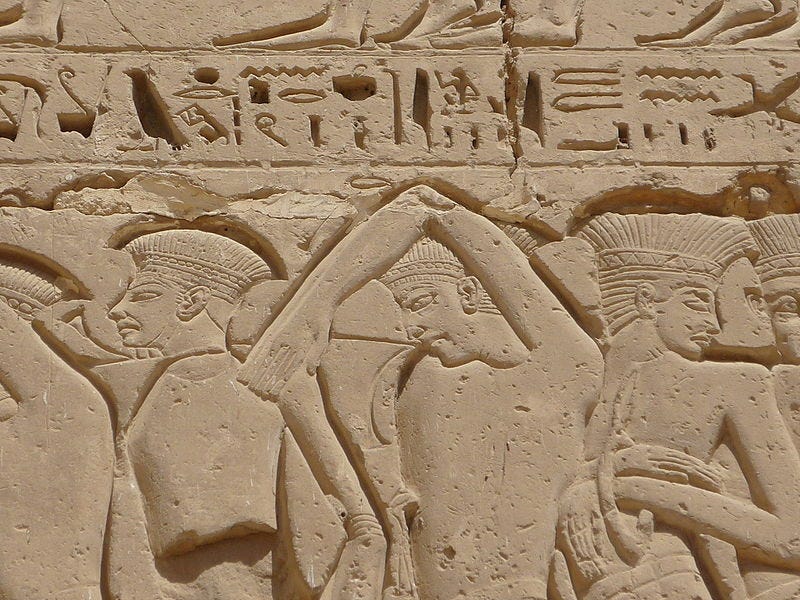
They desolated its people, and its land was like that which has never come into being- Ramses III
The Late Bronze Age (1200 BC) was a period of unprecedented technological progress in human history. Grand cities with sophisticated urban life, interconnected global trade, and a well-developed writing and record-keeping system defined the era.
Within a period of fifty years, it was all gone. Beautiful cities, palaces, and farmlands were destroyed, burned down, and abandoned.
Who was responsible for this mindless devastation?
The guilty party were the Sea Peoples, a group of marauding seafarers who launched a major amphibious assault on cities like it was never seen before. They came from the sea, razed, burned, killed, looted, and then disappeared!
Or so we thought.
While the narrative of uncivilized invaders wreaking havoc on sophisticated settled peoples has captivated the human imagination since time immemorial, the truth was a little more complicated.
We now have a clearer idea of who the Sea Peoples were.
They were not a single group, nor were they the cause of the Bronze Age’s demise. They took advantage of the declining civilizations and may have harbored a grudge against them.
Their alleged unexpected appearance from the sea, laying waste to cities, may not have been so sudden, nor did they disappear into the ocean after looting and plundering.
Who were the Sea Peoples?
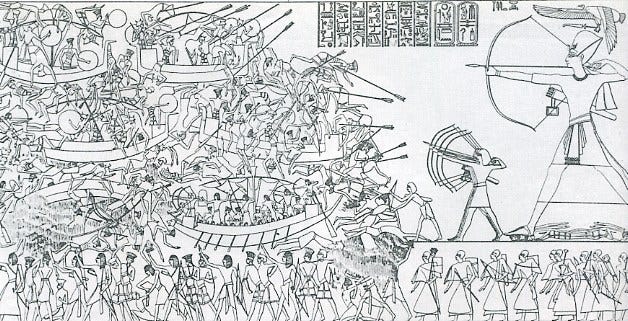
Pharaohs Ramses II (1236 BC) and Ramses III (1198 BC) fought wars against the Sea Peoples, according to ancient Egyptian chronicles.
Egyptians classified them as a confederation of various tribes. Based on their records, Sea Peoples go by the following names:
- Ekwesh: Most likely Achaeans, an ancient Greek tribe referred to in the Hittite sources as Ahiyyawa.
- Lukka: They were the Lycians, a people from Western Anatolia. Later, Greek and Roman sources mention the Lycians.
- Sherden: The Sherden find prominent mention in the Egyptian texts. Historians believe they are related to Sardinians because figurines of ancient peoples wearing armor and horned helmets matching Egyptian descriptions have been discovered in Sardinia. The Egyptians dealt the Sherden a devastating blow, capturing them and absorbing them into their army. They were sent to protect Egypt’s borders.
- Sheklesh: The Sicilian Siculi tribe came the closest to fitting the characteristics of this group of Sea Peoples.
- Peleset: The Peleset, like the Sherden and Lukka, are one of the more well-known tribes. Historians think the Peleset was the biblical Philistine tribe that settled in the Levant. They are most likely from the Greek island of Crete.
- Teresh: This is one of the most intriguing tribes since they may have descended from the famous city of Troy. Troy was a Hittite client state. The epics Iliad and Odyssey by Homer are set against the backdrop of the Bronze Age’s collapse. Is it possible that the residents of Troy’s ruined city took up arms and began conquering other cities?
- Tjeker: This group’s identity is unknown; they may have originated in Crete.
- Denyen: They were from the Danuna, which was close to the Hittite city of Ugarit. There is some disagreement over who Denyens were. According to some historians, they belonged to the tribe of Dan, one of Israel’s twelve tribes. Others believe they were the Greek Danoi, another name for the Acheans.
The names of the Sea Peoples are mentioned in Egyptian and Hittite texts. Ramses III goes on to highlight his brave acts in defending Egypt from the horror of these people who destroyed established civilizations.
But was the Pharoah telling the truth?
Why did they invade the civilizations?
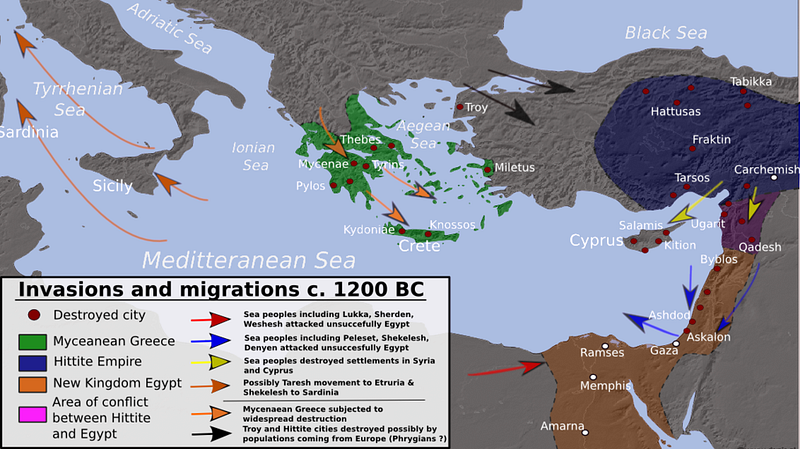
A closer investigation suggests that the Sea Peoples were not unknown to the Mediterranean and Middle Eastern societies. They didn’t appear out of the blue.
If the civilizations were aware of them, as appears to be the case based on Egyptian and Hittite records, we must wonder what motivated them to such actions. How did they muster the courage to attack the well-defended Bronze Age cities?
Earlier speculations about them being marauding bands of invaders have been called into question.
The Sea Peoples could have been vassals of the kingdoms, mercenaries, or refugees fleeing climatic change and food scarcity.
Famines and volcanic eruptions were common in the Late Bronze Age. Such occurrences may have a domino effect.
Famines cause a food shortage, which will harm exports. Lower trade volume means less revenue and, as a result, less money to pay for soldiers and mercenaries. It was only a matter of time until people revolted if they weren’t paid.
Tribes that were utilized in fighting may have betrayed their former masters. Food scarcity also forces people to migrate in search of other regions. Some climate refugees are welcomed, while others are not. Not everyone accepts the word “no” for an answer. Many people take up arms because it is a matter of survival.
According to Egyptian sources, a number of Sea Peoples appear to be from Greece, where the Mycenaean civilization was destroyed.
When a highly sophisticated and urbane economy collapses, many city dwellers flee and become refugees. The bold among them take up arms in the hope of looting and pillage.
Thus, it’s possible that people of crumbling civilizations joined each tribe of the Sea Peoples, and their numbers grew to invade other empires.
What happened to the Sea Peoples after the Bronze Age collapse?
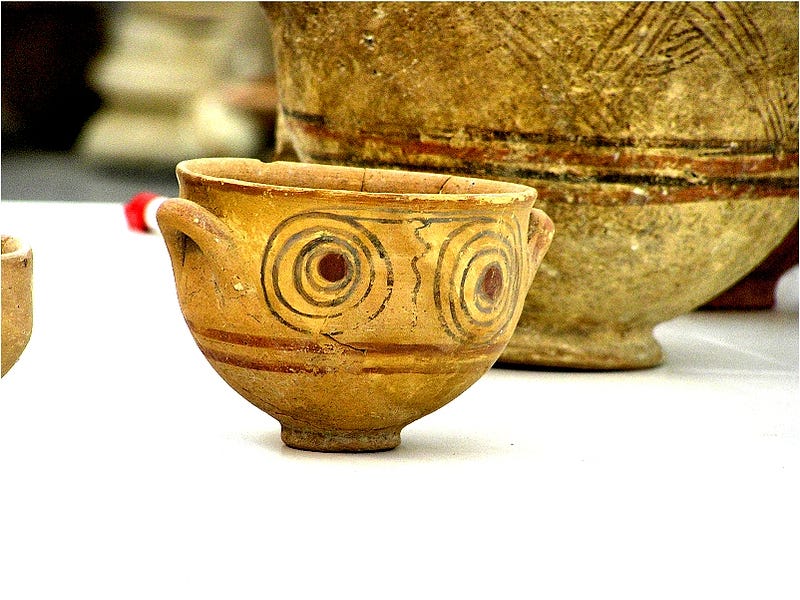
Historians of the nineteenth century painted a romantic image of the Sea Peoples as invaders who annihilated civilizations before disappearing into thin air. While that seems like an excellent plot for an alien invasion movie, it was not the case.
Archaeologists studying the pottery remnants of ancient Philistia, a kingdom in Southern Levant, believe that the Sea Peoples, at least one group, were closely related to the Mycenaeans.
.. in Philistia, the producers of Mycenaean IIIC pottery must be identified as the Philistines. The logical conclusion, therefore, is that the Philistines were a group of Mycenaean Greeks who immigrated to the east … Within several decades … a new bichrome style, known as the “Philistine”, appeared in Philistia - Ami Mazar, Israeli Archaelogist.
Another hypothesis suggests that descendants of Trojans joined the bands of seafaring marauders and later settled in Italy as the Etruscans, who were the dominant civilization of Italy before the rise of the Romans.
Some of the Sea Peoples tribes from Italian islands such as Sardinia and Sicily may have gone back and settled there after accumulating wealth from the collapsing civilizations.
Other theories suggest that because of widespread famines in Anatolia, tribes that were under the Hittites revolted and destroyed the civilization. They did not migrate but remained in the area. Archaeologists are skeptical that the Sea Peoples can be linked to the kingdoms that arose in Anatolia after the collapse of the Hittite Empire.
It is clear that Sea Peoples did not vanish but remained in the region.
The Sea Peoples are one of history's most interesting mysteries. While there is no consensus on their identities, we have clues about who they were. There is better evidence explaining why they attacked the powerful Bronze Age civilizations.
But, unlike in the past, they are no longer viewed as a band of marauders that appeared on city beaches, annihilated them, and then vanished. They eventually established and replaced the civilizations they had destroyed, though it would be a long while before they caught up to the degree of sophistication and urbanization witnessed during the Bronze Age.
Do you have a theory about who the sea peoples were? Perhaps pirates? Let me know your opinions in the comments below.
Migrations are frequently forced by climate change. When people are pushed out of their homeland, several empires are formed. If you want to learn more about civilizations and human migrations, read about the ancient empires of the Steppes in the story below.
Enjoy reading tales of the past? Please support my work by subscribing to Medium using my referral link and gain unlimited access to thousands of stories.
References.
- Cline, Eric H. (2014). 1177 B.C.: The Year Civilization Collapsed. Princeton, New Jersey: Princeton University Press.
- Mazar, Amihai (1992). Archaeology of the Land of the Bible: 10,000–586 B.C.E. Doubleday
- Bryce, Trevor (2005). The Kingdom of the Hittites.
- The Sea Peoples and the Philistines: Penn State.
- D’Amato R., Salimbeti A. (2015). The Sea Peoples of the Mediterranean Bronze Age 1450–1100 BC. London: Osprey.


.JPG)


