
Who Was Rumi: Why People Follow Him as a Spiritual Mentor All Around the World
Rumi is one of the most selling poets in the US and all around the World. Let’s explore the early struggles of Rumi.
Summary:
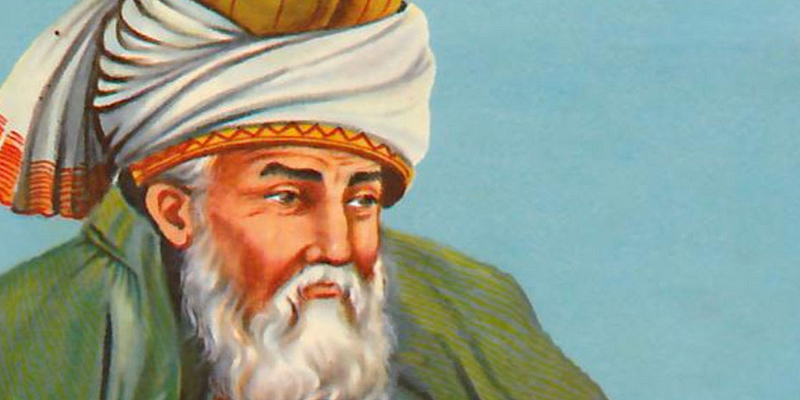
Rumi was born in Khorasan (Region of Afghanistan) on September 30 1207 AD. He lives for 66 years. He spends most of his life as a Bedouin. But he lived more than 20 years in Konya (City of Turkey). He died on December 17, 1273. He buried in Konya ( City of Turkey). He was a great poet, philosopher, and a great mentor. He wrote many poems, gazals, and books in Persian and Arabic Literature.
Early Life of Rumi:
Jalaluddin Rumi was born on September 30, 1207, in Balkh (in present-day Afghanistan). His father, Bahaduddin Walad, was a theologian, jurist, and a mystic, while his mother was Mumina Khatun. They left their town and moved from one country to another because Mongols, Ghengis Khan army invaded in central Asia. First, they went to Mecca, Performing pilgrimage they finally moved to Konya a present city of Turkey. Rumi’s father was a great theologian, a preacher of Islam who’s named Bahaduddin Walad.
Long Journey of Rumi:
Rumi got his early education from his town. Then he went to Aleppo first where he studied at the Madrasa-ye Halawiyya (a college of the Hanafi school of Sunni Islamic law) and where he associated with some disciples of his father. One of his father’s disciples was Sayyed Burhan ud-Din Muhaqqiq Termazi. Termazi was a teacher of Rumi who thought him Sufism and teaches a lot of knowledge about spiritual matters and secrets of the spirit world. Termazi gave him different tasks and he passed all the tasks. Under the guidance of Sayyed Termazi, the Sayyed directed him to do several forty-day spiritual retreats. The Sayyed was said to be so impressed by Rumi’s spiritual state, after completing these retreats, that he declared him to be without equal in the world in the major branches of knowledge as well as of hidden spiritual secrets. After the death of his father, he went back to Konya and take charge of his father’s profession and he became a famous teacher and preacher of Islam. At the age of 24, he proved himself as a great preacher and great mystic in the field of Sufism.
Rumi’s Private Life:
Rumi married at the age of 18. He was very devoted to his two wives. His first marriage was with Gawhar and know him since childhood. She was the daughter of his father’s student. The marriage took place in the town of Laranda (present-day Karaman), which was not far from Konya. It was there, during seven years, that Rumi’s sons, Baha al-Din Muḥammad Walad (known as Sultan Walad) and Salahuddin Muḥammad were born; it was also where his mother, his wife’s mother, and his brother Salahuddin died. The family then moved to Konya in 1228. His wife died there at a young age, and later on, he married a widow (who had a son), Kerra of Konya, with whom he had a third son, Muzaffar al-Din Amir Salim, and a daughter, Malika.
Turning Point in the Life of Rumi:
When Rumi was a teacher or preacher in Konya. He met with a wandering dervish Shamas ud Din Tabraize who was a great Sufi or mystic. Later they became great friends with each other. Tabraize became a spiritual mentor to him. He learns a lot of knowledge about Sufism and philosophy. After that Tabraize went to Damascus, where he was killed by Rumi’s follower due to jealousy from the friendship of tabraize with Rumi. When Rumi learned about his death he feels sorrow. Rumi expressed his love for Shamsuddin and grief at his death, through music, dance, and poems.
or nearly ten years after meeting Shamsuddin, Rumi devoted himself to writing ghazals. He made a compilation of ghazals and named it Diwan-e-Kabir or Diwan-e Shams-e Tabrizi. Thereafter, Rumi encountered a goldsmith — Salaud-Din-e Zarkub — whom he made his companion. When Salaud-Din-e Zarkub died, Rumi befriended one of his favorite disciples named Hussam-e Chalabi. Rumi spent most of the later years of his life in Anatolia, where he finished six volumes of his masterwork, the Masnavi.
Popular Work of Rumi:
Rumi wrote many books on poetry, Gazals, Sufism, and about life.
His books are described here:
Diwan-e Shams-e Tabrizi
Dīvān-e Šams is one of Mawlānā Jalāl-ad-Dīn Muhammad Balkhī’s (Rumi) masterpieces. A collection of lyric poems that contains more than 40,000 verses, it is written in the New Persian language and is considered one of the greatest works of Persian literature.
Dīvān-e Kabīr (“the great divan”) contains poems in several different styles of Eastern-Islamic poetry (e.g. odes, eulogies, quatrains, etc.). It contains 44,282 lines (according to Foruzanfar’s edition,[1] which is based on the oldest manuscripts available): 3,229 odes, or ghazals (total lines = 34,662); 44 tarji-bands (total lines = 1698); and 1,983 quatrains (total lines = 7932).[2] Although most of the poems are in New Persian, there are also some in Arabic and a small number of mixed Persian/Greek and Persian/Turkish poems. Dīvān-e Šams-e Tabrīzī is named in honor of Rumi’s spiritual teacher and friend Shams Tabrizi.
Masnavi
The Masnavi, or Masnavi-ye-Ma’navi (Persian: مثنوی معنوی), also written Mathnawi, or Mathnavi, is an extensive poem written in Persian by Jalal al-Din Muhammad Balkhi, also known as Rumi. The Masnavi is one of the most influential works of Sufism, commonly called “the Quran in Persian”.[1] It has been viewed by many commentators as the greatest mystical poem in world literature.[2] The Masnavi is a series of six books of poetry that together amount to around 25,000 verses or 50,000 lines.[3][4] It is a spiritual text that teaches Sufis how to reach their goal of being truly in love with God.
Rumi is credited with originating the dance of the whirling dervishes:
The dance of the whirling dervishes is a form of Sama, or religious ceremony, which originated among Sufis (Muslims who focus on the inner, mystical dimension of Islam). It’s still practiced by Sufi dervishes of the Mevlevi Order, which traces itself to Rumi and follows his teachings.
In the dance, the dervishes aim to attain perfection and reach God by abandoning their egos and personal desires.
They do this by listening to spiritual music, focusing on God, and spinning in circles
The story goes that he was walking through a marketplace one day when he heard the rhythmic sound of the goldbeater’s’ hammering.
At this point, Rumi heard the words “La ilaha ilallah” in Arabic, which translates to “There is no god but Allah (God),” spoken by the apprentices hammering the gold, and was so overcome with happiness that he stretched out both of his arms and started spinning in a circle.
And with that, the dance of the whirling dervishes was born.
Rumi has many famous admirers, even today:
Despite having died over 700 years ago, Rumi still has a strong following all over the world — probably because of the universal message of his work. Collections of his writings frequently top bestseller lists in the US.
Versions of Rumi’s love poems have been performed by Hollywood figures such as Madonna, Goldie Hawn, and Demi Moore in A Gift of Love, a CD produced by Deepak Chopra.
Philip Glass, an American composer, composed music to accompany Rumi’s poetry in Monsters of Grace, a chamber opera specially organized for the 800th anniversary of Rumi’s birth in 2007.
Recordings of Rumi poems have also made it to the USA’s Billboard’s Top 20 list
Legacy:
Rumi’s popularity has gone beyond national and ethnic borders. He is considered to be one of the classical poets, by the speakers of Persian language in Iran, Afghanistan, and Tajikistan. For many years, he had a great influence on Turkish literature. The popularity of his works inspired many artists, including Mohammad Reza Shajarian (Iran), Shahram Nazeri (Iran), Davood Azad (Iran), and Ustad Mohammad Hashem Cheshti (Afghanistan), to give a classical interpretation for his poems. Rumi’s works have been translated into many languages across the world, including Russian, German, Urdu, Turkish, Arabic, French, Italian, and Spanish.
Death:
Rumi departed from the world on 17th December 1273 AD, in Konya, within the Seljuk Empire’s territory (currently it’s within Turkey). He was buried beside his father in Konya. A tomb named Mevlana mausoleum was built in Konya, commemorating the great Sufi poet. It consists of a mosque, dervish living quarters, and a dance hall. The sacred site is visited by his admirers coming from different parts of the world.
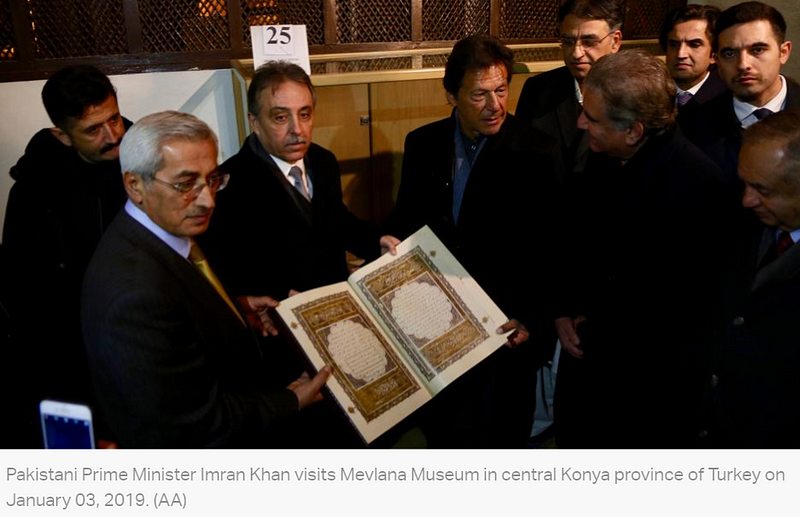
World Most Famous Leaders Visits Rumi Tomb:
In February 2019 Prime Minister of Pakistan Imran Khan former Cricketer of Pakistani Team visit Rumi Tomb in Konya on his special tour to Turkey and he gives remarks about Rumi that he was a great Sufi poet and he is my spiritual mentor and I read his books.
He also said:
“You know how much Muhammad Iqbal, Pakistan’s ideological father, loves his ideological father Mevlana Jalaluddin Rumi,” said Khan, adding that he also read Rumi’s books.
“Rumi is the greatest representative of Sufism,” he said.
Thanks for Reading.