
Who needs the FDA Center for Tobacco Products?
How the regulatory state fails consumers of nicotine and tobacco

Nearly ten years ago to the day, I published an article in the Atlantic detailing one entrepreneur’s struggle to bring a new cigarette to market. This is not a cause that one would expect to get sympathetic treatment in that publication, so it’s a testament to the Food and Drug Administration’s failures to effectively regulate tobacco that it got published there at all. At issue was the agency’s delay in ruling on an application for Hestia cigarettes, a nascent brand started by David Sley.
As I reported at the time, Hestia applied under the “substantial equivalence” pathway, which was supposed to be the easy path to FDA authorization. Basically, it means that new products that are substantially the same as pre-existing cigarettes, raising no new questions of health, should be allowed onto the market after a straightforward process of review. Sley submitted his application in June of 2012 comparing Hestia to American Spirits. As I wrote in my story:
Hestia Tobacco’s report details in minute specification the components of its cigarettes along with those of Natural American Spirit. One page lists the main ingredients, of which there are only two: flue-cured tobacco and water. Additional pages examine the filter and paper, everything down to the decorative ink. A final page looks at construction: Both cigarettes measure 84 millimeters in length and 24.5 millimeters in circumference. They are nearly identical in weight. They are, one might conclude, substantially equivalent.
This wasn’t enough to satisfy the FDA, which asked for much more information, including “a comparison of your new tobacco product and predicate tobacco product with respect to heating source” — in other words, asking how the cigarettes are lit. (With fire, duh.) The process of review was supposed to take a maximum of 90 or 180 days, depending on how one interprets the statute. When I wrote the article nearly a year later in March of 2013, Sley was still waiting along with 3,500 other applicants. The FDA hadn’t authorized a single one of them.
Eventually, in July 2014, the FDA informed Sley that his application was deficient and that Hestia cigarettes would not be allowed to be sold in the United States. I figured that was the end of it, but he recently got in touch to let me know that finally, more than a decade after first attempting to bring a cigarette to market, he had found a path through the agency’s regulatory hoops and was able to legally sell Hestia-branded cigarettes.
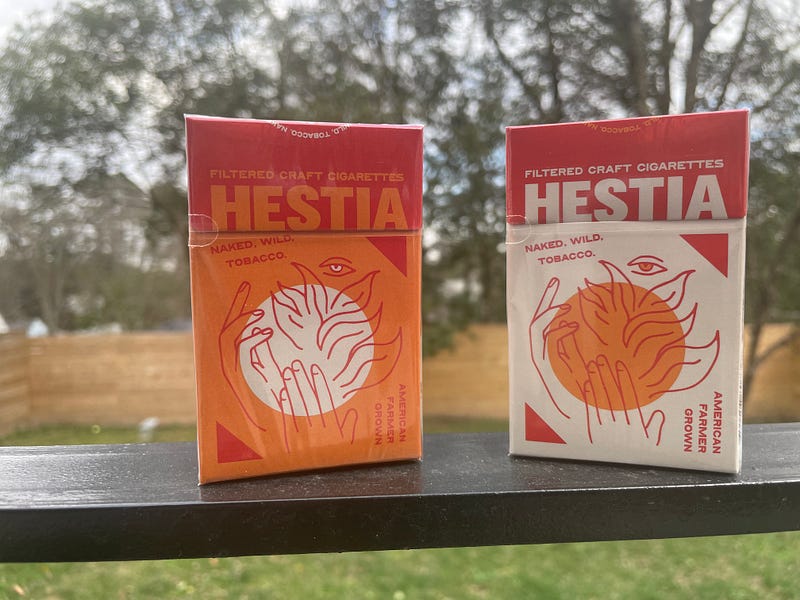
This is good news for David, and as someone who often reports on how overbearing regulators make life hell for small entrepreneurs, I’m happy to see him finally break through. People have mixed opinions on whether cigarettes should be legal at all, but so long as they are legal, companies like Altria and R. J. Reynolds shouldn’t enjoy oligopoly profits on their sale. There’s no justification for giving Marlboro, Camel, and American Spirits the run of every convenience store while banishing Hestia to regulatory limbo. If the FDA had functioned as the law intended, Hestia would have been selling by 2013 instead of 2022. Better late than never.
Admittedly, an indie cigarette maker is unlikely to get as much sympathy as other entrepreneurs I’ve written about, such as the craft distillers whom the FDA threatened with surprise $14,000 fees for making hand sanitizer in 2020. And Hestia is inconsequential for public health; it’s unlikely the small brand will make a dent in sales of Marlboro and Camel, and anyway a cigarette is a cigarette when it comes to health. Yet Sley’s case is worth highlighting given the FDA’s current actions that are destroying makers of e-cigarettes, which are both far safer than smoking and far more capable of competing against Big Tobacco.
You might think that since e-cigarettes are so much safer than combustible cigarettes, that the standards for getting authorized by the FDA would be more attainable. You would be wrong. Because that would be a rational approach to public health. Naturally, the FDA does things differently.
Remember, since regular combustible cigarettes raise no new questions of health, they were supposed to have an easy route to market. Novel products like e-cigarettes have it even harder. Makers of vaping products are required to go through a different pathway, not substantial equivalence but the “Premarket Tobacco Product Application” (PMTA). This requires proving to the FDA that authorizing a product is “appropriate for the protection of the public health” not just for people who smoke or consume nicotine, but for the entire population. In practice, that means that political pressure and moral panic over youth vaping have trumped all concern for the health of current and future smokers, making it virtually impossible to get an e-cigarette past the FDA’s gatekeepers.
The agency has received around 2 million PMTA applications for vapor products. Of these, only about a dozen unique products have been authorized, all but one owned by big tobacco companies and none of them in flavors other than tobacco. (The exception, NJOY, is now in talks to be bought out by Marlboro-maker Altria.) Back of the envelope, the agency has failed to authorize 99.999% of the applications it has received for vapor products. These are now sold unlawfully and the agency has begun issuing fines against small vape companies.
As many advocates of harm reduction have noted, this is a disaster for public health, denying smokers access to products that no serious person disputes offer a much healthier alternative source of nicotine. Such serious people include Brian King, the relatively new director of the FDA’s Center for Tobacco Products (CTP). In a public conversation hosted last week by Alli Boughner and Gregory Conley of American Vapor Manufacturers, King acknowledged that switching from smoking to vaping is beneficial to health and that many people have successfully quit smoking by vaping. Asked directly if the FDA has ever identified a nicotine vaping product that could be more hazardous than smoking, he did not take the opportunity to name any.
The problem is not that regulators don’t know all this; they know it perfectly well when talking about e-cigarettes as a general class of products. The problem is that despite this general knowledge, they have proven unable or unwilling to act on it for 99.999% of the individual products that make up the class. That strongly suggests that the fault lies with regulations and regulators, not with producers of e-cigarettes.
King says that the onus is on manufacturers to provide scientific evidence that their products should be authorized. Ideally, he says, this should come in the form of randomized control trials (RCTs) or longitudinal studies, which he calls the “Cadillac” versions of scientific studies. (He notes that an application is not required to have these, but that any alternative evidence would have to meet a similar standard of rigor.) This is the kind of approach one would expect for a drug approval, but it’s certainly worth questioning whether this is a rational standard for consumer products that make no medical claims, especially when those products draw users away from the combustible cigarettes that kill nearly half a million Americans every year.
There’s a tremendous variety of vaping products using different hardware components, nicotine concentrations, and flavors. It’s ludicrous to expect an RCT for every single one of them, given what we already know about the relative risks of smoking and vaping. The differences between various e-cigarettes are minor when compared to the difference between vaping and setting tobacco leaves on fire to breathe smoke into one’s lungs.
King likes to say that the CTP’s decisions are grounded in science, but part of doing applied science is figuring out the right standard of evidence needed to make a decision. That includes considering the costs of inaction, which in the case of e-cigarettes is all the lives that could be saved by not making it illegal to sell them. Frankly, the FDA sucks at this.
We saw throughout the pandemic that the regulatory state is failing us, such as when the CDC and FDA hindered COVID testing early on. (Even now, FDA processes for authorizing a combined home COVID and flu test are so burdensome that a firm trying to bring one to the United States went bankrupt in the process. Europe already has them.) More broadly, economist Alex Tabarrok has described excessive caution at the FDA as creating an “invisible graveyard” for all the people who have died because of unnecessary regulatory delays of tests and treatments.
Every year, deaths due to smoking in the United States are greater than the number of American deaths caused by COVID in 2020, yet the agency tasked with regulating cigarettes shows no signs of urgency authorizing safer sources of nicotine. Indeed, if the FDA had been given authority earlier, the market for e-cigarettes might never have developed here at all. We know this because the FDA’s response to e-cigarettes in 2009 was to ban their importation, a decision that was thankfully overturned by a federal court. The agency has been failing on tobacco harm reduction from day one.
Responding to criticism of the FDA’s Center for Tobacco Products at a conference yesterday, Brian King is quoted as saying, “It’s easy to criticize from a twitter handle in your mother’s basement.” Perhaps he should consider that the tweeters have a point? (For the record, I live on the top floor of my apartment building.) Similar criticisms are coming from within the King’s own house. Last year, the problems at the Center for Tobacco Products having become impossible to ignore, the FDA requested a review from the Reagan-Udall Foundation. Some of the foundation’s recommendations aren’t far off from what you might see from vape advocates on Twitter, albeit phrased more bureaucratically:
CTP should also consider whether certain products would benefit from the creation of new pathways, established based on current scientifically-supportable standards, to illuminate a route forward for discrete categories of products, and seek statutory change if current authorities are not sufficient to support more streamlined reviews. […] CTP should consider what it can do under existing authorities to streamline the review and submission process for significant numbers of applications in this way, where there is scientific evidence to support such an approach. This may be particularly useful when the risk profile and product attributes of a certain type of product are well-understood, and only limited additional data would be needed for authorization. Subsequent products could then proceed through a less-burdensome submission pathway and CTP could better manage its workload.
Or to rephrase that less diplomatically: “stop pretending that you need two million randomized control trials to sensibly regulate the market for e-cigarettes, you dummies.”
It’s worth noting as well that last year the CTP’s director of the Office of Science, Matthew Holman, quit his job to work for Philip Morris International. Let’s not be naïve; I expect PMI pays better than the FDA. But it’s also plausible that after years of working at the CTP, and weeks after Brian King taking over, Holman figured he’d have better opportunities to advance harm reduction working for a big tobacco company than for a big government agency. He wouldn’t be wrong.
More than a decade into FDA regulation of tobacco and nicotine, it’s hard to make a case that the agency has had any worthwhile impact. And for the independent vape manufacturers who see feds getting sicced on their industry while cigarettes remain freely available, the frustration with the CTP is understandable.
In the near future, the FDA is expected to announce plans to ban menthol and strip most of the nicotine from cigarettes. I’ve written elsewhere about why these attempts at prohibition are likely to bring about their own pernicious unintended consequences. In the meantime, considering the most basic tasks of accurately informing the public and making it legal to sell much safer sources of nicotine, the FDA’s Center for Tobacco Products is an abject failure. Sadly, despite talk of reform as the agency matures, its bureaucratic opacity and hostility to authorizing new products remains substantially equivalent to its early days.
None of this should be surprising given that the law creating the CTP was quietly backed and negotiated by America’s biggest cigarette company to insulate its products from competition and seize the market for innovative alternatives. In that sense, FDA regulation is working exactly as intended. So who needs the FDA’s Center for Tobacco Products? Big Tobacco, clearly. The rest of us might better off without it.