
Who Knows What’s Become of Charlie?
A Syrian Memory
The first thing to say about Charlie was that he had one leg, but what he lacked in limbs he made up for in charisma.
He was stocky, hair slicked back like a ’20s mobster. Greying stubble covered his boxer’s chin. A crutch, the sort of wooden A-frame number you might associate with an eighteenth century pirate, rested under his right shoulder to compensate for the missing right leg. Half-Popeye, half-Long John Silver, you could tell, somehow, that he was mariner.
But the most arresting thing about Charlie — the trait that stopped me in my tracks — was the voice: “HEY CHARLIE, HOW ARE YA?” The words came out loud and jaunty, and in an exaggerated east-coast twang.
“You’re American?” I asked, uncertainly.
“Nah, man. I’m from the Le-ba-non.” He spoke the country with elongated vowels, like a Vietnam veteran in an Oliver Stone film.
Charlie was one of those eccentric characters who seem irresistibly drawn to places of transit. His stage was the southern bus terminal in Damascus, and, on this sultry Syrian afternoon, sat on a bench in the terminal’s echoing ticket-hall, it quickly became clear that I was his chosen audience.
“You want some tea?” he asked, as we settled down to chat. “Lemme get you some tea.”
I went and got us some tea.
It was late 2010.
You don’t always appreciate the significance of an encounter at the time. Only much later, when this place where I’d found happiness descended into misery, did my run-in with Charlie become charged with meaning.
That day in Damascus, shooting the breeze with Charlie, few could have predicted the trauma to come. Within six months, the optimism of 2011’s Arab Spring would give way to malcontent, then rebellion, then full-blown civil war.
For those like me who visited Syria in those calmer days, it’s hard to reconcile recent events with the country of before.
But ask any one of them and they’ll say the same thing: before the guns opened up in Hama — before the chemical attacks and the refugees, the ruined cities and broken lives — there were people like Charlie, welcoming outsiders with outstretched arms.
Over sickly-sweet tea, his story came out in sporadic non sequitur. He was originally from Lebanon, and it was there that he’d obtained the nickname, together with the aptitude for mimicking a New York accent, while working with US navy-men in a peacekeeping force deployed in Beirut after the Lebanese civil war.
It was there, too, that he’d forfeited the leg, though through accident or conflict he didn’t say.
Now, so far as I could tell, he just hung around the buses, striking up random conversation with the handful of travellers passing through.
You knew the shtick was well-worn. Charlie’s side of our half-hour chinwag was as much performance as conversation, punctuated as it was by that peddler’s patter the Arabs excel in — a comedy salesmanship honed in the bazaar.
He had the most expansive handshake I’d ever shared, a great wheeling haymaker, employed with regularity and dispatched each time with a devilish grin.
Occasionally, he interrupted his elliptical biography to deploy his catchphrase at other backpackers — “HEY CHARLIE, HOW ARE YA?” The words rebounded across the cavernous ticket-hall in that voice so out of time and place that the tourists recoiled in confusion, which just broadened Charlie’s smile the more.
Yet there was also a sincerity about Charlie — a warmth and a curiosity about my very different life: Where was I from? Where had I been? What did I think of Syria?
It’s hackneyed to the point of banality for a tourist to describe the people of a host country as friendly. But you have to understand, Syria took the prize — this generosity of spirit had become the hallmark of my journey.
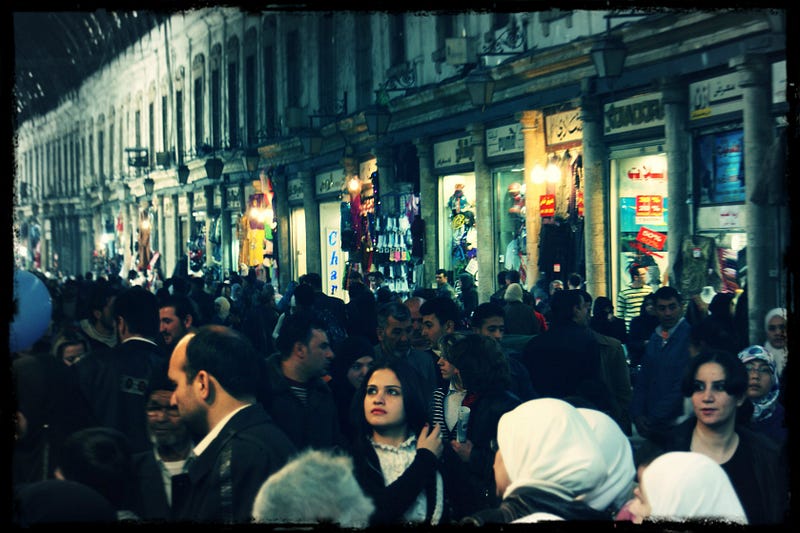
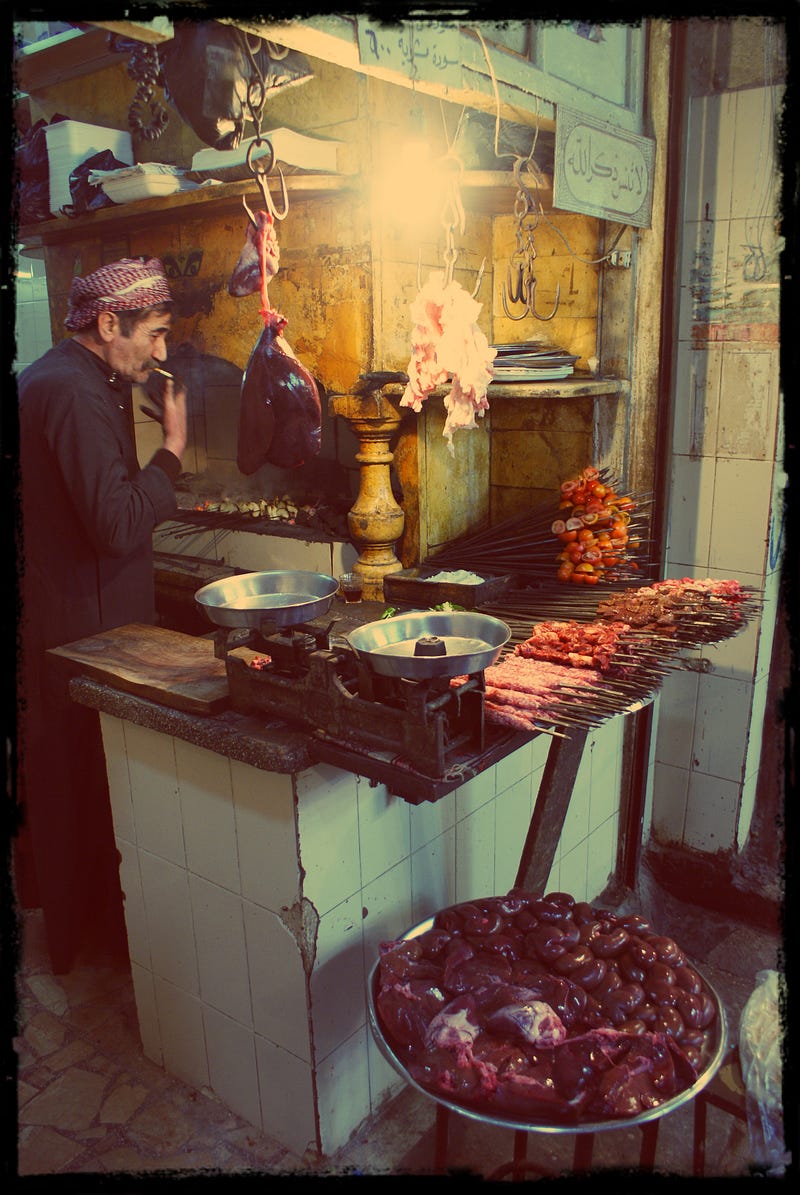
Damascus then was a place where markets teemed and children played in mosque courtyards before dusk prayers. In Aleppo’s medieval souq, its labyrinthine thoroughfares since destroyed, textile-merchants camp as cabaret dames plied me with shocks of cashmere shawls, as the sweet-sellers walked by with their barrows laughing.
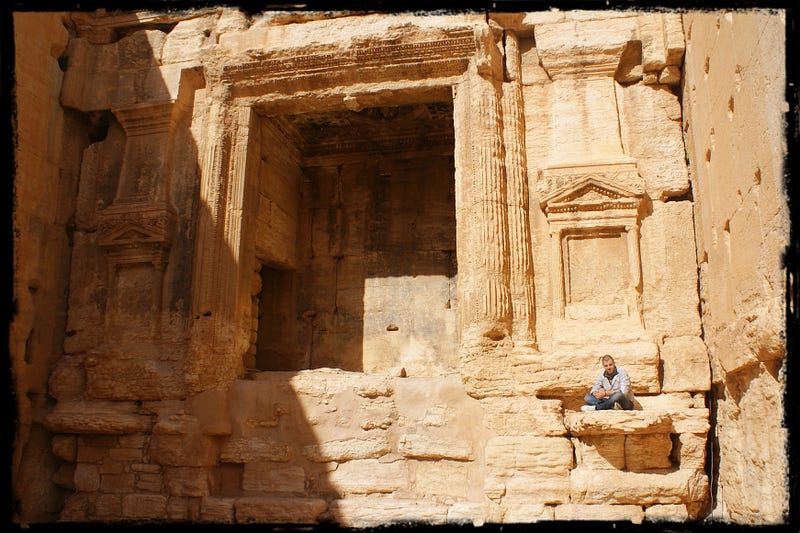
In Palmyra, the ancient city which, at the time of writing, risks total destruction at the hands of iconoclastic ISIS fighters, a guide had declined payment for his expert commentary about the Temple of Bel upon discovering that we supported the same English football team. And on the ruin’s periphery, I’d joined boys to play football in the dust, as the camels they’d ridden there loitered impassive about the sandstone colonnades.
I’d loved it all. It was the Islamic world you cannot apprehend from afar, when the drip-feed of atrocity can render the Middle East one-dimensional — a basket-case land of violence and sectarianism. Few countries I’d visited better epitomized the author Aldous Huxley’s dictum:
“To travel is to discover that everyone is wrong about other countries.”
Now, the places I visited are rubble and dust. The people I met — those numberless strangers who had walked up to me smiling, hand on heart, to say “welcome to Syria” — are victims of war, buried by the bombs or part of the Diaspora, fleeing west.
Who knows what’s become of Charlie?
My memory of him has become a valediction — the moment the Syria I encountered disappeared into the fog. This man, this smirking street comedian, was my last interaction with a country on the cusp of Armageddon.
“Let’s putcha bags in here,” he said. As the evening bus to the Jordanian capital Amman had pulled onto its stand, he’d insisted on lugging my rucksack across the concourse, in spite of his disability.
Then a final wheeling handshake. SLAP! “See y’around Charlie.” He turned away without asking for a single Syrian pound.
As the bus rattled out of the terminal the sky in the west was tinged with red. But as Charlie stood on his one leg and waved me off, neither of us had an inkling of the events it portended — the horror that was about to engulf him and the land he called home.
Syria’s civil war is now in its fifth year. The UN estimates that 7.6 million people have been internally displaced, while over four million more have fled the country, precipitating the worst refugee crisis seen in Europe since the Second World War. The conflict is believed to have claimed over 200,000 lives, 50,000 of them children. You can donate to the humanitarian relief effort at:


