
How We Move Beyond Business as Usual to Reduce Climate Risk

Much of March, rightfully so, has been focused on Covid-19. This is a clear and present danger to our well-being and health. As we get this under control, which looks to be another couple of months, we should not take our eye off of a more significant danger. Climate change has and will continue to result in significant extreme weather events. These extreme weather events wreak significant economic damage and community disruption. Covid-19 is a significant public health crisis, but unlike climate change, it is not impacting our food and water supply, nor our infrastructure. There are plenty of resources, although maybe not properly allocated or developed, to deal with Covid-19.
Climate change will bring the disease vectors, which will stress our public health system. It will also significantly increase risks to our infrastructure, food and water supplies. The ability to respond to Covid-19 like disasters will be significantly reduced. Consider dealing with Covid-19 in the aftermath of a Cat 4 hurricane or a multi-year drought in the nation’s bread basket. You think we have a toilet paper shortage now, consider the availability of TP under future wildfire forecasts. Relatively speaking, the goods on store shelves have been restocked fairly quickly.
Let’s Run Some Scenarios
To reduce this risk, organizations and governments need to start planning for current and future events. A key tool for this is scenario analysis. Scenario analysis allows for the development of multiple future states and helps to shape thinking around how to best deal with these future states. In the electric power sector, several utilities have started to run scenarios, unfortunately, most are focused on transition risk, i.e. how to respond to decarbonization of the power market. Only a handful are looking at physical climate risk. This is the risk to the generation, transmission and distribution assets that ensure the power stays on. Up until recently, it has not been easy to run physical climate risk scenarios. However, the data and models are now maturing to where there is becoming no excuse to run these models. The Houston Advanced Research Center (HARC), my employer, has developed a new climate risk analytics program that allows for the development of climate risk scenarios, with a specific focus on the energy sector.
Scenario Analysis to Reduce Climate Risk
Fortunately, the Task Force on Climate Related Financial Disclosures (TCFD) has developed recommendations for climate risk reporting and scenario analysis. These recommendations allow organizations and governments to develop scenarios to better understand the strategic, economic and societal implications of climate risk and the opportunities. The scenarios allow stakeholders to look at a multitude of possible end states under a variety of constraints and assumptions.
With these scenarios, organization can better understand the nature of the specific climate risks it will face. Further, whether a business or government, it is possible to see how risk and impact will differ across communities, departments, market sectors and sub-sectors (upstream, operations and downstream). This information allows for stakeholders to see what market sectors or communities benefit and which ones do not, allowing for reallocation of resources.
What is the engine for a physical climate risk scenario? They are the representative concentration pathways (RCP) models. The results of these global climate models that show response of Earth’s environment to changes in GHG concentrations. The results of these models are down scaled. With this down scaled data, scenario developers are able to consider questions such as what type of physical impacts there may be, consequences if physical climate risk becomes more severe and when, where, and to whom will this risk be seen/felt.
The development of scenarios allows us to look at a variety of potential states. For example, we can look at different “degree” scenarios. How does the world function if we let the temperature go past 4 degrees vs. a world where temperature stays at 2 degrees or even at 1.5 degrees. In the call out below are examples of different scenarios to consider.
Business as usual (BAU)— Representative Concentration Pathway (RCP) 8.5 — exceed 4 degrees
Some mitigation — emissions increase to 2080 and then fall — RCP 6.0-likely exceed 2 degrees
Strong mitigation — emissions stabilize at half today’s levels by 2080 — RCP 4.5 — more likely than not to exceed 2 degrees
Aggressive Mitigation-emissions halved by 2050 — RCP 2.6 — not likely to exceed 2 degrees
2 degree scenarios that are public, independent body, regularly updated and visualized
Scenarios should be plausible, consistent, distinctive, relevant and challenging. The TCFD recommends that those starting out take a more qualitative approach to scenario analysis and then tighten it up with more quantitative factors as the data becomes more available and an organization becomes more familiar with the process.
Further, it is key to be transparent in assumptions and variables consider in scenario analysis, i.e. inputs, assumptions, outputs, methods. It must also be made clear how sensitive the results are to these assumptions. Documentation of the analysis is vital for those who will be utilizing the scenario for planning efforts or who will look to run additional scenarios. Stakeholders must understand how the analysis was ran to help ground truth it a bit.
Some good scenarios to assess the validity of your scenario include those developed by International Energy Association (IEA) and the Inter-governmental Panel on Climate Change (IPCC).
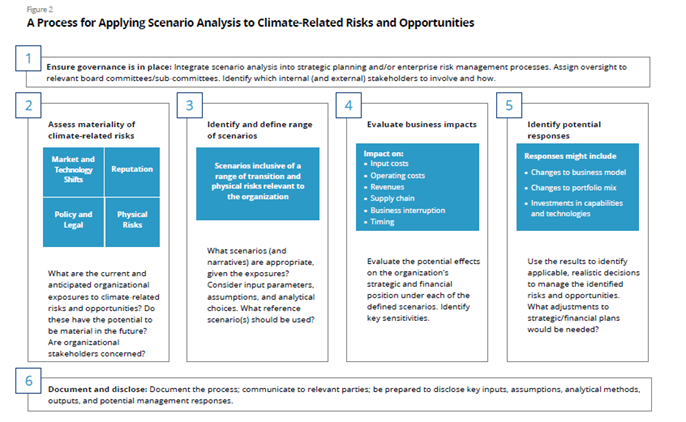
There are six steps for scenario planning recommended by TCFD. They include (see chart below from TCFD):
- Ensure governance is in place;
- Assess materiality of climate risks;
- Identify and define range of scenarios;
- Evaluate organization impacts;
- Identify potential responses;
- Document and disclose
What to do with the analysis?
There are a variety of activities that can be done in association with the scenario analysis. One key item is to inform future planning. This may include:
- Evaluation of potential resilience options to reduce risk and increase opportunities;
- Assess how current planning efforts perform under different scenarios;
- Adjust strategic, community and financial plans
We face a lot of uncertainty at this time. With Covid-19 our focus is largely on the here and now. As we move out of this crisis, it is imperative that we take the steps necessary to consider short, mid and long-term risks. Reducing climate risk and improving our resilience requires forward-looking risk management, planning and hedging strategies. Without effective scenario analysis that is taken seriously, understood and fully incorporated in our strategic and community planning efforts, COVID-19 may only be the beginning.