
Blue View — Red View
Who Gets to Speak? Or Not?
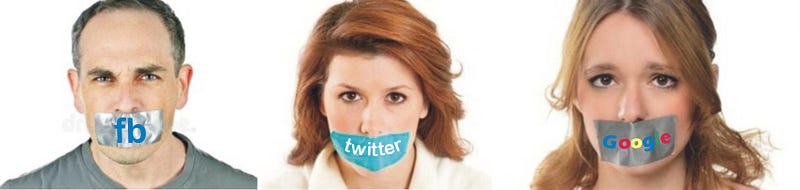
Does social media have a right to silence us?
The Blue View — By DJB
As each member of the US House of Representatives rose to speak during the impeachment discussion, it became clear that a lot of what they were arguing about was who gets to speak, and what they are allowed to say.
There have always been heated discussions about what “free speech” really means, and what are its limits. This discussion has become much more complicated due to how much “speech” these days is done over social media platforms. Especially because it can be done anonymously or behind a pseudonym. If someone threatens to rip your ears off on Twitter, is that a serious threat? Are bots that relay and amplify a message a thousand times, and thereby distort its importance, free speech?
I have been a member of the ACLU for as long as I can remember. I was a kid when my father tried to explain to me why some of his friends lost their jobs because they knew someone who Joe McCarthy mentioned on TV. No trial, just rumors, but McCarthy was a Senator who thought he could say anything he wanted, true or not.
Recently, a lot of “conservatives” have been complaining that their voices have been silenced by the major social media platforms. Obviously, that all came to a smashing climax last week when Trump, and so many of his radical and Q-Anon followers were thrown off the major platforms, and Parler was shut down by Amazon.
There were reasons why that happened that those “conservatives” don’t like to admit. The first is that their posts had been questionable for years because they had a marginal, if not totally oppositional relationship with the truth. Are lies free speech? Mostly yes. But when they get to be dangerous and threatening they can cross the line. The second reason was that after the raid on the Capitol, the messages on those sites clearly crossed that line. There were many messages about how to make bombs, what weapons to bring, and whom to target.
The most important reason that these sites got shut down is that private businesses, even big corporations, can determine who they want or don’t want as customers. They don’t have to give everyone free speech. Facebook, Google, and Twitter can establish their own guidelines, put them in the contract, and decide when someone crosses the line. Corporations don’t have to allow everyone and anyone to say what they want. That’s why, in a narrow decision in 2018, the Supreme Court allowed Jack Phillips to decide to not bake a cake for the wedding of a gay couple. It was his business, and it was his choice. The choice cost him a lot of customers, as they decided that they didn’t want cakes from someone who discriminates. That too is free speech.
My naive opinion, as I am not a lawyer, and lawyers will argue differently depending upon who is paying them, is that anyone can say anything he or she wants, no matter how true, how ridiculous, or how wise and transformational. But, the limit is that they can’t say anything that leads to harming or restricting the rights of others. The “free speech” described in the Bill of Rights applies to the government. The US Government cannot limit the speech of a communist, a racist, or anyone who has anything gross or disgusting to say until it becomes a danger or a threat. I can say I hate Trump and I wish he would die, but I can’t say “Let’s all get together and devise a plot to kill him.”
Often, where the line is drawn is difficult to determine. Most other developed nations have more restrictions about hate speech. The hallmark of dictatorial governments is when there are restrictions or punishments for open political criticism. That is probably true in half the countries in the world at this time. The United States has almost always made a point of allowing all of the yahoos, rabble-rousers, and prophets to speak freely. Sometimes they turn out to have brilliant insights.
Now, President Trump has been impeached again for using words to incite a riot and threaten the workings of Congress, and the lives of the people in Congress. He has hired Alan Dershowitz, a guy who needs to be in the spotlight almost as much as Trump, to defend him. Dershowitz is going to say that near the end of his battle cry, Trump told the crowd to go peacefully.
Again, my naive opinion is that saying Trump did not incite the crowd is like saying the rain didn’t cause the flood because some of the water went down the drain. Trump has been yelling “Stop the Steal. Fraud. The Democrats are evil. Unfair to me. Fight to stop the count. Fight for your freedom,” and many more statements like those for months, beginning before the votes were taken and counted. He did nothing to contradict Giuliani when he told the crowd this was a “trial by combat.” There is a recording of Giuliani trying to tell a senator to do anything he could to stop the counting of the Electoral Ballots.
Also, Trump was the president of the United States while he was saying these things. That should carry some extra responsibility. But, it is clear that even after all these years, and thousands of obvious lies, there are still some people who believe what he says. That is the real danger.

Who Gets to Speak? Or Not?
The Red View — by Jim West
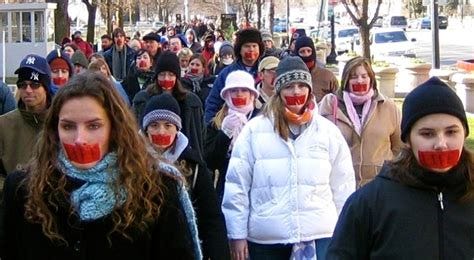
The answer in a fair and just world is… everyone. Everyone gets to speak. It is everyone’s right for merely being born. The Declaration of Independence calls it “inalienable,” that which cannot be surrendered or transferred. Freedom to speak is a right endowed by our Creator and a critical measure of our Liberty. We all understand that we can’t incite actions to harm others, but it is morally wrong to silence political speech, period. And that is precisely what it going on as Facebook, Twitter, Google, and YouTube continue to censor one political party over another.
Does “free speech” mean we can say offensive things? Yes it does. Biden can say, “If you don’t vote for me, then you ain’t black.” Clinton can say, when he was referring to Obama, “A few years ago, this guy would have been getting us coffee.” When Lyndon Johnson secured a plan to “buy” votes from Black Americans by making them dependent on government welfare, he said, “I’ll have those n*gg*rs voting Democrat for the next 200 years.” And former Democrat Senator Robert Byrd can say, “I am a former Kleagle of the Ku Klux Klan in Raleigh County … The Klan is needed today as never before and I am anxious to see its rebirth here in West Virginia.”
And when Donald Trump says, “Let’s make America great again,” that too, may be offensive to some. Do we have a right to be outraged? Certainly, if you’re so offended. You also have the right to change the channel or walk away or make judgments about what’s right or wrong. But you don’t have the right to silence even your enemies for speaking.
In 1977 the ACLU represented the Nazis in a landmark case when the city of Chicago and a smaller, predominantly Jewish town of Skokie, refused permits to allow the Nazi Party to demonstrate in parks. After many road blocks and related court cases, the US Supreme Court ruled in favor of the Nazi Party.
So on July 24, 1978, with the assistance of 1,000 police officers to keep the peace, not from the Nazis, but from angry counter protesters, the Nazis had their little assembly. They wore swastika armbands, waved Nazi flags and spoke their white supremacist words into open air. And why? Because free speech also includes hate speech.
If you’re still puzzled as to why the ACLU would even represent the Nazi Party, let me quote from the pamphlet that was released shortly after the Skokie — Nazi case was settled, due to massive resignations in ACLU memberships:
Because we believe that the constitutional guarantees of freedom of speech and press would be meaningless if the government could pick and choose the persons to whom they apply. The ACLU’s responsibility — since its founding in 1920 — has been to make sure that all are free to speak, no matter what their ideas.
Furthermore, in a prior case (1969), the ACLU represented a KKK leader in Ohio. In that case the US Supreme Court decided that even a hate group who can profess that “all black Americans need to be sent back to Africa” is protected free speech. You and I would consider this offensive, and some might conclude this language is inciting violence, but the Supreme Court would disagree. Unless the speech “is directed to inciting or producing imminent lawless action,” then it cannot be restricted or punished. It is not enough if the audience simply believes the rhetoric. The speech must result in illegal action to be classified as inciting violence.
So when President Trump said on January 6th, “I know that everyone here will soon be marching over to the Capitol building to peacefully and patriotically make your voices heard,” not only is this NOT hate speech, it is NOT inciting violence in any way, and is therefore no cause for impeachment.
And DJB’s point about prior Trump language to “stop the steal” or “fight to stop the count” does not apply because even if someone considers it inciting violence, it was not imminent and no violence occurred at the time.
But these court cases are examples of the government limiting free speech. The Constitution clearly says that Congress [government] “shall make no law…abridging the freedom of speech.” But what if a private company is abridging free speech? Is that allowed? Should a private company be allowed to silence others?
DJB brings up the case with the Colorado baker who refused to commemorate a gay wedding because of his religious beliefs. The US Supreme Court ruled in favor of the baker in a 7–2 decision [not exactly a ‘narrow decision’]. It was actually the gay couple who was violating the free speech and religious liberty of Jack Phillips, the baker.
Regardless, the example doesn’t apply because the gay couple does not have a Constitutional right to have a cake made for their celebration. The law does not demand Phillips to express the free speech of others on his cakes if he doesn’t want to. It’s on the gay couple to express their own free speech, or to find another baker who doesn’t mind expressing it. So yes, in that case, and in many others, a business has the right to choose or refuse who their customers might be.
On the other hand, Silicon Valley dictators are actually and directly censoring the free speech of citizens who simply want to talk and share ideas. These companies are choosing which speech to allow and which to deny, regardless of their so-called “company policies.” We know this is just an excuse because they are very inconsistent.
Right now, the world’s most hated and oppressive dictators can speak on all big tech platforms, but not the leader of the world. Right now, Muslim leaders are allowed to voice their hatred and threaten violence toward Israel and Jews, and that’s ok. During the Michigan hearing over election fraud, state representative, Cynthia Johnson, posted on YouTube, “Warning to you Trumpers. Be careful. Walk lightly. And for those of you who are soldiers, you know how to do it….Make them pay.” Also, Twitter had no problem posting these 25 incidents where political, media, and Hollywood celebrities called for harassment, assault and assassination. But Trump can’t challenge the election or encourage patriotism? Is there no double standard here?
There is plenty of evidence of unequal treatment by big tech regarding political speech and “inciting violence,” and I was hoping to find court cases to make the point that it’s not allowed. But alas, all the cases I found were not about private companies, only governments treating people unequally.
So perhaps, this is where Section 230 of the Communications Decency Act comes in, which was created in 1996 to encourage internet growth and protect internet companies from being sued for offensive content posted by third parties, in particular, pornography. How that protection gives these platforms the right to silence their conservative users is beyond me, but it seems the inconsistency hasn’t been challenged in court. (Are there some lawyers who can help us in the comments?)
This is why Trump was hoping to reform Section 230 with an Executive Order last May. But the wheels of justice moved too slowly to make a difference in the 2020 election, or soon thereafter, when election irregularities were flying about.
One thing is for certain, though, the censoring of conservatives on Facebook will not help the cause in Facebook’s dual antitrust cases filed by the Federal Trade Commission and Secretaries of State. Likewise, Parler is suing Amazon for antitrust violations and breach of contract, but not free speech violations (perhaps because there is no precedent for it). The fact that any of these social media companies can silence Americans and the president himself is a solid argument that these companies are too big and too powerful. They need to be broken up.
What needs to happen regarding censorship by Silicon Valley oligarchs, is there needs to be a legal case that sides with the American people regarding free speech. Private companies do not have a right to silence anyone just because they’re a private company. I don’t get to silence you. You don’t get to silence me. The government doesn’t get to silence anyone. Phone companies are not be allowed to shut off service because of our speech. Neither should these big tech platforms.
Imagine the harm that would come to our Democracy if all of our information only came from one side of the isle. Why, it would be like living in Russia or China, except our media isn’t controlled by the government — they censor us voluntarily. If you don’t understand what I’m getting at, consider this logic. To everyone who believed Trump was a dictator — a dictator can’t be censored. The ones doing the censoring are the dictators. Which side are you on?
Tyrion Lannister in Game of Thrones said it well, “When you tear out a man’s tongue, you are not proving him a liar, you’re only telling the world that you fear what he might say.”
Update on Jack Phillips, the Colorado baker: After he won his case before US Supreme Court, the state of Colorado filed another lawsuit against Phillips only 30 days after, this time for refusing to bake a cake for a transgender reveal party. So the abuse continues in defiance of the SCOTUS. Whether it’s this case or draconian and unscientific Covid-19 lock-downs, why is it that the biggest bullies in government are almost always Democrats?


