Whispers of Life and Echoes of Mortality: Understanding Our Place on Earth
Have you ever pondered the true essence of existence on this harsh planet? Dive into a narrative that unravels the beauty in life’s fleeting moments and the stark reminders of its end. Find solace in stories that connect us to the tiny heartbeats around us and discover the poignant truth of our earthly journey.
✨Don’t forget to 👏 and comment💬 to share your views/thoughts. ✨

The Enigma of Existence
There was a hush, a pause in the world’s breath, as I found myself perched on a weathered rock, gazing out where the ocean kissed the sky. It was a canvas of contemplation, the vast blue expanse both soothing and overwhelming. It’s in moments like these — where the heartbeat of the earth seems to synchronize with one’s own — that the grand enigma of existence bubbles to the surface of our thoughts.
I recall a particular twilight, the sky blushing from the day’s fervent whisperings. There I was, insignificant in the grand tapestry of nature, yet filled with an acute sense of being. It was then that the question unfurled within me, like a sail catching the wind: “What is my purpose here?”
The beach was silent, save for the rhythmic chant of waves whispering to the shore. It’s said that life is not measured by the breaths we take, but by the moments that take our breath away. As the hues of the sunset painted an ephemeral masterpiece, I realized that these moments of wonder are the universe’s gentle nudge, a reminder that there’s more to existence than the eye perceives.
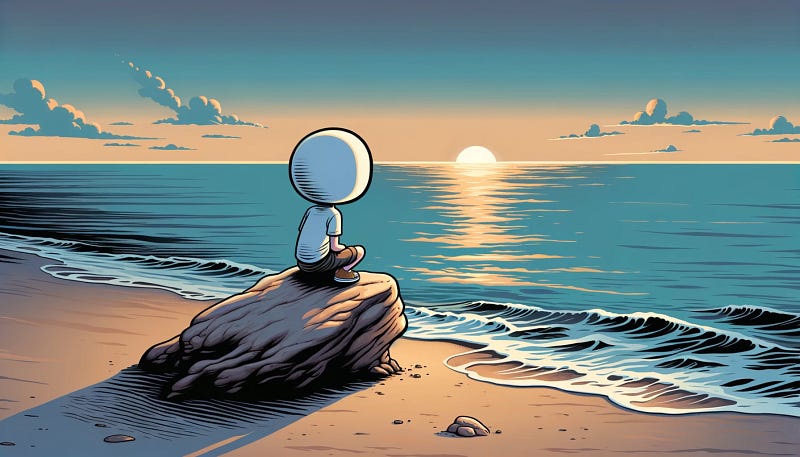
There’s a quote by Ralph Waldo Emerson that says, “The purpose of life is not to be happy. It is to be useful, to be honorable, to be compassionate, to have it make some difference that you have lived and lived well.” As the last glimmer of light sunk below the horizon, Emerson’s words echoed, mingling with the ocean’s chorus, and I understood that perhaps our purpose is woven into the very fabric of these contemplative silences.
The Onyx-Eyed Sentinel: A Seagull’s Last Stand
Amid the ebb and flow of the tide, I stumbled upon a sentinel from the skies — an onyx-eyed seagull. Its feathers were matted, its stance unsteady, and its plight painted a stark contrast against the golden sands. The beach, once a place of carefree joy, now held a tableau of life’s fragility.
It’s strange how the distress of another creature can crack the shell of our own existence, revealing the soft, vulnerable life pulsing within. As I approached the ailing bird, its gaze met mine — a silent plea in the depth of black. The raw vulnerability of life was laid bare in that moment, a mirror reflecting our collective struggle against the inexorable march of time.
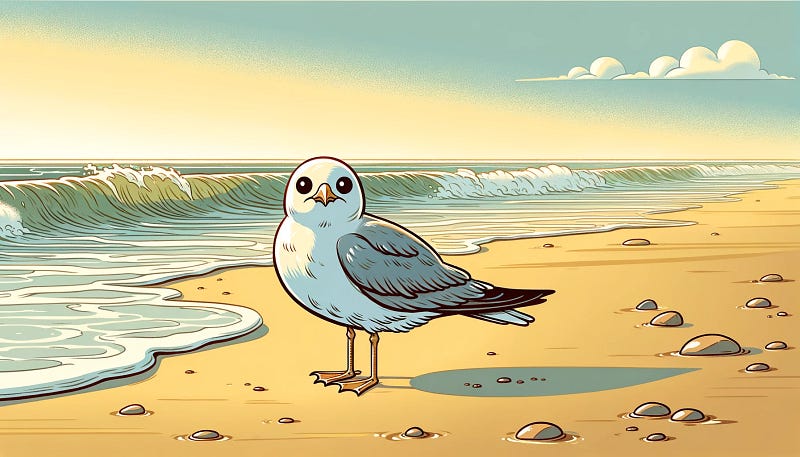
In the seagull’s struggle, I found an unexpected kinship. As the poet Maya Angelou once mused, “We are more alike, my friends, than we are unalike.” And isn’t that the truth? The bird’s battle was not just a struggle for survival but a testament to the resilience that threads through all living things.
Assisting the creature as best I could, I was reminded of the words of Albert Schweitzer, “Until he extends his circle of compassion to include all living things, man will not himself find peace.” And as I watched the seagull eventually take to the skies, the beach was no longer just sand and sea; it had become a place where the whispers of life’s delicacy and our echoes of shared mortality danced in the salt-laden air.
Of Magpies and Mourning: The Rituals of Birds
Once, on a day splashed with the melancholy grays of an overcast sky, I found myself witnessing a procession most peculiar. Magpies — birds known for their stark black-and-white attire — were gathered around what seemed to be one of their fallen. The scene was eerily reminiscent of human mourning; a quiet, somber gathering, a communal acknowledgement of loss. Shakespeare once said, “When beggars die, there are no comets seen; The heavens themselves blaze forth the death of princes.” It seemed that in their own way, without the fanfare of celestial bodies, these magpies paid homage to their lost companion.
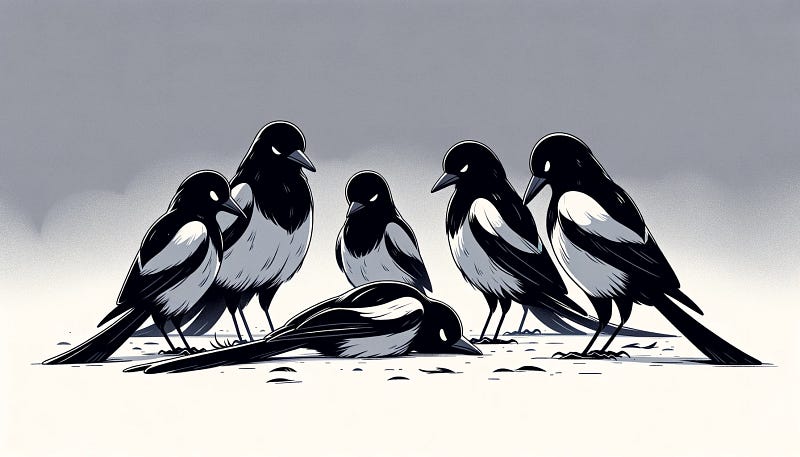
In human terms, we gather, we speak words of love and loss, and we comfort each other. These birds, with no words to whisper, no hands to hold, still stood in solidarity with their fallen kin. As I watched, it dawned on me: grief is a universal language, not confined to the tongues of humans. The rituals may not mirror each other in form — there were no eulogies or flowers here — but the essence was uncannily similar. The solemn silence among the magpies was as powerful as any spoken condolence.
In observing this, I remembered the tender words of poet Rumi, who reminded us that “The beauty you see in me is a reflection of you.” In the magpie’s vigil, could we not see our reflection? For in the face of death, be it under the roof of a chapel or the canopy of the sky, the heart feels the same pang, the soul recognizes the familiar hymn of farewell.
Ants, Aggression, and Altruism: The Paradox of Coexistence
It was a sweltering summer afternoon when I stumbled upon a miniature battlefield. Ants, those paragons of industry, were locked in a fierce struggle. I was reminded of the words of the Dalai Lama, who spoke of compassion and cooperation, yet here I saw the law of the jungle in its rawest form, aggression in the name of survival. But amidst the chaos, a startling scene unfolded. One ant, caught beneath a leaf, was freed by another — was this not altruism? Aggression and cooperation entwined in an intricate dance.
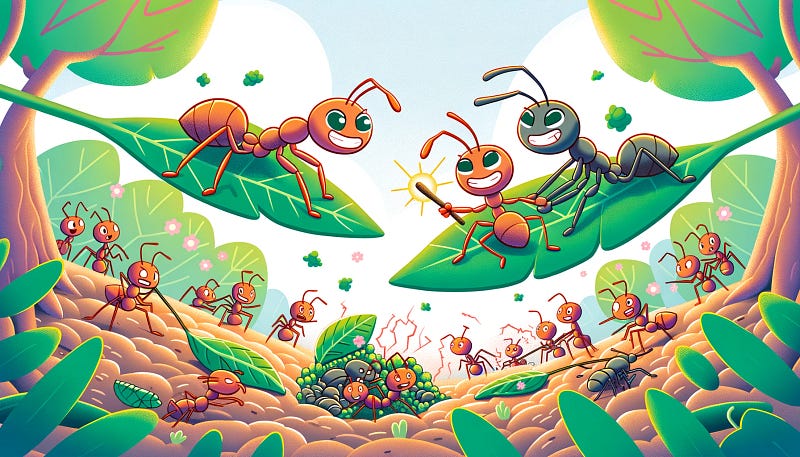
This paradox is not unique to ants nor to humans. Consider how we, too, wage wars and yet sing songs of peace and brotherhood. Within our own nature lies this duality. As Leo Tolstoy mused, “All that is necessary to make this world a better place to live is to love — to love as Christ loved, as Buddha loved.” Is it not remarkable that even in the insect world, one can glimpse the shadows of both conflict and compassion?
That afternoon, nature whispered a complex lesson — a reminder that the world is neither black nor white but a canvas of grays. In the hustle for survival, creatures both great and small may wield weapons of war, yet also extend an olive branch. Perhaps this is the paradox not just of coexistence, but of existence itself.
The Unsentimental Wild: D.H. Lawrence’s Perspective
D.H. Lawrence once penned, “I never saw a wild thing sorry for itself. A small bird will drop frozen dead from a bough without ever having felt sorry for itself.” Life, in its most primal form, unfolds without the drama of human emotions. This statement, stark and raw, nestled its way into my contemplations, whispering the stark difference between human beings and the rest of nature.
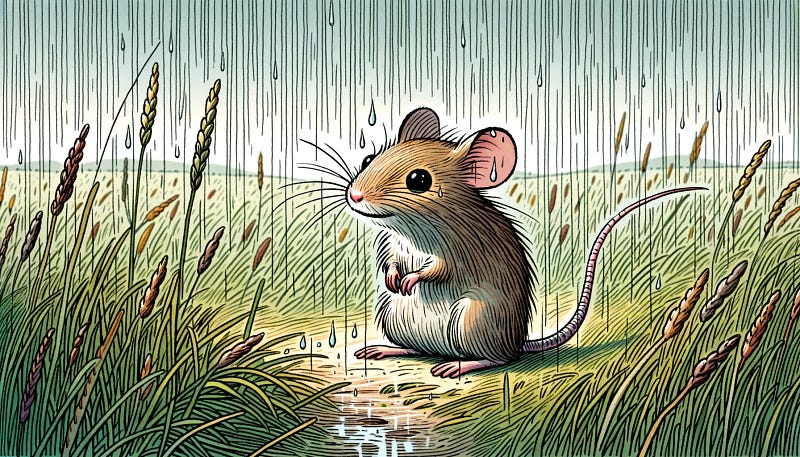
In my own stroll through life, Lawrence’s words often return to me in moments of self-pity or sorrow. I recall, on a day dampened by drizzle and the weight of my own worries, stumbling upon a field mouse in the midst of a meadow. Its tiny heart was a drumline of survival, unclouded by worries of its own mortality. It was a creature driven by necessity, not contemplation, embodying Lawrence’s observation to the fullest.
Life, it seems, has an intricacy woven into its simplicity. It is a tapestry of survival, instinct, and the unadorned will to exist, free from the complexities of human sentiment. This reflection brings a sense of liberation. To live like the wild — without the constraints of sorrow for the existence we lead — is to embrace life in its purest form.
Transience and Permanence: The Beach’s Lessons Revisited
Once more, my path led me to the beach of my yesteryears, a place where the sands had often cradled my thoughts and dreams. The ocean remained, its waves murmuring ancient secrets, yet each grain of sand seemed to hold a new tale. In the dance of the tides, I witnessed the eternal cycle of change — water shaping shore in endless rhythm.
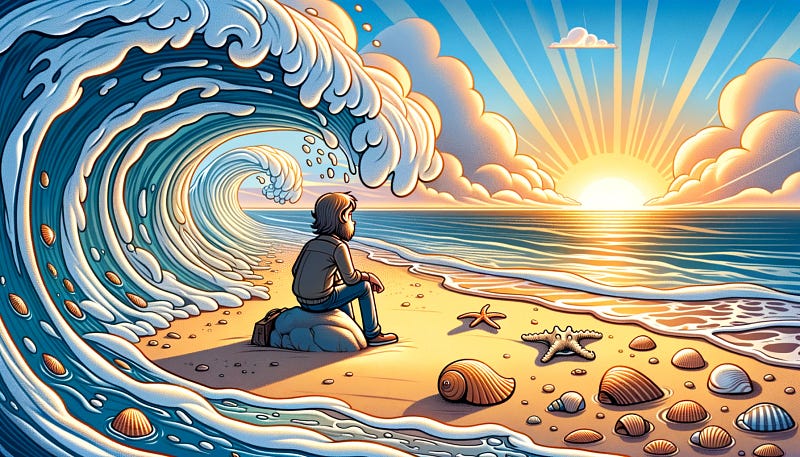
On a rock, where once I had sat with youthful eagerness, now rested a seashell, spiraled and kissed by the sun. Its presence was a testament to life’s unceasing motion. “Nothing is lost, nothing is created, everything is transformed,” mused Lavoisier. This shell, perhaps once a home to a small sea creature, now lay as a symbol of life’s resilience and its perpetual transformation.
Both stories, reflections of Lawrence’s unsentimental view and the revisited lessons of the beach, remind us that life’s beauty and complexity are often found in its simplicity. Each wave, each creature, each visit to a cherished place, spins a story of life’s undying cycle and the truth that, in our world, there is a marvelous balance between the fleeting and the everlasting.
The Color Purple: A Symbolic Encounter
In the tapestry of life, each thread intertwines to create a mosaic of memories, each with its own shade and hue. On one such occasion, I recall the profound impact a simple natural element had on my perspective. It was the color purple, not just any purple, but the particular lavender shade of a wildflower that I stumbled upon during an early morning walk — a time when the world is quiet, save for the whispers of dawn.
This flower, delicate and yet so vibrant against the soft browns and greens of the earth, seemed to hum with life, as if it held secrets within its petals. Purple, you see, is the color of royalty, of spirituality, and of the deep velvet curtain that separates the known from the unknown. It is said that when Julius Caesar returned to Rome, he demanded that he be welcomed with a carpet of purple; perhaps, even then, it was a color of transitions and momentous occasions.

To me, this flower was a reminder of someone dear who had passed — a grandmother who adored the color purple. Her laughter had been a balm to the soul, much like the soothing shades of her favorite color. In her life, the color represented joy and uniqueness. In her passing, it reminded me that what we hold dear never truly leaves us; it simply takes on a different form. The sight of the flower was a visceral tug at the heartstrings, a symbol of remembrance and the eternal bond of love that survives the mortal coil.
This encounter with the color purple breathed life into the words of Alice Walker, who famously wrote in The Color Purple, “I think it pisses God off if you walk by the color purple in a field somewhere and don’t notice it.” In that moment, I understood that to notice and appreciate the beauty around us is to celebrate the spectrum of our experiences, our losses, and our enduring connections.
Conclusion: The Bittersweet Symphony of Living
As the curtain falls on this narrative of life and the echoes of mortality, I am reminded of the intricate dance between joy and sorrow, between the vibrant vivacity of life and the somber shadows cast by the setting sun. Our existence on Earth is indeed a bittersweet symphony — a composition that moves from major to minor keys in a melody that resonates with each of us.
To articulate this symphony, I often think of the metaphor of the ocean. The same waters that lap soothingly against the shore are those that can rage in tempest fury. The ocean is a cradle of creation and a vast, unknowable abyss, reflecting the duality of our existence — gentle yet powerful, giving yet unforgiving.
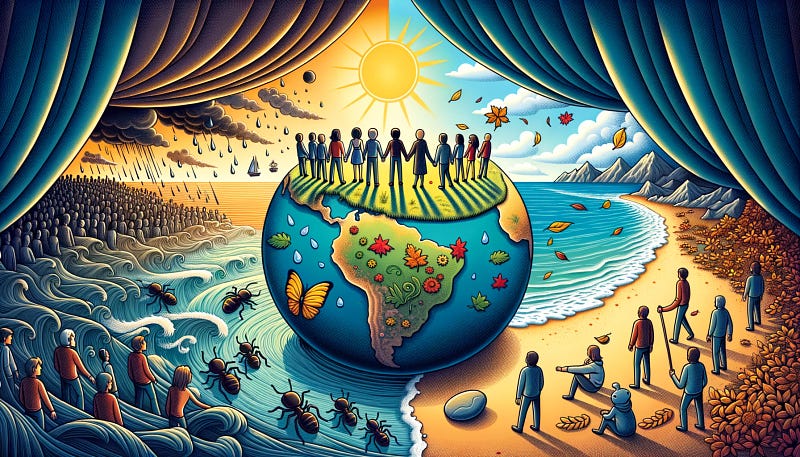
In the natural world, the change of seasons serves as another poignant symbol. As leaves blush with autumnal colors before they fall, they remind us that there is beauty even in decay, that every end is merely the prelude to a new beginning. It’s reminiscent of the profound words by Rainer Maria Rilke, “And yet, though we strain against the deadening grip of daily necessity, I sense there is this mystery: All life is being lived.” It is within this mystery that we find the true essence of our journey.
Our lives are composed of fleeting moments, much like the ephemeral ripples on a pond’s surface after a stone is cast. They are reminders that our impacts, no matter how small, reverberate beyond what our eyes can see, shaping the world in unseen ways.
As we move through this existence, let us embrace the symphony’s cadence, find harmony in the contradictions, and dance to the rhythm of life’s contrasting melodies. In doing so, we acknowledge the profound simplicity of D.H. Lawrence’s perspective, the altruism of ants, the shared rituals of grief, and the immutable lesson of transience taught to us by a secluded beach.
To live is to accept this symphony with an open heart, to understand that our time here is both magnificent and transient. It is to walk amid the colors of the world, recognizing the purple in the fields, and knowing that we are part of something infinitely complex and wondrous — a tapestry that weaves together whispers of life with the echoes of our own mortality.
Thanks for reading. ❤️ Leave your views/thoughts💭, I’d love to hear from you! ✨
If my words touched your soul, please consider supporting my journey: [Donate Link](https://www.buymeacoffee.com/tokyofullstack). Your generosity weaves into every story. ❤️