
Which are top places in our solar system that may harbor life?
What is hiding in our neighborhood?
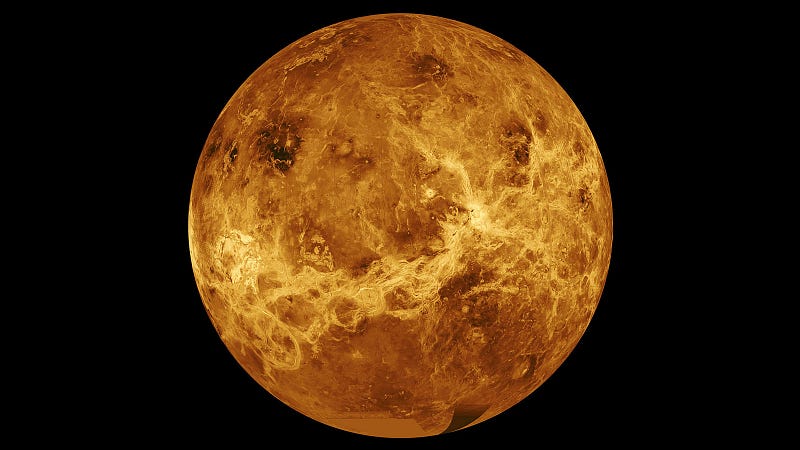
In September 2020 British scientists revealed they detected phosphine in the atmosphere of Venus. Phosphine is a toxic compound made from phosphorus and hydrogen. On Earth, it’s only produced by tiny microbes that live in oxygen-free environments.
We can’t confirm that phosphine is a sign of life on Venus, but for now, we don’t have a different explanation.
Discovering a possible biosignature on Venus has come as a great surprise for many people. Our closest neighbor is a hellish world with a very toxic atmosphere, creating a runaway greenhouse effect.
96% of its atmosphere is carbon dioxide, the rest being nitrogen and sulfuric gas. The temperature on the surface is 467 °C (872 °F) and the pressure is 93 bar — same as 900 m (3,000 ft) underwater on Earth.
So, not at all the kind of place where you would expect life.
And yet, life might be hiding there. Microbial, sure, but still. It would be the very first time we found life on any other body than our beloved Earth.
Which means our intuition about where life might thrive and which conditions may be necessary, can be wrong. Still, the detection of phosphine in the upper layers of Venus’ atmosphere is not definite proof of anything.
We cannot possibly pretend we know every fine detail of geological activities on our sister’s surface. Phosphine could very well be produced by a chemical process we’re simply not familiar with.
But what are some other bodies in our relative vicinity for which we have high hopes of running into some microbes one day? Let’s take a look at the most promising candidates.
Life in our solar system
In our solar system or beyond, the only body we are sure harbors life is Earth. If we go on a hunt for life in our neighborhood, we might not concentrate so much on other planets. We’ll pay more attention to some of their moons.
The king of our system — Jupiter — and its little brother Saturn together have almost 150 moons. And from the perspective of somebody searching for life, some of them are very interesting.
Enceladus
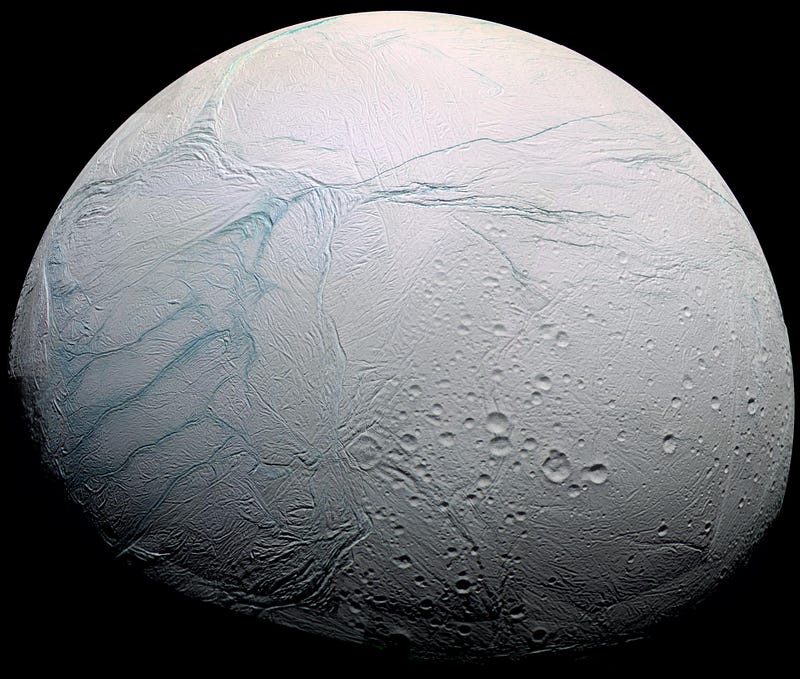
Named after a giant in Greek mythology, the sixth largest Saturn’s moon is actually tiny — it has a diameter of only about 500 km (310 mi).
It is mostly covered in ice, and its snow-white crust makes it the most reflective body in the solar system. As a consequence, its surface temperature is very low: minus 200 °C (minus 330 °F).
Apart from its astounding beauty, Enceladus is very interesting for another reason: its global underground ocean. In 2005, NASA’s spacecraft Cassini observed icy water particles and gas gushing from the moon’s surface at 400 meters per second.
These continuous eruptions create a huge halo of ice dust around Enceladus. A small part of the material ends in Saturn’s E-ring and the rest falls back to the moon’s surface.
Analyses of this material have detected water vapor, carbon dioxide, methane, ammonia, but also salts and silica — most of the chemical ingredients needed for life. Since silica can only be generated at high temperatures, this indicates potential vents on Enceladus which supply its ocean with hot, mineral-rich water.
Its global ocean, unique chemistry and internal heat make this tiny Saturn’s moon a very promising lead in our search for life.
Titan
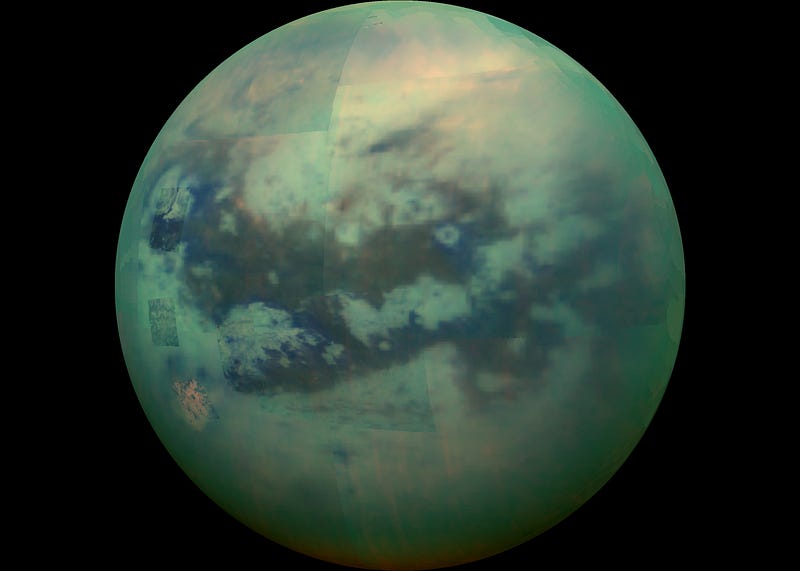
With its 5,000 km (3,000 mi) in diameter, Saturn’s largest moon is actually bigger than the planet Mercury. In Greek mythology, the Titans were a race of powerful deities that ruled during the Golden Age.
Titan is an extraordinary world. It is the only known moon in the solar system with a thick atmosphere, which — like on Earth — is mostly made of nitrogen.
High in Titan’s atmosphere, methane and nitrogen molecules are split apart by the Sun’s ultraviolet radiation. These molecules recombine into different organic chemicals. This creates an orange haze that makes the moon’s surface difficult to view from space.
Titan’s air is actually dense enough that you could walk on the surface without a spacesuit. But you would need an oxygen mask and protection from the extreme cold.
Titan is also the only body in our system — besides Earth — known to have rivers, lakes and seas on its surface. Beneath a thick crust of ice lies more liquid — a subsurface ocean of water which could harbor life as we know it.
Titan’s surface lakes and seas are mostly made of methane and ethane, and they could harbor life that uses different chemistry — life as we don’t yet know.
Europa
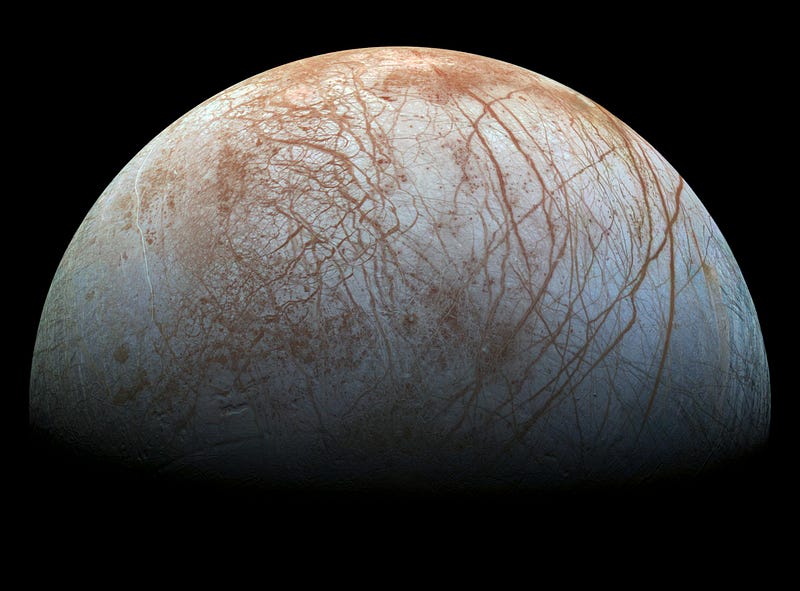
Europa — princess abducted by the god Zeus in Greek mythology — is the smallest of the four Galilean moons orbiting Jupiter (Zeus became Jupiter in Roman mythology). It was discovered by Galileo Galilei in 1610.
Like Enceladus, Europa’s surface is made of water ice, which makes it very bright and reflective. Underneath this thick icy surface probably lies a salty underground ocean, up to 150 km (100 mi) deep.
Europa’s diameter is four times smaller than Earth’s, but its ocean may contain twice as much water as all of Earth’s oceans together. This vast body of water is widely considered the most promising place for life beyond Earth.
If water vapors are being ejected above Europa’s surface, a spacecraft could sample them without needing to land on the satellite, as Cassini did on Enceladus. Scientists could analyze them to see if they contain the necessary ingredients for life.
Potential volcanic or hydrothermal activity on the seafloor might eject nutrients that could make the ocean suitable for living organisms.
Ganymede
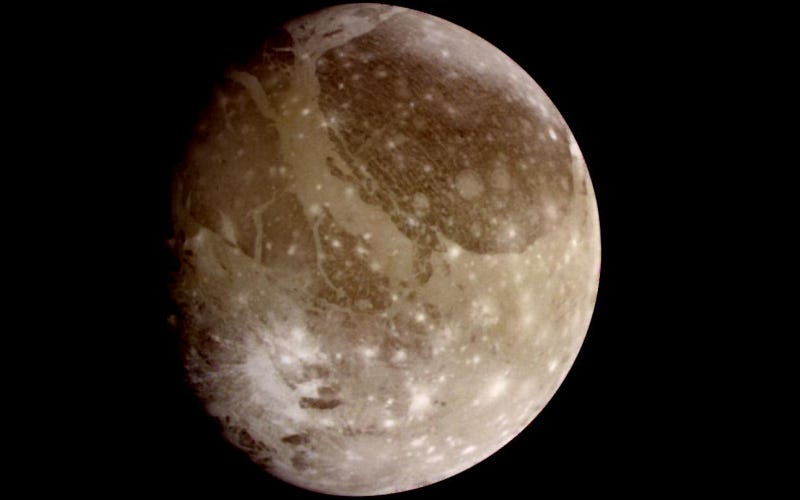
The largest moon in our solar system is named after a beautiful mortal hero made cupbearer in Olympus by Zeus. It is also the only moon with its own magnetic field, which causes auroras — ribbons of glowing gas.
This Jupiter’s moon was discovered by Galileo Galilei at the same time as its sister Europa. It is composed of an iron core, surrounded by a rocky shell, and an icy crust. Here also, scientists have found strong evidence of an underground ocean.
Liquid water and a magnetic field protecting the moon from radiation could very well provide the necessary conditions for certain known or unknown lifeforms.
Ceres
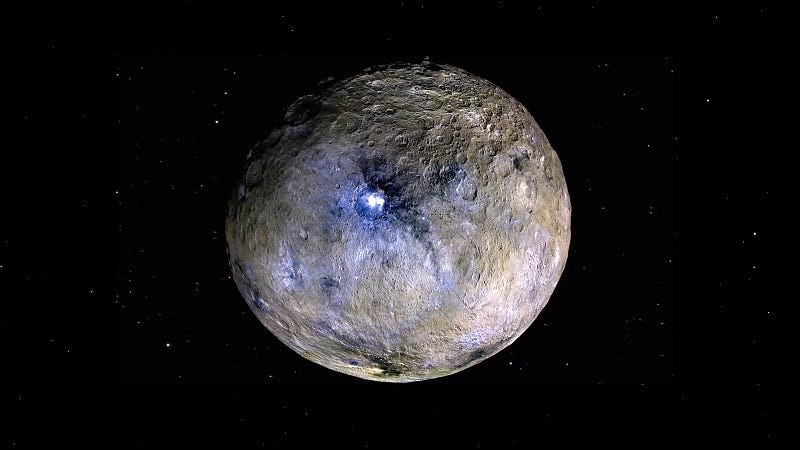
This rocky dwarf planet measures less than 1000 km (600 mi) in diameter. Named after the Roman goddess of harvest, Ceres is the largest body in the asteroid belt between Mars and Jupiter. It is also the only dwarf planet in the inner solar system.
When NASA’s Dawn arrived there in 2005, it became the first dwarf planet visited by a space probe.
Ceres probably has a solid core, surrounded by water ice and a rocky crust. It might be composed of as much as 25 percent water, which would mean it has more water than Earth.
Although Ceres has a very thin atmosphere, its subsurface ocean is a place scientists would like to check for microbial life, present or past.
Bottom Line
Unexpectedly, Venus became one of the top candidates for life in our solar system. Mars has been on that list for a while, although so far, we haven’t found any Martians or microbes lurking around.
Saturn’s moons Titan and Enceladus are two of the most intriguing bodies of our system. They both harbor an underground ocean that may be swarming with living organisms. Titan also has seas of methane and ethane on its surface that may be home to an unknown form of life.
Jupiter’s moons Europa and Ganymede are promising leads, but more research is needed to see if they provide the necessary conditions for life. The same goes for the dwarf planet Ceres.
When we look for life outside our solar system, we usually concentrate on the habitable zone around the star — an area where water can exist in its liquid form. But interestingly, most of the prominent candidates for life in our system lie well outside the Sun’s habitable zone.
If we do find some form of life on any body in our system, it may look familiar or not at all.
And if we can determine that life formed independently at least twice around our star, we could suppose that life happens relatively easily once the necessary ingredients are present. This would mean that life might exist elsewhere in our galaxy, and in the universe.
How would such a discovery change our view of the cosmos and our place in it?

Thank you for reading my story!


