
Wherefore Spirituality?
What are you trying to do with spirituality, make life better, or transcend yourself?
As I’ve written before, the word spirit can imply many things. There’s team spirit, the spirit of the times (zeitgeist), and ‘getting into the spirit of things’. Here in our corner of Medium, it’s probably safe to assume that by spirit we mean something beyond these psychological and social meanings, and that we’re into the realm of the nonmaterial or metaphysical.
We’re talking about something beyond the world that we see, and beyond the psychological and social meanings. In this sense of spiritual, we have many possible meanings, which I’ll divide into two broad classes.
The first variety of spirituality we could call pragmatic. We’re talking about doing something in the world via nonmaterial means. We could be contacting the spirits of the departed (mediumship) or non-incarnated beings (channeling). There are also the various forms of divination, magick, and other means of gaining information about or manipulating the material world via nonmaterial or metaphysical, means. Prayer, in its many forms, is another example, as are all kinds of intention-setting and ‘manifesting’. In this sense, spirituality is about making your life (and possibly afterlife) better — more comfortable, prosperous, and maybe even fun.
Then there’s spirituality in the sense of knowing The Ultimate: the highest pinnacle of being (and nonbeing, for that matter) that we can conceive, and our relationship to it. This is the spirituality of traditions like Buddhism, Philosophical Taoism, and Vedantic Hinduism, as well as many Western esoteric traditions. This is transcendent spirituality — getting past your limited sense of self to a greater identity with the Cosmos, God, Nature, or whatever the Great Ultimate is for you.
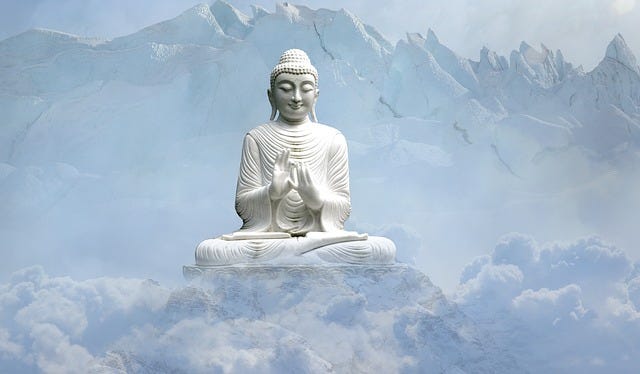
There’s a lot of common ground between these two broad categories. Technique, for example, can be applied to either pragmatic or transcendent spirituality. Meditation and methods of quieting the mind are employed by magicians and diviners, as well as those who are seeking enlightenment. Religions often serve both purposes, helping folks to live better in the world while also supporting transcendence (some of them place great emphasis on the afterlife, too).
I think it’s a good question for those who consider themselves ‘on a spiritual path’ to ask themselves. Are you trying to make your life better, or are you looking to transcend your limited sense of self?
How about a little of both?
In my estimation, full-on transcendence is probably beyond most of us at this point. After all, we’re reading and writing on Medium, probably watching some inspiring YouTube videos, and maybe doing a little yoga outside on days when it’s not too cold. We’re still too keyed in to the pleasures — and responsibilities — of life to make transcendence our only priority.
There aren’t clear demarcations between these two meanings of spirituality. As I said, many religions cater to both, offering pragmatic spirituality to the masses and transcendent practices to a few monks and nuns. Esoteric traditions are also split in terms of their emphasis, and it isn’t unusual to see a little of both types of spirituality within a tradition. The New Age is all over the shop on the matter, with a blending of pragmatism and transcendence that can be difficult to sort out.
They May Be Onto Something…
Before we jump to the conclusion that New Agers are just befuddled and unclear about what they’re doing (and no doubt many of them — us — are), we should step back and consider whether these two approaches necessarily imply irreconcilable extremes. Even some mystics have long cast a doubtful eye on transcendence — not its possibility but its ultimate value.
Transcendence, as such, suggests getting beyond this world, and not just into heaven or some comfy resting place, but eventually to the core of reality, the Ultimate Beyond, never to return. A good model for this would be Theravada Buddhism: “House-builder, no longer will you build this house!” declared the Buddha.
Yet it wasn’t long before the Mahayana ideal of the Bodhisattva began to supplant the solitary arhat of Theravada. Bodhisattvas are advanced spiritual beings who vow to keep returning to incarnate existence in order to help move all sentient beings along the path to transcendence. It’s a big job, but they’re up for it.
Another approach is that of Sri Aurobindo, whose Integral Yoga assumes that our material existence is in a process of continual upgrading. One doesn’t escape up into the spiritual realm, one brings the spiritual down to the material plain. It’s a project we’re engaged in at both the individual and collective levels.
For Your Consideration…
My intention in writing this article isn’t suggest that either pragmatic or transcendent spirituality is the better approach, and certainly not to judge. I do think it’s a worthwhile topic for each of us to consider before we get on our meditation cushions, light candles, or otherwise engage in what we consider to be spiritual practice — just what is the goal? Or if there is more than one goal, how do they fit together?
Many of us will continue to move towards transcendence, but in the meantime will employ some metaphysical means of improving life on a practical level. Perhaps a good strategy is to be as mindful and compassionate as we can as we pursue our pragmatic goals, avoiding doing harm, tempering our desires, sharing abundance as it comes to us, and helping others in small ways as well as larger gestures. I believe that doing so will further both pragmatic and transcendent spirituality.