
Where Were You When the World Changed Forever?
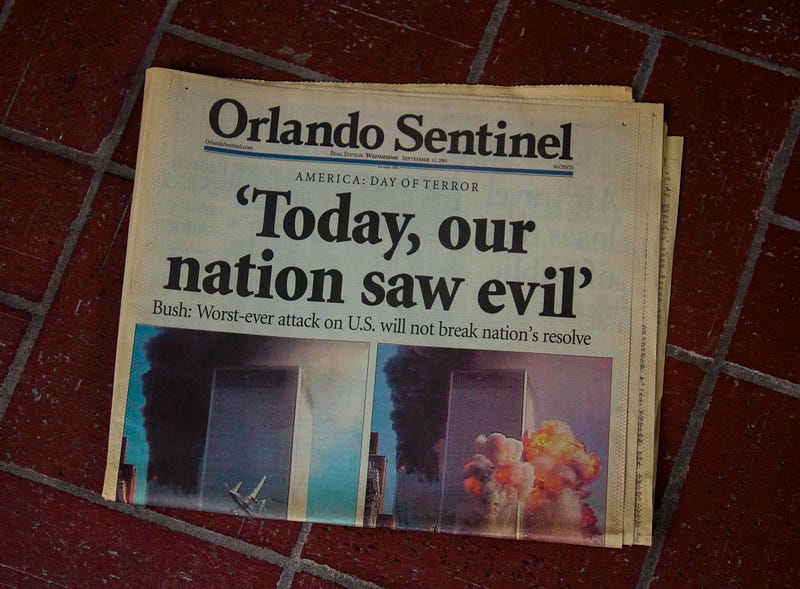
I was talking last week with my mom about how the 20th anniversary of 9/11 was coming up, and I started to cry when we exchanged our “where were you” stories.
For some reason my brain chose that moment to grasp how traumatic of an experience that day was for the children of the country. It never really hit me until that moment — my childhood died that day, and so did the childhoods of the millions of millennials who were in elementary and middle school on 9/11.
It’s fascinating how twenty years can simultaneously feel like both a lifetime ago and just like yesterday. I was in sixth grade on 9/11/2001 at GAMS Tech in Newburgh, New York — a small city about 60 miles north of Manhattan.
I was so excited for sixth grade because I got to finally be in Mr. Gutierrez's class, who was one of the most popular and well-liked teachers in the school. He had the coolest room. We had a stove and a little hangout room and a giant chess mat in the back of the class.
The day started normally enough. The school year was barely a week old. The notebooks still had that fresh-paper smell. The classroom barely looked learned-in.
One of the best things about Mr.G was that he was emotionally expressive, which was not something you got from your typical male teacher.
Mr. G was his typical energetic self and he had us excited to start the day. But then soon he heard a knock on the door, and he went out in the hallway for a couple of minutes.
The same man did not walk back in. His soul was saddled with an unbearable weight, which was obvious even to an 11 year-old. The energy was nowhere to be found. He was sullen and monotone. His eyes were glassy at times.
Then over the next hour, kid after kid was pulled out of class and none of us knew why. I remember being in gym class that morning speculating with my friends what happened. We all thought it was some sort of school shooting.
Being 11, we were all bugging the hell out of Mr.G to find out what happened. Naturally the policy was to not inform kids of what happened. Looking back, I think they simply wanted to preserve our innocence for a few more precious moments, knowing that the world has changed forever.
Mr. G finally snapped when we got back from gym class. “You want to know what happened?!” He yelled in exasperation as he turned on the television. “This is what happened!”
I vividly remember two things from that moment. The image of one tower smoking and another freshly collapsed, and how in the moment, it actually froze my 11 year-old brain. I could not process the gravity of what I was seeing in those few seconds. Then I looked back to Mr.G and he was crying openly.
To see your male teacher cry openly in 2001 during an era where the vast majority of men saw emotive expression as a sign of weakness really meant something significantly world-altering was happening.
Two of my best friends at the time had parents who worked in the city. One had an office just a few blocks from the World Trade Center and the other was a firefighter, who by divine intervention was off that day and did not make it into the city to help until that night. A couple of kids in my school were not so lucky.
Living within the commuter sphere of NYC made it much more visceral. It seemed like we all at least knew someone who knew someone that passed away. The following War on Terror felt like it was launched from our doorstep.
With West Point and Indian Point only miles away, we were always on edge about the possibility of another attack. I remember getting woken up by crazy loud thunder that fall and wondering if a nuclear bomb had gone off at Indian Point. That’s a pretty f*cked up thought process for an 11 year-old to have.
Writing this made me realize that not all of the trauma weighing on us comes from experiences from our personal lives. A shared experience like 9/11 causes its own kind of trauma, and for the subsection of millennials in my age bracket, that trauma was the sudden death of our childhoods.
The world no longer felt safe after 9/11. There was the fear of another 9/11 for at least three years after the attack, but in the immediate months after, that fear was at a fever pitch.
Parents were scared of the new world 9/11 had birthed, and their parental instincts kicked in. Helicopter-style parenting became widespread because parents couldn’t bear the thought that their baby could die in a senseless act of terrorism. No matter how old we were, whether it was a kindergartener, sixth grader, or highschooler — that stage of our development was permanently altered when the Twin Towers fell.
When I wrote about grieving the deaths of certain eras of our lives, I had not realized I never really properly grieved the role 9/11 had in the death of childhood as I knew it. It only took twenty years, but it’s never too late to process and heal from trauma.