
Where to Start to Find Product-Market Fit
A Step by Step Guide to Finding Product-Market Fit
Where Did It All Go Wrong?
You have such an excellent concept/product/service, so why is there no Product-Market Fit (PMF)? Where did it all go wrong in your growth journey? Well, let’s not get too caught up on the exact point in time or reason and instead focus on the different parts that make up Product-Market Fit:
Product — Market — Fit
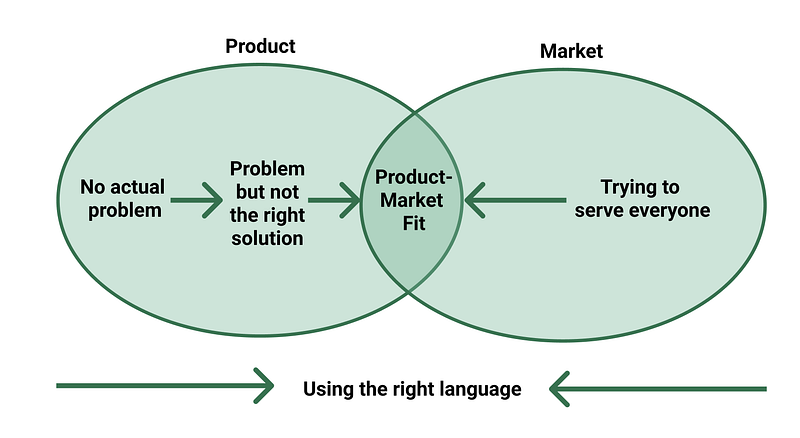
As you can see from the above diagram, a lack of Product-Market Fit can be on the Product side and the Market side: are you trying to serve the right niche? Then, on top of that, there is the language you use (the fit); it doesn’t matter if I have the best possible solution for my market if I can’t communicate in their words.
This is part of a series looking at finding PMF step by step. In the first part, I covered all the myths that prevent companies from finding PMF. Now, let’s look at what could be causing your lack of Product-Market Fit; why you don’t have PMF impacts how you will need to start finding it.
So first up, Product.
Viktoria has a job coaching company; she offered resume templates, interview coaching and Linkedin support. Viktoria is super passionate about this and wants to work full time on her business. However, the interest in her biggest category, resume templates, was dying. She realized from all her conversations with potential clients it was not what people were looking for anymore.
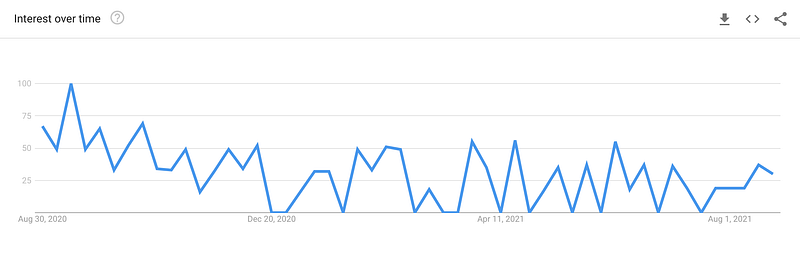
Now I think it is a fair assumption that there is still a market for job seekers who would like support. Competition is high, especially given the crazy world situation we are in. Sure some jobs have a higher demand (trust me, it is impossible to find a CRM manager right now), but there is still a market out there.
Viktoria’s challenge is that she doesn’t seem to have the right product, or at least her main product isn’t the right one. So she’ll need to figure out from the market actively looking what their actual pain is and what could be the right product in solving that.
When it comes to solving the product part of PMF, there are two steps:
- Ensure you are solving an urgent enough problem
- From there, find the right solution for that problem
We will look at how to work out both in the following article.
Next up is the market side.
You know you have a market problem because some people LOVE your product, you have great reviews, but your acquisition cost is still high, and the conversion rate is low. So often, market-challenged companies throw spaghetti at the wall and hope some will stick….whilst a load is sliding off the wall and goes to waste.
Francesca, another business I talked to about PMF, had this. She runs a tutoring company for years 9–12 in English, Maths and Science. Francesca got a decent number of phone calls requesting help, but only 1 in 5 was a fit. The reviews for her and her tutors were excellent, students came back, but she was spending loads of time qualifying all these leads and not getting enough of the right one. She wasn’t sure where the 1 in 5 was and how to find more of them.
Francesca has the product side down but needs to start reaching the specific market that wants her services.
You may know your market in some cases, but it is so niche you can’t build a business around it. When that happens, you’ll still need to define that original market and from there, test one of the following options:
- See if you can identify similar markets
- Adjust which problem you focus on communicating per market you target
- Increase your offering to manage with that smaller market
- Expand the market by adding specific features to attract more customers
Finally, communication.
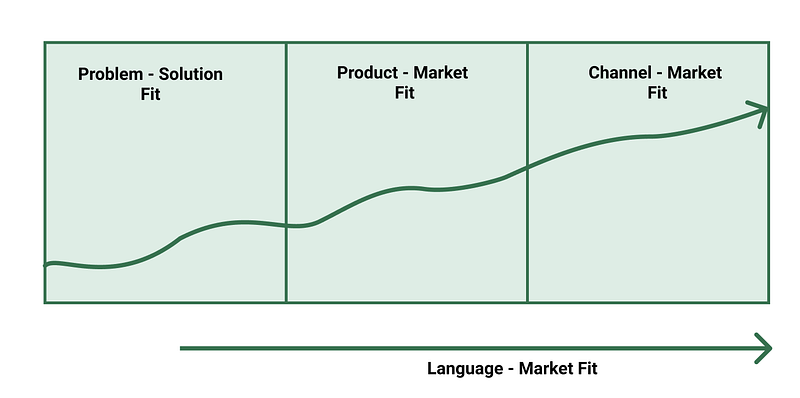
This is also sometimes known as Language-Market Fit (LMF, not the official acronym, but we will go with it). Sometimes what appears to be a PMF challenge is a communication issue.
You have a great product, you know the market but struggle to get them to buy your solution. This comes down to communication and how you explain what you do.
The reason I lump LMF with PMF is that I have seen it affect PMF. It impacts how excited you get users, how quickly you help them to the AHA moment, how clear you make it that you can solve their pain, the answer to their challenges.
I usually identify an LMF challenge when I hear statements like: “I need to give them a lot of information before they understand what the benefits are” or “If I call and explain to them why they should buy the product they love it, but I can’t call every single lead”. People will often have a communication problem on top of a product mismatch or market mismatch, and figuring out how to communicate will actually improve your PMF.
Another sign of this may be a low conversion rate, something about your product is intriguing the market, but they aren’t entirely convinced.
Once all this is fixed, there is a final part to the puzzle, which I’ll cover in the last article, Channel-Market Fit. This is all about making sure you are using the best channels to reach your audience. However, that only comes after PMF.
How to Identify Where to Start
I could give you some complex research to conduct and send you on your way, but let’s be honest, you are probably not looking for that. So instead, the 80/20 is answering the shortest quiz ever:
What is your biggest growth challenge?
- I know this market struggling with specific pain, but I’m not sure we are offering the right solution to help them / the solution they want.
- People who use our product/service love it, but we have to reach a considerable audience to find the few that convert.
- We know that people love the product, we know there is a market, but we struggle to convert them. We struggle to explain what it is we do in just one sentence.
Take a look at the options and figure out which one matches your situation. It could be a combination of several: when I started at Heights, we had a mismatch in terms of communication mainly, but we could also definitely improve the focus on with whom we have PMF.
Keep an eye out for my next article, where you’ll learn all about the Jobs to Be Done Framework and why it will be the foundation of finding PMF, especially from a product and language side.


