
Where To Sell AI Art? — Part 2. Art Marketplaces
Last week, we reviewed top stock image sites and discovered that Adobe Stock is about the only one that allows uploading AI-generated images as long as you follow all their rules and recommendations. Generative AI is at its earliest stages, and it’s great that we have at least one major stock image site that is ready to support AI artists.
However, stock image sites, including Adobe Stock, have a focus on “useful” images, the ones you can use as illustrations in your blog post, news article, or business presentation. People are rarely going to stock sites for artwork.
As we have all witnessed, generative AI can assist artists in creating incredibly fascinating and stunning images. There should be a place to sell these masterpieces. So, let’s review the policies of major art marketplaces with regard to AI-generated content.
Etsy
Etsy is a marketplace focused on handmade and vintage items, but as of today, you can find a ton of AI-generated images there. It looks like the Etsy team hasn’t yet defined their position toward AI art. It’s not on a prohibited items list, but there is also no clear message that this content is allowed.
On one hand, a great part of the Etsy community is strongly against this kind of art. You can even find a petition on change.org arguing for banning AI-generated art from Etsy. On the other hand, Etsy is not a curated marketplace, and so, even if they decide to ban AI art, it would be hardly possible for them to implement this decision. The better decision might be to support transparency among sellers and request disclosure about the items created using AI.
There is still a risk that they will stop welcoming AI art on their platform because this art product is simply not handmade or vintage. Most AI artists I know, prefer to be fully transparent about their art process, and wouldn’t be willing to sell on a platform that officially banned AI-generated art, even if it’s hardly possible to actually detect it.
So keep in mind this possibility before deciding to invest your time and effort into the Etsy shop. But meanwhile, selling AI art via Etsy is a viable option.
DeviantArt
This huge online art community balances embracing AI art and protecting original artists, whose work is used to train text-to-image generators.
First of all, they have launched their own generative AI platform — DreamUp, which basically uses a vanilla Stable Diffusion model. Users can generate images with DreamUp and post them on DeviantArt. The #aiart tag will be added automatically. Furthermore, DeviantArt allows uploading AI-generated images from external providers as long as you properly tag your submissions as #aiart.
Interestingly, monetization of images generated with DreamUp is not allowed at the moment, while AI images, generated using external technologies are available on the platform for premium download. So, it looks like DeviantArt welcomes AI artists on their platform.
At the same time, the platform takes steps to protect human-generated artwork:
- In response to community criticism, they have set the “noai” flag on by default, which means that all images are set to “Tell AI Datasets They Can’t Use Your Content” by default. But artists can explicitly signal their agreement to have images scraped.
- Also, if an artist’s name was used in a prompt to DreamUp, the resulting image will have a tag with this artist’s name, indicating that the artwork was inspired by the style of that particular artist. The artists can also opt out if they don’t want their names being used in the DreamUp prompts.
- Considering that the platform got crowded with AI-generated images, the DeviantArt Team added functionality to control the amount of AI content you see on a platform.
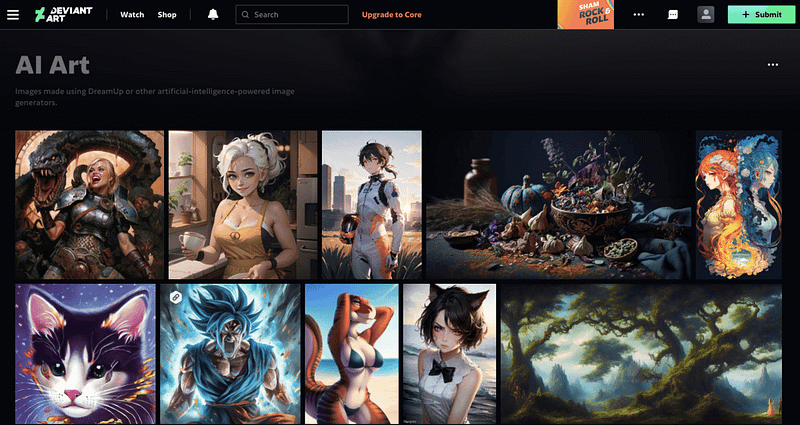
In general, I find DeviantArt’s approach quite balanced and smart. My only concern is their choice of Stable Diffusion to power DreamUp. It was probably the easiest way, considering that Stable Diffusion is open-source. But at the same time, we know that a lot of copyrighted images were used to train this model without any authorization (as evidenced by Getty Images watermarks appearing on some of the generated images). This could be the reason why the platform doesn’t allow monetization of DreamUp-generated images.
Anyway, DeviantArt is not fighting the technology but trying to embrace it instead. That’s a great start!
Artfinder
Artfinder is a huge art marketplace with a focus on original paintings and drawings. You can also sell limited-edition prints, collages, and digital art, among many other kinds of artwork accepted on Artfinder.
What’s not welcome on Artfinder is AI-generated artwork. The list of items that you cannot sell on Artfinder is concluded with “Images created using Artificial Intelligence (AI)”.
Interestingly, this rule goes well beyond digital images generated with AI. My husband is a traditional artist, creating oil paintings on canvas, and some of his recent paintings were inspired by images that he generated with Midjourney. All these paintings were banned from Artfinder recently, and the support team responded:
We do not accept any artworks that involve AI in the process of their creation at present, so that includes paintings that are created from reference images produced in Midjourney.
Obviously, they were able to detect AI involvement in these paintings only because of the proper disclosures that my husband provided in the painting descriptions.
Considering that there is no technology yet available to detect AI-generated images with high confidence (especially, when these are oil paintings 😅), it looks like Artfinder’s approach only punishes artists who choose to be transparent about their art process, but doesn’t really erase AI art from their platform.
I like to think that “at present” in Artfinder’s response means something. Maybe they realize that this policy will need to be reviewed in the foreseeable future if they want to keep up with the industry’s advances.
Artmajeur
Artmajeur is one of the largest online galleries. Similarly to Artfinder, it focuses on original paintings. However, you’ll also find sculptures, photography, and digital art on this platform.
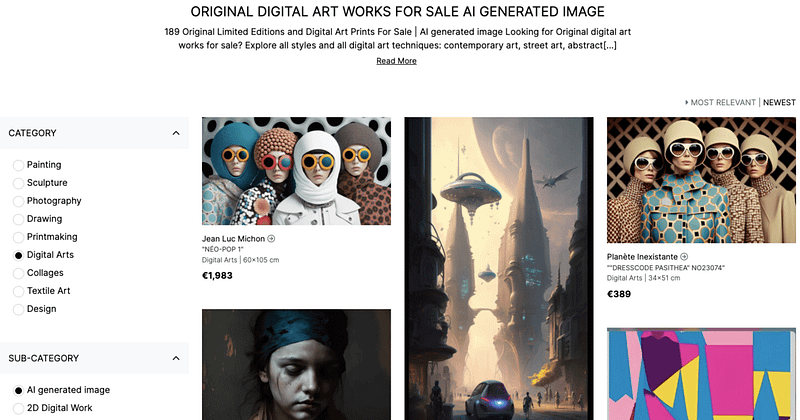
At the moment, Artmajeur welcomes AI art in its gallery. You’ll even find a separate AI-generated image subcategory under the Digital Arts category. Most of the AI artists on the platforms sell their works as limited-edition or open-edition prints (on fine art paper, canvas, or metal). Some works are also offered via digital licensing — you choose the license you need (e.g., media, commercial), then pay and download an image. The prices on the platform vary from $30 to $2000 and even more.
While being friendly to AI art content, Artmajeur has recently updated its terms and conditions to explicitly prohibit the use of crawlers for machine learning purposes on its site. Basically, they don’t want any more AI models to be trained on the images from their gallery.
We want to assure you that this decision was not taken lightly. We understand that machine learning has many legitimate uses and that this may inconvenience some users of our site. However, the protection of your creative rights and intellectual property is of utmost importance to us, and we believe that this is a necessary step to ensure that your work is not exploited for the benefit of others.
To sum up
Art marketplaces try to balance between welcoming AI art and keeping their artistic community happy. They cannot just ban AI artwork because, at the moment, there is simply no technical possibility to detect high-quality AI-generated images and guarantee their removal from the platform.
At the same time, many art marketplaces try to refrain from explicitly allowing AI art on their platforms, because a large part of the artistic community is strongly against this technology, seeing it as a threat to their profession.
So, we’ll see how it goes, but historically we know that it’s always a losing battle to fight against technology.
This article was originally published in my Kiki and Mozart newsletter, where you’ll also find the latest generative AI news, top tutorials, and featured AI artists. Subscribe and you’ll receive a link to a comprehensive Midjourney guide that I’ll keep up-to-date with the latest Midjourney releases.