
Where the hell did my talent go?
George R.R. Martin on self-doubt. (The Commonplace Book Project)

The Commonplace Book Project is a daily post based on Ray Bradbury’s advice to aspiring writers: read a poem, a short story, and an essay every day for 1000 days. These posts start with a quote and go wherever the rabbit hole leads. Follow The 1000 Day MFA publication so you don’t miss a thing.
“Boy, there are days where I get up and say ‘Where the hell did my talent go? Look at this crap that I’m producing here. This is terrible. Look, I wrote this yesterday. I hate this, I hate this.’” — George R.R. Martin, The Observation Deck
I have George R.R. Martin on my mind today because I’ve been watching the 1987 series, Beauty and the Beast. I’ve watched the whole series a couple of times over the last thirty years, but this is the first time that I realized that he was a writer for the series.
I didn’t realize it before because I hadn’t seen or read Game of Thrones the last time I watched it. His name didn’t register with me then like it does now.
If you have a chance, the whole interview where the quote above came from is worth reading.
This longer quote from the interview really struck me.
One of the big breakthroughs, I think for me, was reading Robert A. Heinlein’s four rules of writing, one of which was, “You must finish what you write.” I never had any problem with the first one, “You must write” — I was writing since I was a kid. But I never finished what I was writing. [I realized] I gotta actually finish these stories. It does me no good to have this drawer full of fragments. And always be chasing the next idea, which is so much better, so much more beautiful, so much more entrancing then the idea that you’re actually working on.
I went and looked up Heinlein’s rules of writing and turns out there were actually five.
Rule One: You Must Write Rule Two: Finish What Your Start Rule Three: You Must Refrain From Rewriting, Except to Editorial Order Rule Four: You Must Put Your Story on the Market Rule Five: You Must Keep it on the Market until it has Sold
Pretty straight forward. The third one gave me pause.
Refrain from rewriting unless an editor asks you to. Like at all, ever? First drafts only? Um. Come on Heinlein.
It took me about thirty seconds of critical thinking to realize that I doubt that’s what he meant.
Heinlein probably knew writers like some of the writers I know. The ones who are still revising the same old manuscript a decade after they finished their first draft.
I bet he knew writers who could not move past a single story. I know that I do.
Revise for spelling and grammar. Polish the story. Revision is part of writing. But then send it out. Get it out to agents or publishers. Do not keep picking at your story for the rest of your life.
If the story is close to publishable, you’ll get feedback. Someone will tell you — the characters fell flat for me, or your real story starts on chapter three, or your book is 30,000 words too long.
When that happens, you’ve got editorial direction. Go ahead and edit some more. If you only get Dear Author type rejections without feedback? That’s okay, too. It just means that this story wasn’t it. Make the next one better.
I actually think the original advice was for short story writers. I don’t see how the final piece of Heinlein’s advice is possible otherwise. There are only so many agents and book publishers out there.
But I read that advice like this: Send it out wide. Keep sending it out until you’ve exhausted your pool of possibilities or it sells or lands you an agent.
And while all that’s going on? Write the next thing. Make it better than the last thing.
It’s very telling that George R.R. Martin’s career finally grew legs when he started finishing things though. Of all those rules, I think that’s the one that catches the most people up.
There’s a bottle neck at rule #1. Lots and lots of people write. Relatively few finish, especially if we’re talking about novels. And then there’s another bottle neck at rule #4. Of the writers who finish, many are either too scared or too filled with self-doubt to send their work out, or the rejection shuts them down and they give up.
The people who keep pushing are the ones who make it. You literally can’t get there any other way. Be one of those writers, if you can.
Here’s Martin giving three pieces of writing advice.
And a podcast he put out with advice to aspiring writers. (He talks about Heinlein’s four rules here, too, instead of five. He skips the rule about editing. He does address editing, though.)
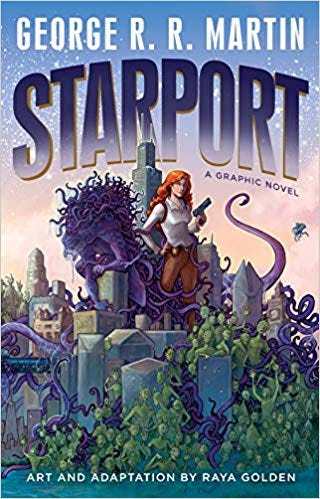
Martin has a graphic novel, Starport, coming out in a couple of weeks that I’ve added to my list. It looks fun. The Amazon description calls it Law and Order meets Men in Black. It’s based on a TV pilot that Martin wrote in 1994 and I saw a Tweet that said it brings back 1990s cop shows the way that Stranger Things brought back Goonies.
I’m fascinated with graphic novels right now, because they inspire my daughter so much. Maybe this is one we can both read?
Today’s Short Story:
I thought this was fun. An early one (from 1979) of George R.R. Martin’s called The Way of Cross and Dragon.
Today’s Poem:
[2 little whos] by E. E. Cummings
2 little whos (he and she) under are this wonderful tree
smiling stand (all realms of where and when beyond) now and here
(far from a grown -up i&you- ful world of known) who and who
(2 little ams and over them this aflame with dreams incredible is)
Shaunta Grimes is a writer and teacher. She is an out-of-place Nevadan living in Northwestern PA with her husband, three superstar kids, two dementia patients, a good friend, Alfred the cat, and a yellow rescue dog named Maybelline Scout. She’s on Twitter @shauntagrimes and is the author of Viral Nation and Rebel Nation and the upcoming novel The Astonishing Maybe. She is the original Ninja Writer.


