
Where should you lead from? The front? The back? Or the side? Answer: A Fourth Option
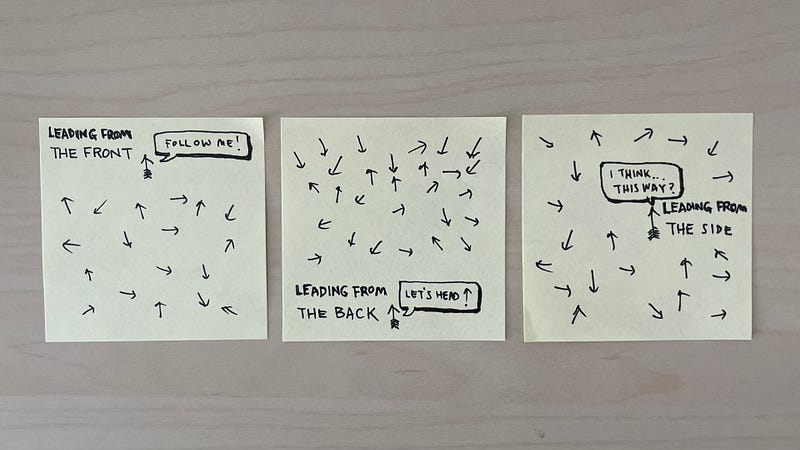
When leading where your teams are going, you also need to know whether they’re following.
—A Fourth Option for leaders to take
As a “maker” of things, I’ve never been a “leading from the front” kind of person and more of a “leading by example” one. But over time I learned that the unfortunate truth of using the latter approach is that it doesn’t work too well. That fact runs counter to the many heroic parables that we get taught when we’re kids. It’s true, though. Because maybe YOU fully understand the example you’re setting. But everyone else doesn’t. So where’s the leadership in all of that?
So you have three options:
- Lead from the front
- Lead from the back
- Lead from the side
Let’s break these down in detail.
Leading from the front wins you medals
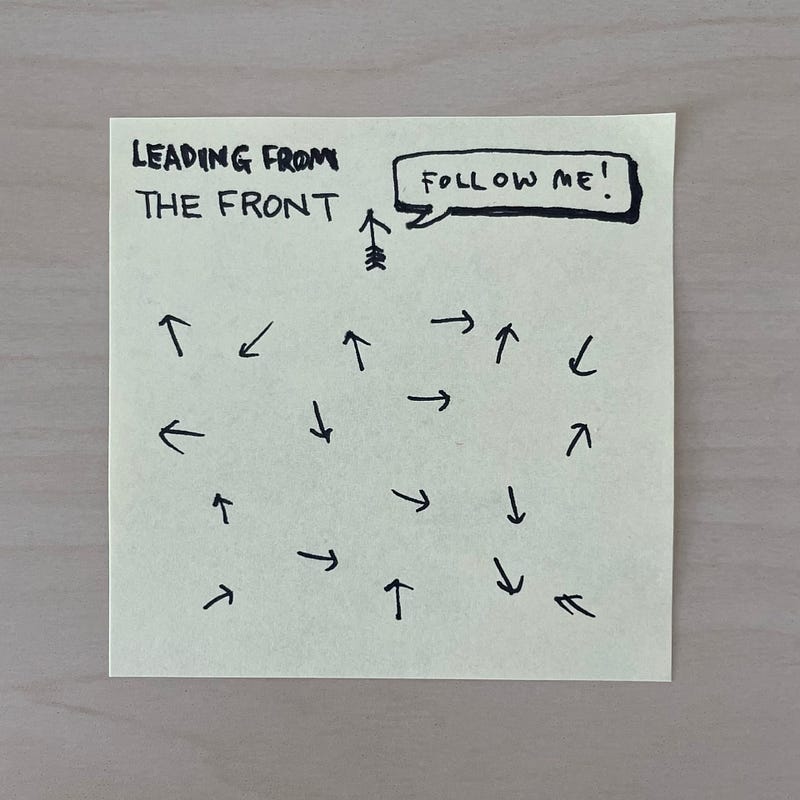
If you’re taller, you’re more likely to be acknowledged as a leader — according to research from 2013. I think a simpler way to frame this concept is to imagine that you are amongst many tired, hungry cave dwellers looking for hope and the next meal. The person that’s the tallest in the group is going to literally stand out in the crowd and be more easily heard.
Research suggests that tall individuals have an advantage over short individuals in terms of status, prestige, and leadership, though it is not clear why. Applying an evolutionary psychology perspective, we predicted that taller individuals are seen as more leader-like because they are perceived as more dominant, healthy, and intelligent. —Group Processes & Intergroup Relationships 16(1)
When you’re leading from the front and telling folks to “Follow me!” it’s in your favor to be tall and have a loud voice. You’re easily visible and easily heard. On the other hand if you’re on the shorter side like myself, and to have a voice that was conditioned to “not be loud” based upon how my parents raised me, then leading from the front is going to always feel a little unnatural.
Though regardless of their height, it’s the daring human being who is able to lunge forward into the unknown that we tend to want to follow. Because nobody wants to be the first to be eaten by the scary thing that could be lurking in the dark behind the bushes. But a fearless leader? They make things happen for the world. Once we all see that they’ve not been eaten, we can follow the leader safely. Keep in mind, sometimes the leader does get eaten …
Leading from the back makes you the doormat
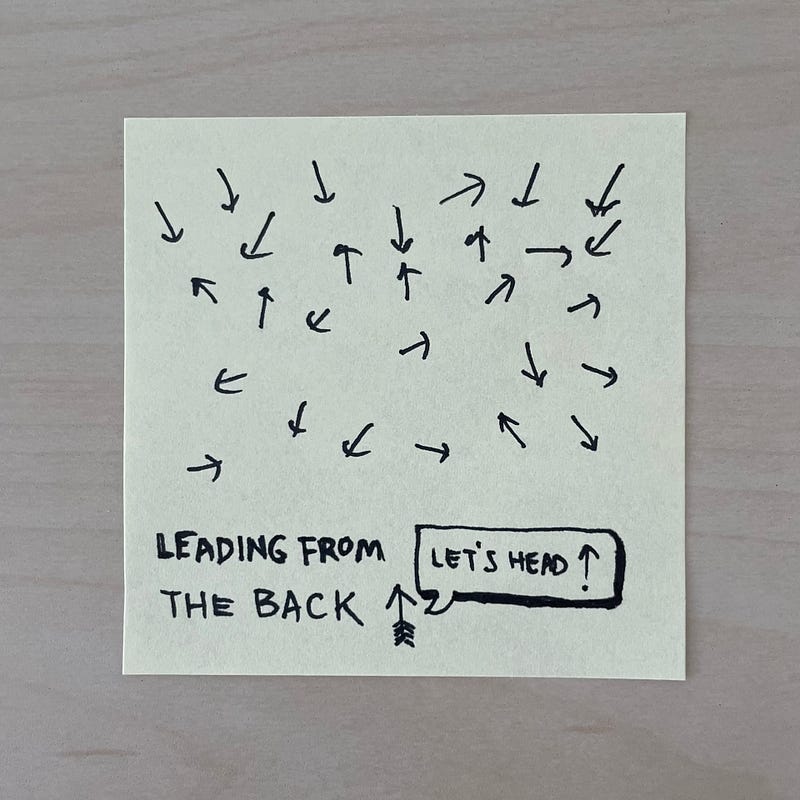
Leading from “the back”” takes an unusual amount of energy and solemn trust that folks in “the front” are taking things in a direction you agree with. You sense where the crowd is going, and you’re the sweeper that is bringing everyone along for the ride. This approach works well when you’re in coordination with “the front”—otherwise you’re unlikely to be all that helpful. One might call this method of leadership a variant of “followership”—where you are exercising your right as a constructive follower for the leadership happening at “the front.”
Most leading from “the front” fails when there’s no leaders who are leading from “the back.” A common mistake that leaders in “the front” make is to mistake leaders in “the back” as people you can convince will come along with you. That’s because they read the famed Doris Kearns Goodwin biography on Abraham Lincoln and got in their head how adversaries can be turned into partners when treated inclusively. Ummm. Maybe this worked for good ole Abe, but leaders shouldn’t count on it happening. Instead, leaders “in the front” should locate leaders “in the back” who are roughly aligned with where things are heading. That may fit a classical Pareto distribution where it’s only 20% of the folks “in the back” you need to partner with—which is what I’ve empirically found over time sounds right.
Leading from the side seems cool but it will confuse people
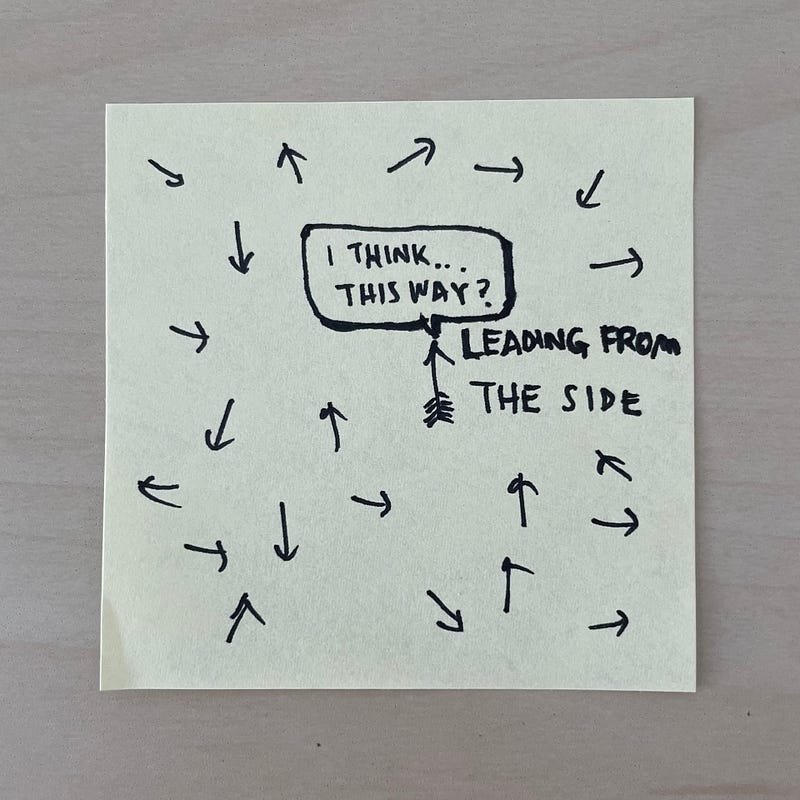
Leading from the side is a mode of operating that might better suit an introvert. For most of my early career this was an approach I would take because it felt most natural to me. I’ve seen myself more as an enabler, and the people I serve as their leader are folks who I’m charged with empowering. Hearing their visions for what should be the future, and then figuring out how to bring everyone along, is an approach I took in the late 90s when I led the Aesthetics + Computation Group at MIT.
But the problem when leading from the side as a kind of “player-coach” approach to moving things along is that it won’t feel natural to the folks you’re leading. Why? Because most of us are accustomed to just the lead from “the front” model and aren’t sure why the Coach is hanging out with the Players. “Is s/he/they trying to micro-manage us???”
Surprise! There’s a fourth method! Lead from the front while walking backwards to check if people are still following you.
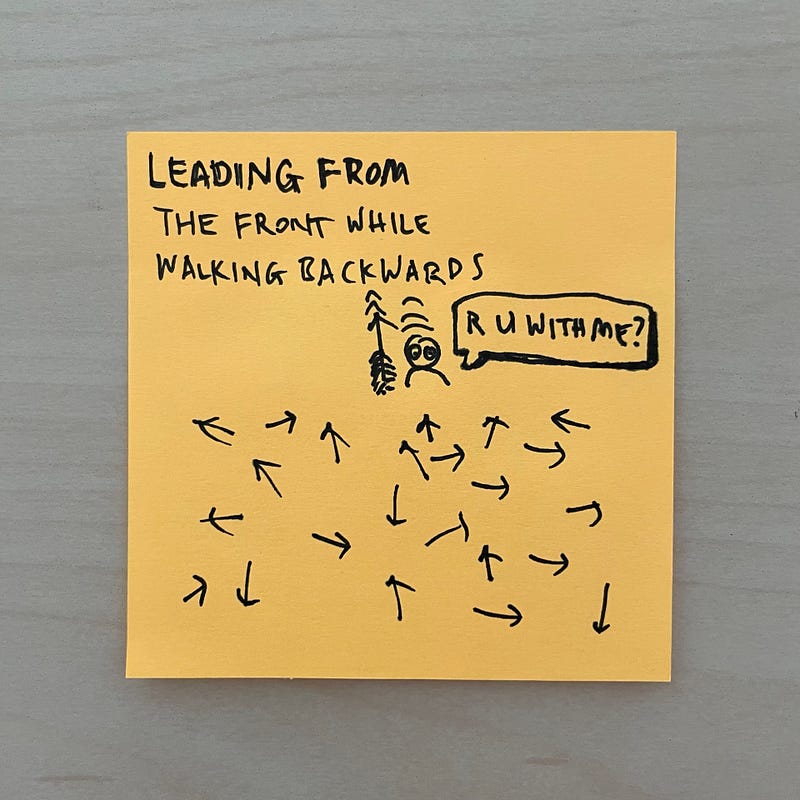
There’s a fourth method for leading that I discovered while working in venture capital at Kleiner Perkins from entrepreneur Lakshmi Pratury.
Tour guides at the Pentagon are trained to walk backwards to face their audiences while traversing the system of hallways. I wondered how they avoid bumping into things — turns out that: 1/ they practice a lot, and 2/ the tour group will often warn the guide if he’s about to bump into something.
I thought it a good metaphor for leadership — facing your team and walking backwards some days to keep their attention fully on you so that you can direct. To eventually getting to turn around and walk fast again and count on them to follow. —JM (2014)
Seems simple enough, but it’s often hard for the person leading from “the front” because they can get over-fixated on where s/he/they’s taking things. Turning around and checking if anyone’s following you in the front, in the middle, and in the back—by having as many ongoing conversations as possible—means that you might bring everyone along into the future.
Hopefully you won’t get eaten. Hopefully they won’t get eaten. And ideally all turns out as well by collectively moving your organization forward.
When leading where your teams are going, you also need to know whether they’re following.
As a longtime student of leadership and how it works (and doesn’t) I’m building “the useful MBA” right now that I’ll be testing soon 👇