
Writing Prompt Response
Where Salt Water Meets Fresh Water
Living near the fish ladder
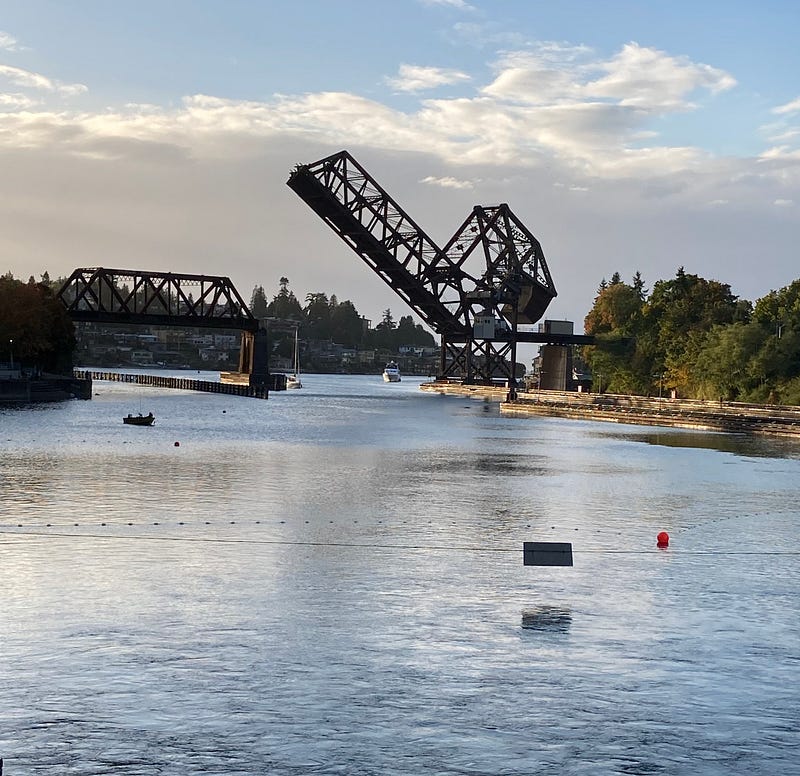
When I was a kid growing up in the suburbs, my family would often take a little drive into town to visit the Ballard Locks in northwest Seattle, where the saltwater Puget Sound meets the freshwater Lake Washington.
The Locks are a pretty cool engineering construction: they allow boats to cross between the different bodies of water. The Locks will raise or lower the boats as needed because the lake is about 20 feet higher than the sea level of the Sound.
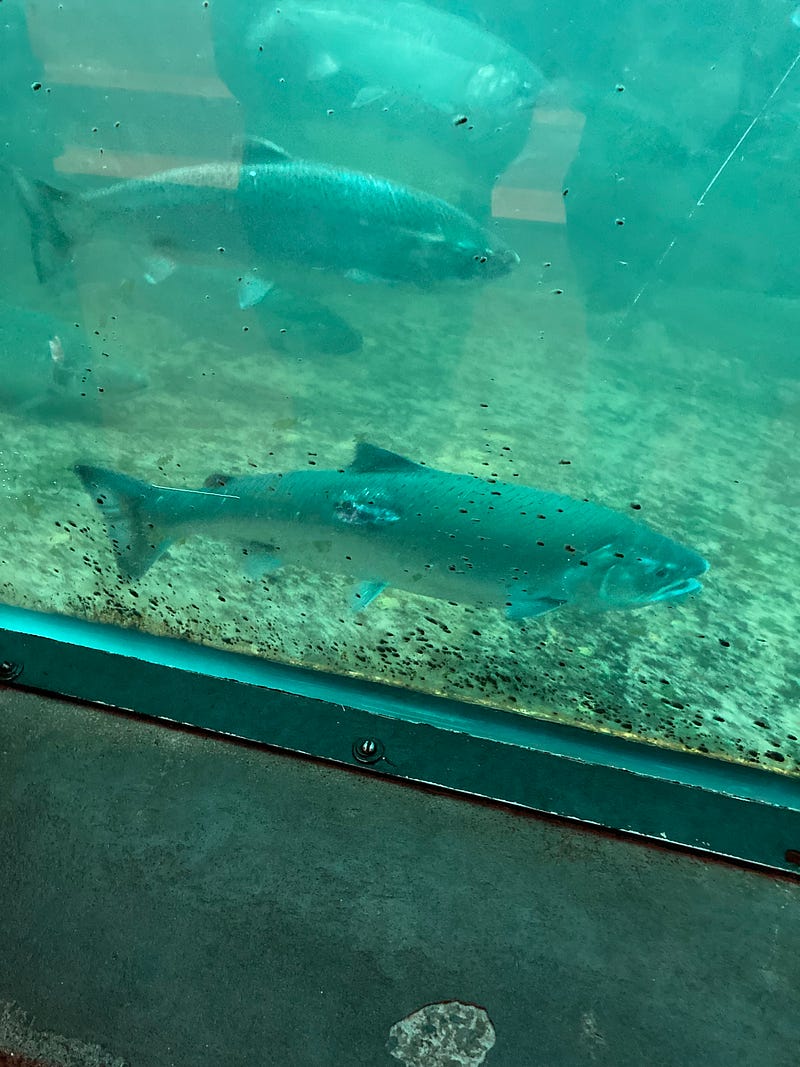
There’s also a fish ladder at the Locks, with underwater windows where you can see different types of salmon (Silver, Sockeye, Chinook/King…!) up close as they make their way from the saltwater to the freshwater streams where they were born. It’s a “circle of life” kind of moment because the fish are returning to the streams to lay eggs and die.
It’s not easy for the salmon to swim up the fish ladder because there are many steps in the ladder, and the fish are swimming against the current and jumping from level to level. I remember my dad saying when my brother and I were little, “See how hard it is if you try to throw your own body out of the water the next time you’re at the swimming pool.”
But it’s also exciting for the fish because they can feel the freshwater mixing in with the saltwater, and sometimes you can look out across the Sound and see fish just randomly leaping out of the water. They know they’re getting close to reaching their original home.
The fish have been on a long journey, and sometimes they look a bit worse for wear like the one at the bottom of the photo below.
Well, I’ve always liked going to the Locks, as a kid and now as an adult. It’s one of the best free outings in the Seattle area. There are also public gardens at the Locks, and lots of nice places to spread out a blanket for a picnic.
When I was a foster parent, I liked taking my foster daughter there. One time as we were looking down into the saltwater to see what we could see, we spotted a huge jellyfish: we could see its body moving with the current. We also saw a harbor seal. Seals and sea lions sometimes visit to go fishing, as do blue herons and LOTS of seagulls.
Earlier this week, I talked with Trish (my former partner) and we decided to take our (former) foster daughter to the Locks to see the large salmon run that has been happening this September. She hadn’t been there since she was maybe four or five years old, so now at age 12, she had a lot of new questions about how the Locks work and where the fish are going.
And something out of the ordinary happened on this recent visit. While we were watching some boats, Trish mentioned how we used to like to say hello to our (late) friend Vicki as she worked at the Locks, operating the mechanisms of the gates and the water flow, helping secure the boats, etc. Right after Trish mentioned Vicki, I saw the bench pictured below, a memorial for Vicki that happened to be right next to us.
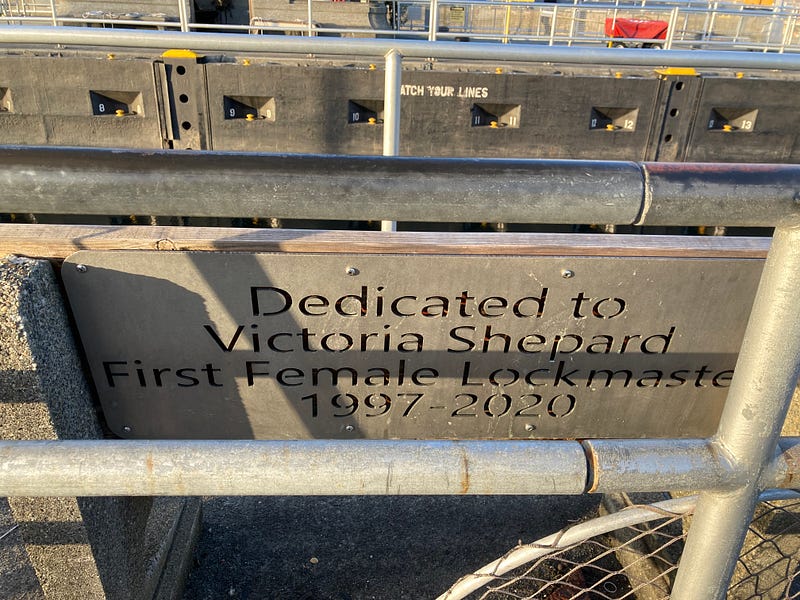
I pointed at the bench and asked Trish if she’d thought of Vicki because she’d just seen the bench, and she said she hadn’t seen it at all until that moment as I was pointing it out. Maybe it was a coincidence, or maybe Trish had seen the bench out of the corner of her eye without realizing it, or maybe Vicki was greeting us somehow (though differently, of course, than she used to).
I hadn’t known Vicki was the first female Lockmaster before I’d seen the bench, so it was cool to find that out. I sent some photos of the bench to a friend in California who had been good friends with Vicki, and she appreciated seeing the tribute from Vicki’s longtime coworkers.
The Locks are about people, and about fish and sealife and shorebirds, and of course about the waterways in our world. Visiting this park is to experience our local environment and how we all co-exist here in our Seattle-area home.
All in all, the Locks are a uniquely urban place to see fish in their wild saltwater and freshwater surroundings. The salmon are moving through our lives, carrying on to complete their instinctual to-do list and to lay their eggs for a new generation of fish to go out to sea and come home again.
Thanks to Sahil Patel for the recent Flickering Fish prompt:
And for your reading pleasure, I might also recommend these stories I read recently. First, from Celeste Wilson, a story with some really cool photos of visual art creations that show what you can make with just a pen and some paper.
And then from Caroline de Braganza, a poem that offers an alternative to the ideas of self-improvement gurus. If you’ve ever seen a popular self-improvement book and just not been able to relate to the buzz about it, you might relate to Caroline’s poem.


