
Fiction
Where Refrigerators Go to Die
Origin of a soldier
My best friend Tommy sits on the roof of his parents’ house, legs dangling. “Hey, man!” I yell up to him, “You’ve been sittin’ up there all day.”
“I know it,” Tommy mumbles, wiping a grimy sleeve across his face, cradling a rifle in his other arm.
“Your mom’s kinda worried about you. It’s getting dark now, see?” I nod toward the multi-hued horizon.
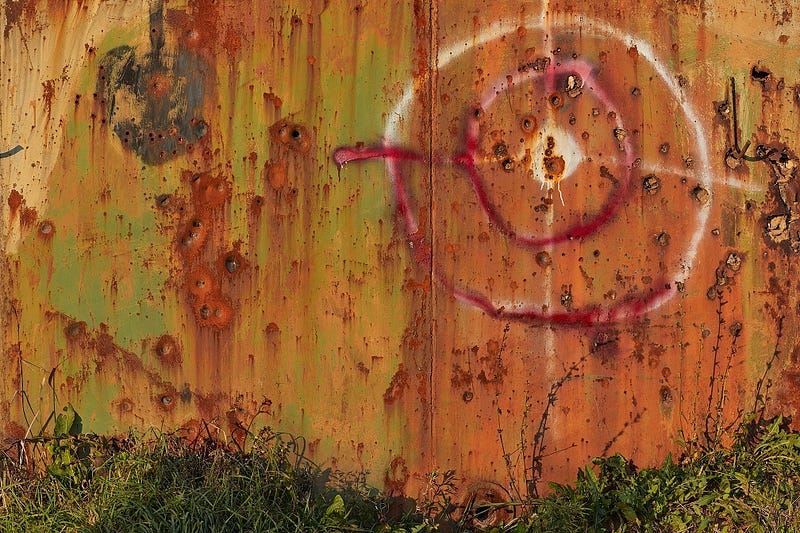
Tommy shoulders the .22 and aims at one of the white porcelain hulks scattered about his family’s backyard. His dad was an appliance repairman before going off to the war. By the looks of it, there were a lot of things that were beyond repair.
Pop!
The rifle spits and a small, round chip appears in the enamel of one of the appliances — an old stove maybe? Tommy cocks the gun angrily and sniffs. The spent shell tinkles down the roof tiles and joins a small pile of brass in the dirt below.
“Can I come up?” I ask.
“It’s a free country,” says Tommy.
I walk to the side of the house, hop up on the A/C unit, and then climb the trellis (on which nothing has ever grown) to the rooftop. Tommy and I are in the same high school class and we have been buddies since middle school. The roof is an infrequent, but important, meeting place where we talk about serious stuff like girls and music. I carefully shuffle down the incline and sit down beside Tommy.
“I don’t think I’ve ever seen you hold that thing,” I say to him.
“Never wanted to before.”
Up close, I can see evidence of sadness on his ruddy cheeks, the lines of recent tears. But there is fury too, a stern tightening of the eyes as if focused on a mortal enemy. I don’t know how to process the sudden change in him, so I look down at my own sneakers, swinging in the air.
“I…I heard about your dad today. I’m really sorry,” I offer awkwardly.
He sniffs again and tries unsuccessfully to hold back a sob. His voice breaks as he says, “The bastards killed my father,” the words crackling with hatred.
Tommy’s father had been passed up for the first few draft calls, partly because he was a flight instructor at nearby Fort Rucker, and partly because of Tommy, his mother, and little sister; he had a family to support. But this is 1968. Everyone is needed, they say, for a new counter-offensive in the jungle. And for reasons I don’t understand, Tommy’s father was actually eager to join and go fight. Today, less than a week after watching his father walk away in his olive-green flight suit, they received word that he had been killed in action. Just like that.
Pop!
I jump at the sound of the rifle shot and almost fall off the roof. The bullet ricochets off an old washing machine and careens into the twilight with a high-pitched whine.
“Dammit, Tommy! What the fuck are you doing?”
“Sorry,” he says, “I’m just practicing.”
“Practicing for what!?” I scream, ears still ringing.
“I’m gonna kill ‘em,” he says, “Kill all of them or as many as I can. I’ve decided to volunteer, join up.”
“Man, what are you talking about? We have college coming up. And besides, you’re no fighter. I mean, look at you.”
I’m not being cruel. We both know we are nerds, not knights. Both of us are pretty regularly beaten up in school for being “smart-asses” which basically means we answered a question in class or flattened the grading curve on a test. Tommy in particular is short, chubby, and sensitive. A perfect target for the jocks and bullies at the top of the high school food chain.
“I know I’m not ready yet, but I will be,” he explains. He’s thought this through, I guess.
Retreat begins to play on Post, the distant musical notes wafting in and out with the slight breeze. Every day at dusk the soldiers at the Army base retire the flag while a lone bugler blows this lonely tune, at once melancholy and courageous. We both know from long experience that all the cars on Main street in our little town, the one leading into the main gate of the fort, will have pulled over, their occupants standing beside them with hands over their hearts. Tommy and I continue to sit where we are, but we remain quiet until the final note fades away with the sun.
“Where the hell is Viet Nam anyway?” I ask to break the silence.
Tommy says, “I looked it up when dad left. It’s in the middle of nowhere, someplace near China. Barely a speck on the atlas. I still don’t know why he had to go over there.”
Attempting to be helpful and lamely trying to justify why his dad’s long journey only to be killed in his first battle might have been worthwhile in some way, I relate a theory I heard from some GIs at the burger joint where I work after school. Something about dominoes and Communism, but I probably get it all wrong because the logic doesn’t hold. My voice trails off before finishing.
“I don’t care about any of that,” Tommy replies. “I just know they killed him, and now I want to kill them.” The last part was delivered through clenched teeth.
“What about your mom and sister?” I ask him, trying to switch to a more pleasant topic. “Don’t you need to stay here and take care of them now?”
Tommy shifts his weight to hand the rifle over to me. He answers, “Well, somebody’s got to pay the bills now that Dad’s gone. They’ll get used to it, I guess. Actually, I’m hoping you’ll keep an eye out for them, at least until you’re off to college.”
I’m holding the .22 on my lap. It feels leaden and dangerous. We can hear helicopters, another common sound here, approaching from behind us. Seconds later, a pair of Hueys in tight formation make a loud, low pass directly over us, en route to the nearby heliport, or perhaps the firing range.
The light has nearly gone now, with only a deep red sliver marking the far horizon. The appliances in the backyard are no longer distinguishable. Their porcelain exteriors, strewn about at odd angles, resemble ancient gravestones in the rouge glow. I hand the rifle back to Tommy without firing it.
“Do you really hate them that much, Tommy? Enough to change everything, to give up all your plans and become … someone else?”
Tommy raises the gun again and aims at one of the ghostly monoliths in the distance.
“I do,” he says just before pulling the trigger.
Pop!


