
Where Languages Clash: Belgium’s Language Border
The complex role of language in Belgian society
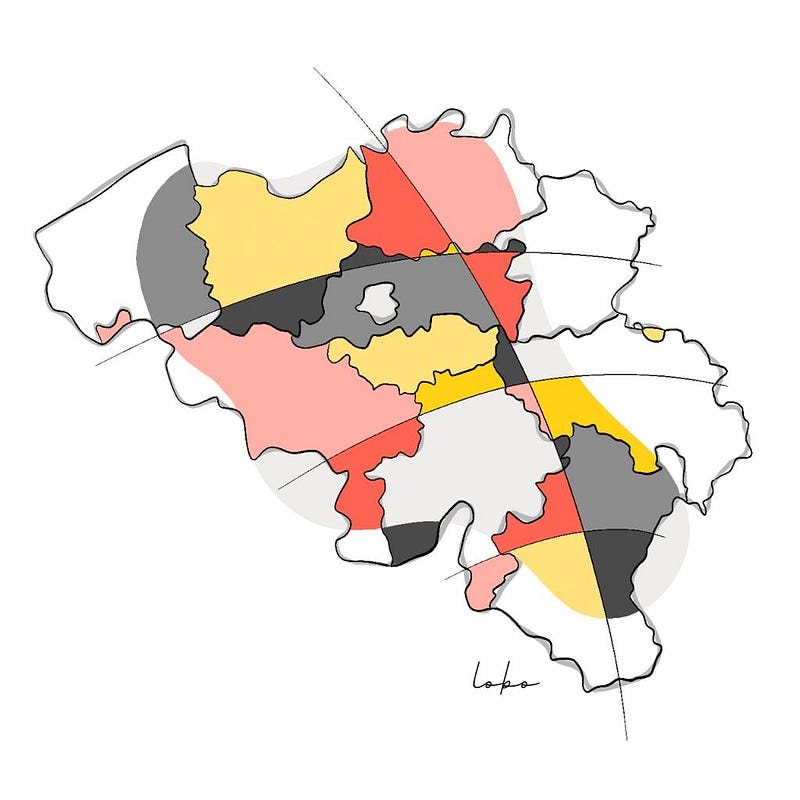
Let’s have a little quiz, shall we? What language do they speak in England? English, you say? That’s right. And in France? Yes, French. That’s too easy. What about Indonesia then? Indonesian? Close, but not quite right. It’s Bahasa Indonesia. Now a really hard one: Belgium; what language do they speak in Belgium?
Many countries around the world house an array of different languages. Let’s take Indonesia, one of the most linguistically diverse countries in the world, as an example. In 2021, 711 languages were spoken in the country. Even in this diverse linguistic landscape, there is one official language: Bahasa Indonesia. 94% of the population knows it, while it’s the primary language of merely 20% of the populace. It functions as a lingua franca, a common language used to communicate across an area where many different languages are spoken.
There are few countries in the world without such a dominant language. Think of South Africa, Switzerland, Luxembourg or India. But you’ll rarely find a country with two equally dominant languages, which both enjoy official status on the national level.
Belgium is such a country. The country hosts 11,5 million people, of which 59% speak Dutch as their primary language, 40% French and 1% German.
How did this situation come to be, what role did linguistic division play in the creation of Belgium, and how does it affect the people living there today? Well, turn on your fryer, grab a waffle and pour yourself a beer, and journey with me to the land where languages clash, to find out how the linguistic frontier affects Belgium.
The language battle
The territory which is now occupied by Belgium has served as a battlefield many times throughout its history. In Roman times, the armies of the emperor fought Germanic tribes for dominance of the region. Napoleon was defeated at Waterloo, which is not only the name of a popular Abba song but also of a small Belgian town south of Brussels. During the First World War, the allied powers and the forces of the German empire sheltered in trenches near Ypres, just north of the French-Belgian border. Throughout history, lots of blood has been spilled on the land which we now know as Belgium.
Belgium was also the battleground for a less bloody battle: the Language Battle (Taalstrijd in Dutch and Question communautaire in French).
This battle began in the 18th century, when Belgium was part of France. The French rulers promoted the use of their language and it soon became the tongue of the elite; a lot of official and social business was conducted in French.
Between 1815 and 1830, after the fall of Napoleonic France, Belgium was part of the Netherlands. The Dutch tried to counterweight the influence French had gained by making Dutch the only language allowed in primary education. Over the years, king Willem I of the Netherlands introduced more and more anti-french policies, which upset the largely francophone Belgians.
The repression of the French language was one of the many causes of the Belgian revolution, in which the country gained independence from the Netherlands and became a sovereign nation.
In the early years, French gained popularity again and Dutch was reduced to a language for informal interactions. French was declared the official language of the new Belgian state.
But the Dutch speakers did not disappear into thin air and not all of them were happy with the new status quo.
Throughout the 19th century, a political movement of Dutch speakers fought for the right to use their native language in their native country and little by little, they succeeded. In the late 19th century Dutch was recognised as an official language.
In 1921 a new language law was introduced, which required for a linguistic census to be held every 10 years. The results of this census were used to determine which language would be used on an official level in the municipalities across the country.
This situation continued until 1962 when an official, permanent linguistic border was established. In the 70s, a process of federalisation began, which would divide Belgium into states along the lines of the linguistic frontier. The north-western, Dutch speaking state came to be known as Flanders and the south-eastern, French speaking one as Wallonia. The capital of the country, Brussels, became its own state and would be officially bilingual.
How language shaped Belgium
Present-day Belgium is, at its core, formed by the language battle and language is still a major factor in many of its modern problems.
So, dear reader, before we do anything else, let me paint the battlefield for you. Belgium is a small country in western Europe, bordering France in the south, Luxembourg in the south-east, Germany in the east, the Netherlands in the north and the North Sea in the west.
Belgium is divided in 10 provinces, 5 of which belong to the federal state of Flanders and are therefore Dutch-speaking. That leaves the 5 French-speaking provinces for the federal state of Wallonia. Brussels is its own federal state and does not belong to any province. As stated earlier, it’s officially bilingual.
Each of the federal states have their own governments, in addition to the central government, which are democratically elected by its respective subjects through a compulsory, yes compulsory, voting process.
Very complicated, right? How can the country even function? I don’t know. And the worst part is that we’re not even there yet. We still have two more governments to discuss.
The linguistic division in Belgium promoted the creation of language communities, which over time have gained responsibility for matters directly relating to people speaking the language of the community, like sports, education, media and culture.
The Dutch language community has merged with the Flemish government, because their geographic areas of influence largely overlapped, with the exception of the Brussels Capital Region. But the French language community remained separate from the Walloon government, because, surprise surprise, within Wallonia, there is another language community: the German one.
German speakers make up about 1% of the Belgian populace. They are concentrated in what the Belgians call the East Cantons, which were given to the Belgians from Germany after World War I.
Each of the country’s different governments is made up of separate political parties, which all have to work together on a national level to form a government. This has proven to be very difficult numerous times.
In 2010–2011, Belgium was without a government for 541 days, which is actually the Guiness World Record. The Walloon parties and the Flemish parties could not come to an agreement on a great many topics, one of which was the status of the French language in Flemish municipalities surrounding the Brussels Capital Region.
Language in everyday Belgian life
The linguistic division of Belgium does not only cause political difficulties for the country, but is at the source of many cultural problems, too.
Dutch speakers generally speak very decent French as a second language. In fact, French is a mandatory subject in the Flemish educational system from the 5th year of elementary school. Especially in regions where there is a lot of interaction with French speakers, like at the borders with Wallonia and France, or around the Brussels Capital Region, Flemish people usually know enough French to get by.
Currently, in Wallonia, the number of Dutch speakers is a lot lower. For the French speaking population, it is mandatory to learn at least one foreign language at school, but they can choose between Dutch, English and German. As a result, only 47% of students study the Dutch language in secondary school.
This causes tension from the Flemish side. “Why do we have to speak their language when they can’t speak a word of ours?”.
I, your humble writer, have many friends who are Belgian or grew up in Belgium and have heard frustration being voiced about this subject many times. Especially by the ones who grew up in linguistically diverse areas.
Another source of resentment from the Flemish to the Walloon population is the fact that Brussels, the officially bilingual capital, is rapidly becoming a monolingual, francophone city. Historically, the Brabantian dialect of Dutch was the main language in the city, but through centuries of migration from French-speaking areas of Belgium, France and former French-speaking colonies, French has become more and more important in Bruxellois life. This was accelerated when, in the 20th century, Brussels became a hub for international organisations, which promoted the use of French.
Official numbers describing the Dutch-French division in Brussels are hard to come by, since the census in which they were last measured was held in 1947, but the Flemish news outlet, VRT, reported that in 2019, 91% of Brussels’s inhabitants filed their tax forms in French, while only 9% opted for Dutch.
Even though, most Flemish people and some Walloon people are able to speak the language of the other community, they usually tend to stick to their own part of the country. While language created Belgium in its modern form, it is also the reason for its present division.
Belgium effectively consists of two different countries, between which there is a lot of underlying tension, and yet it is still an amazing country to live in, being the 25th most successful economy in the world according to the international monetary fund. In addition to that, the country is known for its excellent education, with the KU Leuven university, which consistently ranks among the top universities in Europe, as its crown jewel.
But, if everything else fails, Belgium is and always will be, a language lovers’ paradise!
Enjoy my writing? Then follow and subscribe, and you’ll be the first to know when I upload a new story. If your not a Medium member yet, I would appreciate it if you’d consider signing-up through my referral link. If you do, you will support my writing at no extra cost and you will gain unlimited access to all of the amazing content that Medium has to offer. Like the image I used for this article? You’ll find more like them on: https://www.isabelsophielobo.com/.


