
Where Have All the Public Pools Gone?
An ugly history has left America with few community swimming pools, just as rising temperatures make them more valuable than ever for health, safety, and societal well-being.
This article is part of a Wise & Well Special Report: Extreme Heat and Human Health.
More than just summertime fun, public pools are good for people. They can help improve physical fitness, mental health and societal connectedness. Community pools are where many American kids used to learn how to swim. So where have all the public pools gone? Why have they virtually disappeared from urban areas?
The decline in public pool access across the United States—unfortunately occurring as the need only increases with a warming climate—is rooted in a long and ugly history of racism. Many cities stopped investing decades ago, as desegregation forced changes in who could jump in.
I’m fortunate to have access to a local pool. And as I gripe about the limited hours and the fees I pay, I remind myself that the pool is keeping my weight and blood pressure down and my moods up. But as a nurse, I wonder how many people would benefit from greater access to pools to improve their own health, not to mention learning to swim in order to reduce drownings and simply bringing communities together.
Some public officials are starting to wonder the same thing.
High rates of drowning recently spurred the development of the first US National Water Safety Action Plan. Among the strategies: Build or revitalize publicly accessible pools. Whether communities view public pools as an intervention that can improve health or see it as an unnecessary luxury may determine the willingness to support the strategy.
“Here we were, complete strangers, a diverse collection of humanity, practically naked and standing around having fun together.” — Richard Friedman, author and swimmer
Healthy starts and decrepit endings
Public pools in the United States were initially constructed for bathing and hygiene purposes. By the 1930s, cities were building grand pools large enough for thousands of people to enjoy, and a new focus on social health and swimming for physical fitness drove investments in public pools.
“It is an undeniable fact that adequate opportunities for summer bathing constitute a vital recreational need of the city,” Robert Moses, a New York City commissioner who pushed for pools and safe water access, said in a 1934 press release. “It is no exaggeration to say that the health, happiness, efficiency and orderliness of a large number of the city’s residents, especially in the summer months, are tremendously affected by the presence or absence of adequate swimming and bathing facilities.”
These benefits, however, were limited to one segment of the population- until desegregation and the efforts of civil rights leaders. Then the law required public institutions, including pools, to be available to everyone.
Legally opened pools did not lead to open swim time for all though.
Many communities chose to pull the plug rather than integrate. Other pools fell into disrepair as city tax revenues declined. Private pools and clubs sprang up with high member fees that continue to this day. The backyard pool industry grew and marketed pools as luxury items.
Unsafe water access and drownings
The backyard pool construction trend that started in the 1950s led to residential pools outnumbering public places to swim by a long shot. The Pool and Hot Tub Alliance reports there are 10.7 million swimming pools in the United States as of 2022. Nearly all — 10.4 million — are private pools located in backyards, and apartment and condominium complexes.
However, private pools are a serious risk for drowning. Drowning is the leading cause of death of children ages 1 to 4.
“Where known, 73 percent of nonfatal incidents in children under age 5 that led to emergency room visits occurred at a residence,” according to the US Consumer Product Safety Commission (USPSC), which reports fatal and nonfatal drownings in residential pools. “Two-thirds of reported fatal child drownings in pools or spas occurred in residential settings such as the victim’s home, the house of a family member or friend, or a neighbor’s residence.”
A reduction in publicly available pools is also thought to contribute to the low rates of swimming ability, especially among Black people and people of low income. Based on an American Red Cross survey, 79% of children in families making less than $50,000 a year cannot swim or have low swimming abilities. By race and ethnicity, 64% of Black children, 45% of Hispanic, and 40% of white children can’t swim or have low ability.
When it gets hot, as with the extreme heat waves of 2023, drownings increase. With the exception of small children age 4 and younger, more drownings occur in natural water sources than in pools. Risk factors associated with these drownings include a lack of access to safe places to swim, people with low or no swimming abilities, alcohol use, and other risk factors.
Rural areas, many of which have significant natural water sources and few public pools, have drowning rates 1.4x higher than urban areas. The top state for drowning, according to the CDC, is Alaska, followed in order by Hawaii, Montana, Louisiana, Florida, Arkansas, Mississippi, Oklahoma, Idaho, and Oregon rounding out the top 10.
While drowning is the most obvious health issue, there are significant other health priorities that public pool access can also impact.
You don’t have to swim laps
The Office of Disease Prevention and Health Promotion sets national priorities for improving health. These include reducing obesity, increasing physical activity, addressing chronic conditions, and aging concerns, all of which water activities can positively impact.
Pools offer a place to improve both physical and mental health and you don’t even have to swim laps to reap the rewards. Physical activity in the water can include water walking the shallow end, aqua jogging, and a number of water aerobics, flexibility, and strength training classes available at many pools. Or just play.
As the population ages, these water-based activities are also gentler on the joints and work well with older adults’ ability to regulate their body temperature than other forms of aerobic exercise.
While Robert Moses, the New York official, was the force behind public pools to improve health in the 1930s, at least one of today’s politicians recognizes the health value of public pools in a different way:
“Swimming is mental health. It’s therapy. You have to have activities. It’s bigger than just a pool,” said Louisville Councilwoman Tammy Hawkins
Based on the research, Hawkins is right. Mental health is another public health priority that pool access can impact. Water-based activities have been shown to reduce depression and anxiety and improve mood. One study found that people enjoy working out in the water over other forms of exercise. The value of “blue spaces” is about the power of being around water, whether natural or constructed, and water’s effect on moods and mental health.
Who knew just sitting by the pool could be healthy for you?
Pool lounge chairs for health
Public pools also have the potential to impact one other health priority of today — improving social connectivity with one another, a concept that is starting to get a lot of attention with the research on health risks of loneliness and social isolation.
“Social connection should be viewed and treated as a vital sign much like physical activity,” the authors, including a physician, state in an article in the American Journal of Lifestyle Medicine.
Recently, the US Surgeon General, Dr. Vivek Murthy, declared an epidemic of social isolation and loneliness and took the unusual step of issuing a public health advisory to address the problem. The physical and mental health risks of social isolation for individuals are outlined at length in the advisory, but also the benefits to communities of better social connectedness.
“Communities where residents are more connected with one another fare better on several measures of population health, community safety, community resilience when natural disasters strike, prosperity, and civic engagement,” said Murthy.
The social nature of public pools provides an opportunity for social connectivity, benefiting individuals and communities alike.
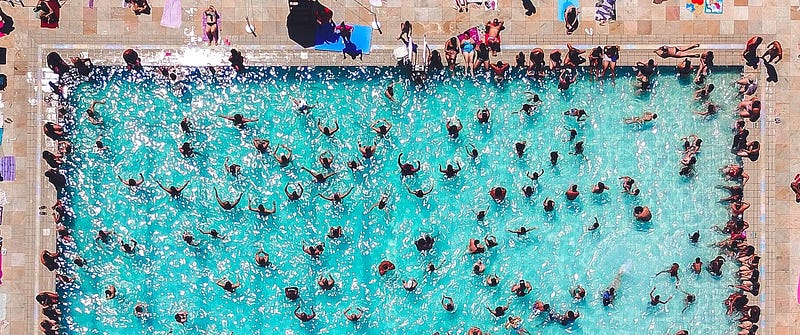
“I..(was) struck by the strange intimacy of it all: Here we were, complete strangers, a diverse collection of humanity, practically naked and standing around having fun together,” says Richard Friedman, author and swimmer. “That is the whole, beautiful point of a public pool: to exercise and cool off with loads of people around.”
Will communities dive in?
Whether communities will rise to the challenge remains to be seen. Barriers include high energy costs of pools and limited availability of environmentally friendly pools, a lifeguard shortage crisis, and the need to shift the demand for pools from backyards to communities.
“There’s a fantastic amount of wealth within the United States, and yet we’re extraordinarily parsimonious in our willingness to fund public swimming pools,” Jeff Wiltse, author of Contested Waters, said recently.
The nation’s new Water Safety Action Plan calls for improving public pools to prevent drownings. Public pool access can also make a difference to so many other health problems. Paying for swimming is a part of my budget because it helps keep me healthy. I’m fortunate to have access to a public pool. So many Americans do not.
Will an investment in public pools be an investment in health again? Or have cities turned their backs on public pools forever?


