avatarSusannah MacKinnie

Summary

The text reflects on the profound sense of loss and longing experienced by adults who have witnessed the disappearance of children from their lives, a poignant metaphor for the impact of time and change.

Abstract

The poem "Where Have All the Children Gone" by W.S. Merwin captures the melancholy of adulthood, where the joy and vibrancy of childhood have faded away. It describes the gradual departure of children, symbolizing the loss of innocence and the passage of time. The author reminisces about the twins, the Patterson family, and other children who used to fill the air with laughter and playfulness. Their absence has left a void, turning the once lively environment into a silent, desolate landscape. The poem suggests that this loss is not just felt but has fundamentally altered the fabric of everyday life, leaving the adults in a state of perpetual waiting and hoping for the return of the children, which represents the return of their own youthful spirits. The inspiration for the poem is drawn from the song "Where Have All the Flowers Gone?" by Pete Seeger and the sight of deserted playgrounds during the pandemic, as well as the author's reflections on the story of Winnie the Pooh and Christopher Robin.

Opinions

  • The author believes that the absence of children has a profoundly negative impact on the adults left behind, causing heartbreak and a sense of darkness and constriction in the world.
  • The text conveys a deep yearning for the past, for the return of the children and the associated joy and carefree nature of youth.
  • The poem suggests that the loss of childhood companions is akin to a thread that runs through the fabric of one's life, coloring everything with its hue of absence.
  • The author implies that the solitude resulting from the children's departure has been reluctantly accepted, leading to a life surrounded by isolation.
  • The piece reflects on the human condition, expressing that absence does not necessarily make the heart grow fonder but can instead cause emotional wounds and a sense of narrowing in life.
  • There is an underlying hope that the future will bring back the happiness of the past, symbolized by the potential return

Childhood

Where Have All the Children Gone

When will they come back to play
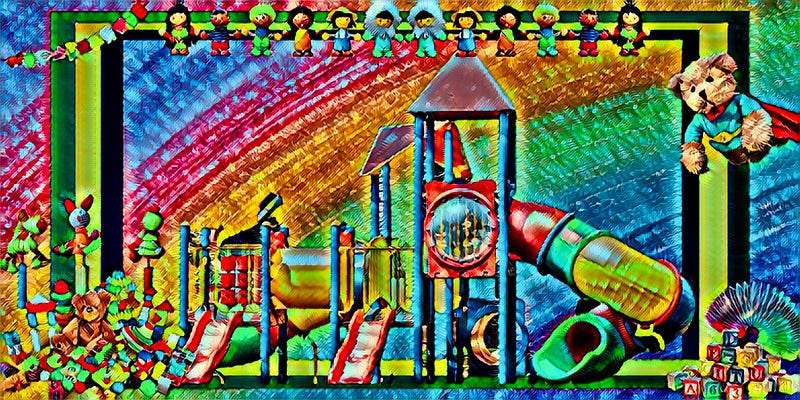
Image created by the author on Canva and Prisma

Your absence has gone through me

Like thread through a needle

Everything I do stitched with its color.

W.S. Merwin

The twins were the first to go, Followed by the Patterson family, Six cousins, every Saturday visitors.

Poof!

Now we see you. Now we don’t.

Child by child vanished From our sight, Remained within the boundaries Of home and walls and a fenced backyard.

We struggled to recall your touch, Sliding, swinging. The smell of being young happiness Clung to us long after you left.

The barometer of our being Became a barren landscape, Empty of laughter and tumult, Abandoned.

Absence does not make the heart grow fonder. Absence breaks the heart. Absence wounds and narrows, Makes the world dark and small.

Too soon we accepted our solitude, Watched the isolation surround us, Encroaching everywhere. When will you return?

The sun shines from a life we used to know. We hope that tomorrow will bring back yesterday, Return recreation, re-creating Squeals of delight, flying hair, smiles.

We listen for your voices. We hope for your laughter. We wait And keep waiting.

A congruence of influences resulted in this poem.

I listened to songs by Peter, Paul, and Mary. Where Have All the Flowers Gone? inspired the poem’s title.

“Where Have All the Flowers Gone?” is a modern folk-style song. The melody and the first three verses were written by Pete Seeger in 1955 and published in Sing Out! magazine Additional verses were added in May 1960 by Joe Hickerson, who turned it into a circular song. Its rhetorical “where?” and meditation on death place the song in the ubi sunt tradition….Wikipedia

I remembered seeing the local playgrounds blocked off so no children could play there.
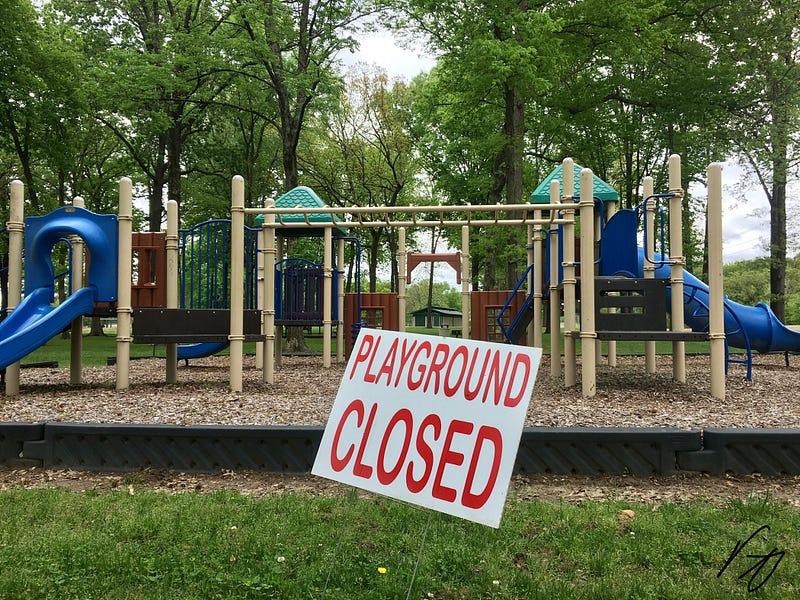
Author’s photo

I thought of Winnie the Pooh waiting for Christopher Robin to return to the Hundred Acre Wood.

Wherever they go, and whatever happens to them on the way, in that enchanted place on the top of the forest, a little boy and his Bear will always be playing. A. A. Milne

Poetry
Storytelling
Children
Play
Grief
Recommended from ReadMedium