
Where Giants Sleep
A pilgrimage in a land of magic
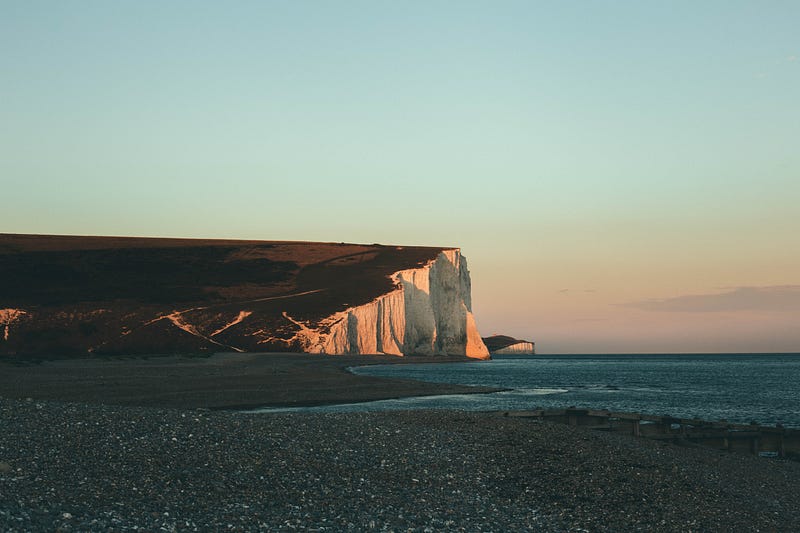
“The real magic lies not in seeing new landscapes, but in having new eyes.”
— Marcel Proust
Of all the places in the world to be, I am standing at the top of Firle Beacon, looking out over layers of time and space.
Behind me the land slopes away to the sea. Below me the flat expanse of the Weald spreads out in a rich carpet of dense green. Once a primeval sea-bed and later a vast, pristine forest known as the Waste of Ondred, it doesn’t take much to imagine great herds of deer, wolves, bears and wild boar roaming these lands, owls and eagles soaring overhead.
I feel a strange longing for them to come back.
Although these days the woodland is mostly carved up, threatened and fragmented by development, from up here it appears strikingly whole: a land still rich in magic and mystery, a place of twinkling villages, moated castles, sacred springs and hidden groves, where giants, fairies, bandits, witches, ghosts and dragons might still be real.
It’s also home. I can see the places where I have lived since moving to Sussex 20 years ago, at the age of 18: the fields of younger, carefree days, the places where I met my husband, became a mother, the villages where my mother and grandmother eventually moved to, the rented cottage I am raising my family in. It’s a mixture of emotions.
Mythologist Martin Shaw calls this “the prayer mat… the stuff of our life.” From up here I can see it all laid out in front of me at once: the songlines of my life, woven into the landscape in threads of gold.
I’ve been swimming around down there on the Weald for years, immersed in the busy-ness of life and early motherhood. At times lately, in the thick of the pandemic, processing trauma and the tidal wave of the climate and ecological crisis, I have felt like I was drowning.
I wanted to get above it all, somehow.
I’m coming up for air.
“Almost everything will work again if you unplug it for a few minutes, including you.”
— Anne Lamott
A strong wind is galloping off the sea. I take off my shoes, turn my face to the wind and ask that it cleanse me, carry away the heaviness and the sludge.
And then I spend a long time just sitting.
“A journey on foot, a slow, thoughtful, reverent walk to a special place, or to no fixed destination — undertaken alone, a pilgrimage is almost like a vision quest in motion. You could even call it a form of spellcasting.”
— Jini Reddy, Wanderland
I’m asking a lot from this journey. To connect with the land and myself, to find healing, solitude, inspiration and enchantment. I am searching for that which is indigenous within me: the stories and songs which have been lost, taken, burned.
I want to remember.
Besides, I’ve decided that in these new days where we can’t travel far, the best way to go is further in.
“The songs of our ancestors are also the songs of our children.”
— Philip Carr-Gomm, The Druid Way
On the way down the ridge, the wind grows stronger, the sky darker and more foreboding. I feel an agitation growing in me. The farmland here looks tired, linear, overworked. Subdued. There’s a barren feel to the empty sweep of hills. I swerve off the Way to allow a loud group of men to pass me by; they seem in a great hurry, shouting over the top of each other, charging onwards to the next thing.
From here I can’t see the wildfires, the melting glaciers, the desecrated rainforests. The bewildering loss. But I can feel the imbalance, the imposition of man on the land, the lack of respect and reciprocity. I see empty spaces before me which once teemed with life.
In my heart I know it doesn’t have to be this way. In my heart, I don’t believe this is the end. But after years of desperate hope, I am leaning into an embrace of uncertainty.
“To be hopeful means to be uncertain about the future, to be tender toward possibilities, to be dedicated to change all the way down to the bottom of your heart.”
— Rebecca Solnit
I still choose hope. I’m a mother, after all. But it feels important to face up to what is, rather than impose my own fantasies. To face the future with courage and an open heart, to feel the grief and the rage and the love of this fragile, living planet, to believe in a better way — and to make it happen.
Across the hills not far from here, a giant figure stands etched into the hillside. Later, I will pass by her on my way home. Known as the ‘Long Man of Wilmington’, she is not really a man at all, but a Goddess, a keeper of the gateway between worlds, her gaze steady and unflinching.
I think she has something to tell us.
If we try too soon to define a new story we will miss this moment of transition, which is the real magic of the present time. To be fully alive is to stand in this doorway, knowing little except the intensity of the moment.”
- Llewellyn Vaughan-Lee, A Time of Fire and Smoke
The white chalk rock crunches and glistens beneath my feet as I reach the ancient burial mound of Long Burgh Barrow, a Neolithic earthwork some 5000 years old. Relieved to be off the ridge and out of the wind, I lie with my back flat against the soft belly of the earth. I feel held by this timeless place, watching the sky flow above me like an endless grey river, pierced with shards of light.
I ponder the hardships, uncertainties and hopelessness our ancestors must have faced. What kind of ancestors do we want to become? A charm of chattering goldfinches rushes overhead.
It’s up to all of us, now.
“It is more important now to be in love than to be in power. It is more important to live for the possibilities that lie ahead than to die in despair over what has been lost.”
— Barry Lopez, Love in a Time of Terror
I walk on through different landscapes and seasons. This is the golden hour, the transition time between summer and autumn. The chalk downland meadows are speckled with sunshine-coloured ragwort, red clover, pink heather, yellow rattle and rare orchids, and the white trefoil said to grow in the footsteps of Niwalen, whose name means ‘The White Track, the goddess of the road, the spirit of the journey’.
From a distance the Downs slumber peacefully — another Goddess, reclining, her curves molded by aeons of ocean waves.
Afternoon light falls viscous over the serpentine river as she writhes through the reed beds, green and lazy like thick glass. This is magic country. The hedgerows are laden with berries, rosehips, damsons and sloes, the hawthorn trees bent under the weight of dark red fruits. Clumps of flowering ivy are bejeweled with bees and butterflies. I forage for nettle seeds and blackberries and pick three plump dandelion flowers and gobble them whole, feeling grateful for such wild abundance.
“What does it mean that the earth is beautiful? And what should I do about it?”
— Mary Oliver
I could follow the river down to the beach, but after the high winds and sea air of the ridgeway, I crave the shade and earthy solidity of trees. I turn uphill and head towards Friston Forest, climbing a steep stairway to find myself in a natural cathedral of mature beech wood.
The high canopy is aglow with mellow, golden-green September light. The light falls and ripples over me in healing waves. The first few leaves of autumn are beginning to drift downwards with an easy grace. I find a quiet spot away from other walkers and ask if I can sit down. Feeling welcomed by these gentle giants, bathed in the peace of their soft green breath, I close my eyes.
If the hills have blown away the heaviness, the forest is putting me back together.
Emerging from the woods, I walk along a pathway edged with ferns, brambles and wildflowers, surrounded by dragonflies and butterflies, too many to count. I am in no doubt now that I have entered some kind of wonderland. This is the enchantment I have been searching for: the earth is singing to me in the soul-language of beauty, and for a moment it takes my breath away, this world, this life.
There is only one place my journey can end. Of all the places in the world to be, I am swimming in the sea off the shore of Eastbourne, bobbing around on my back, watching the silver light play on the water around my toes.
Here in the liminal space between land and sea, summer and winter, present and future, I feel renewed. I am neither old nor really young anymore, but somewhere in between. I think of my husband and two children and feel blessed, glad to know that they are just a train ride away.
I look towards the horizon and see a single white boat, her sail puffed out in the wind. Above me the sky is a deep, impossible blue.
“And, if you feel that prayer mat snug and magnificent underneath you, I ask you to do something else.
Look up.”
— Martin Shaw