
Where Do We Go After Our Last Goodnight?
I’ve lost five people in five months. That’s life. But where are they now?
My life is not exactly a loop of hello darkness . . .
but I’m no stranger to grief and loss. You can’t get to the eighth level without having said a tearful goodbye to at least a goldfish or two. At my age you expect death to come knocking, if not at your own door, then your neighbor’s or your beloveds’. The recent five seems like a big number, but how’d you like 67? I was in my forties and had never served in a war zone. Exactly.
I lived in San Francisco during the ’80s when AIDS ravaged the city. For reasons I won’t go into here, I signed up to volunteer for an organization to give emotional support to the dying and bereaved. People with terminal cancer and widows who’d just lost their husbands. That kind of thing.
It took me a while to make up my mind about the commitment and by the time I made the call, a young man told me, “You know ma’am, we only serve the gay community now. How do you feel about working with people with AIDS?”
I knew what I wanted to do with my free time, with a yearning deep inside me to give something good inside myself to others. “If they’re okay with a straight woman, then I’m okay with them,” I said.
So he signed me up for one of the most exhilarating, heartbreaking, life-affirming, ego-shattering, humbling, and important five years of my life. More about that in another piece, perhaps. But if you knew anything about AIDS in the 80s and 90s, you knew it was a death sentence. And a few years later I stopped counting the number of people I knew who’d died of AIDS at 67, but many more came after them.
Thrown into that mix, in case the universe thought I needed a further demonstration of the power of loss and grief, my best friend, and one of my brothers also passed away.
So losing five? I’m a boss at grief.
More about that in another piece too. Which I’ll title something like Three Quick Steps To Overcoming Grief. Step Number 1: There is no quick step to overcoming grief.
My father died when I was 33. Hard for me to believe, but that was 47 years ago this month. I’ve already outlived him by five years, but that’s beside the point. His death began my serious investigation into where we go when we’re not here anymore.
In case you want the Cliff Notes: I don’t have the answer.
But asking the question and coming up with various scenarios over the years has been an important intellectual and possibly even spiritual exercise. I’m not religious so death has neither upended nor cemented any belief or subscription to organized religion.
By the time my father died, I had long left my Catholic upbringing behind. However, I could never decide on the question of God. Was I an atheist or an agnostic? And that question always led to the sticky question of the afterlife.
If you believe in God, it seemed you must believe in some version of heaven. But suppose you didn’t believe in God? Suppose you just couldn’t wrap your head around the idea of the white-haired old man in the sky you were raised with? Did that mean you automatically had to throw out the idea of going on to another existence after you die?
Suppose you just couldn’t wrap your head around the idea of the white-haired old man in the sky you were raised with? Or any other concept of God. Did that mean you automatically had to throw out the idea of going on to another existence after you die?
Before I looked in my father’s casket, I said definitely yes. I don’t believe in God, and I don’t believe in heaven. My only trouble with that was knowing I’d broken my parent’s heart in leaving their Church. I didn’t break from religion as an act of defiance against my family. I was okay and still am with anybody practicing their faith. It just doesn’t square with my view of life.
I’d always vowed I’d never see my parents after they died. That whole Irish wake and viewing of the deceased in the casket was not going to be for me. I’d remember my mother and father alive, the way I loved them. No morbid ceremonies that had no meaning, that couldn’t bring them back.
For years I girded myself to confront what I knew would be my siblings’ objection when I told them I would not come East when our parents died. And then my father had the last word.
My mother was visiting during my father’s trip to his family farm in Ireland where he was born, his last visit to his mother and father’s grave. You know the sentimental Irish. Except he had a heart attack on the farm where he was born and died in his sister’s arms. My own sister said our brother was bringing his body back to New York for the funeral. “You have to tell Mom. And then bring her home.”
So much for my grand plans.
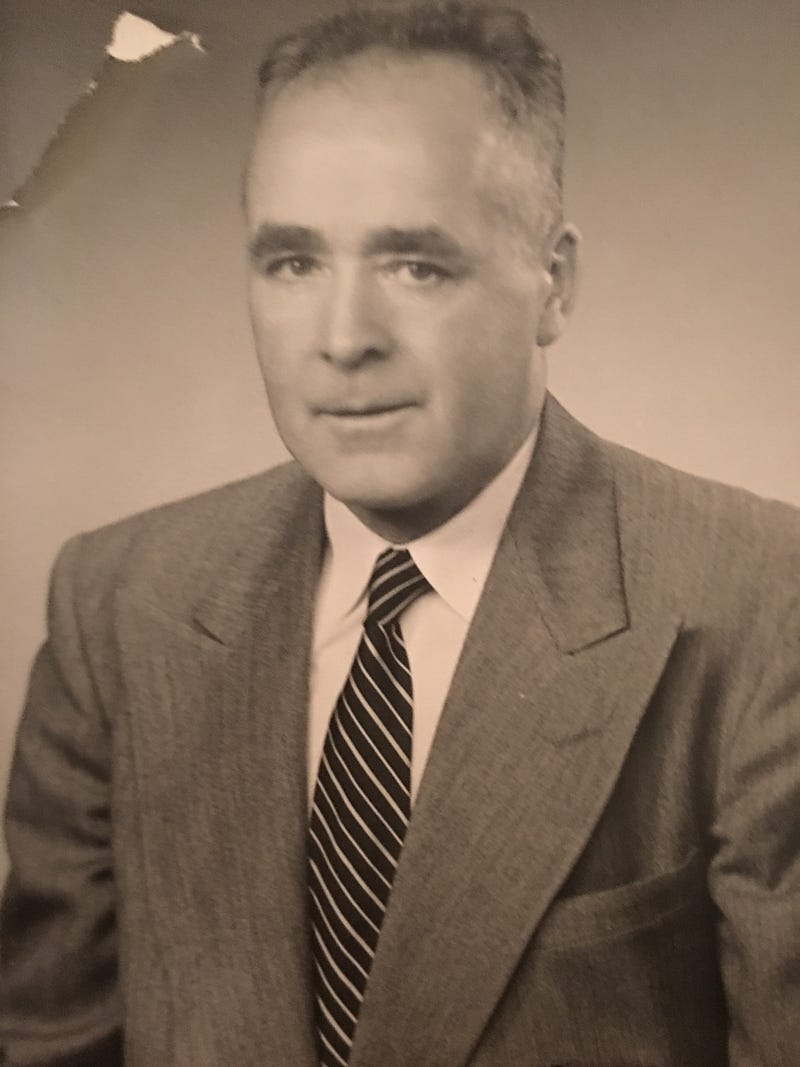
And as I knew I would, I trembled going into the viewing room to see my father in his casket. I could barely walk upright. I later learned the shock of a sudden death will do that, but all I knew at that moment was that I couldn’t bear to see my father’s lifeless body.
And then I reached the casket and stared down at him laid out so neatly in such calm repose. And it hit me like a wrecking ball.
That wasn’t my father.
That lifeless shape no longer contained the pulse and heart of the man I knew and loved, that gave me life. My first thought was, where is he? Because he damn sure wasn’t in the casket.
While my revelation didn’t ease the pain of losing my father, the question has dogged me ever since. Where did he go?
I believe it’s the question we all have to ask ourselves at some point in our lives if we are to find peace while we are living. Because even if we close our eyes to it, death hangs over all of us.
We don’t have to agree on the answer, but I think we need to make peace with the fact that someday we will go to sleep for the last time and come up with some scenario we can live with for what the next moment will be like.
Of course, no disrespect to those with strong religious beliefs on the subject, but I don’t think anyone can know until it happens. But whether you believe you will be reunited with your family in some sort of heaven, or just molder in the ground and that’s the end of you, the idea of death as an end that frightens you loses its power if you’ve said, okay, that’s it. That’s how I think it will be and I’m good. Acceptance is a powerful balm.
Acceptance is a powerful balm.
I was afraid to look at my father in his casket because I was afraid of death. But I never considered that his essence might be elsewhere. And maybe it wasn’t. Maybe his essence dried up and was interred with his bones, never to find life again.
I have an idea about where he is, but whether I’m right doesn’t really matter to me. What’s essential in my life is that I’ve asked many questions about life and death, and considered many scenarios. Some of them make no sense to me. Some of them are appealing. But I know that since I’ve started asking the question and come up with a generalized theory of Helen Page’s afterlife, my fear of death, and having the people I love disappear into that good night has lessened.

Death now holds more of a curiosity than a fear for me. Not that I want to rush it. I want to wake up as many mornings as I can. But I hope that when my final moment comes, I can greet it with a measure of calmness and peace and what’s left of my mind open to a new reality. Whether it’s goodbye to all life and consciousness, or a new beginning.
On that one aspect of my life at least, I think I’ve made some peace.