
When Your Boss Is the Emperor and Your Absenteeism Becomes Art
The delightful tale of ‘The Night Revels of Han Xizai’
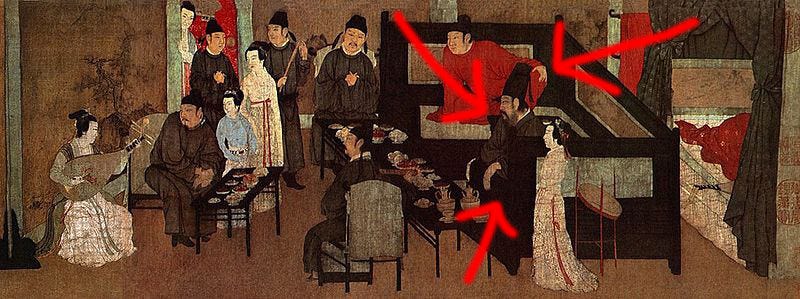

One of the best stories in Chinese art involves an emperor in the mid-10th century and one of his employees who wasn’t acting up to snuff.
As Shanghai Daily explains it, Li Yu (AD 937–978) of the Tang Dynasty was dissatisfied with Han Xizai, a top official.
Han started slacking off soon after Li Yu took the throne. The emperor wanted Han to be chancellor — but Han had other ideas. He thought the Tang Dynasty would have a short shelf life due to the ineffectual leadership of Li Yu.
Han told a close friend that he wanted to “dirty himself to avoid becoming chancellor” and he didn’t want to become “the laughing stock of history.”
Han’s idea of getting dirty apparently involved ditching royal meetings and throwing nonstop parties at his home with his friends as well as the entertainment, including prostitutes. He was already well known for his 40 concubines and his fashionable hats.
Li Yu noticed Han’s absence from court. He just didn’t know why. What to do? Spy on him, of course. But how? There were no hidden cameras in the 10th century.
So the emperor used the tools he had at his disposal — namely the imperial court painters.
I wonder what was going through the minds of Zhou Wenju and Gu Hongzhong when they were dispatched to Han’s house to paint the goings-on. And I wonder what Han thought while they were documenting his throwdown.

.jpg)
Both men did a thorough job, concubines and all.
Well, I take that back. Zhou Wenju probably did a good job but his scrolls were lost to time. The work of Gu Hongzhong is what survives. Shanghai Daily calls Gu’s effort “one of the most treasured masterpieces in traditional Chinese painting.”
The whole piece is a 28.7 x 335.5 centimeter silk handscroll, divided into five separate sections by screens placed at intervals. It is meant to be read as a kind of book from right to left.
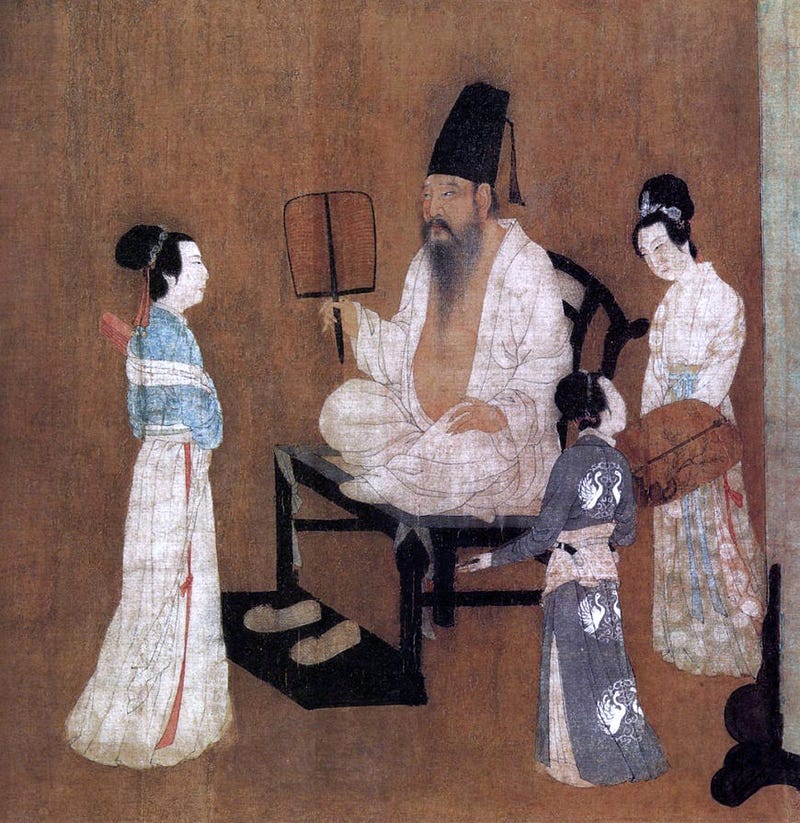
Han is the life of the party — or is he?
The Palace Museum in Beijing which houses the scroll, breaks down what is happening at the gathering, namely 40 different people “flirting, chatting, singing and dancing to delightful music.”
In the first scene, Han Xizai, in the cone-shaped hat, sits on a couch with his red-robed companion Lang Can, a scholar. They listen to a pipa lute played by the sister of the assistant director of the Imperial Theatre and Music Academy, who is beside her. The girl in the blue dress is Wang Wushan, a dancer. Everyone in each scene is dutifully identified by the artists.
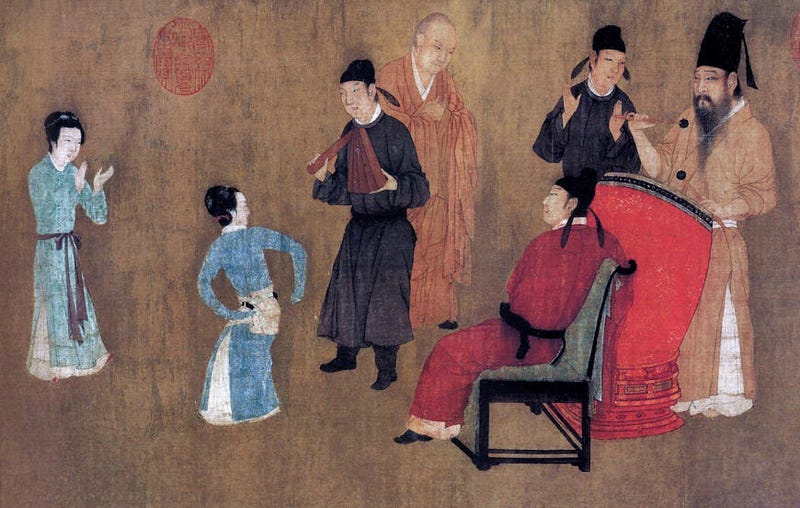
Another scene depicts Wang Wushan dancing to Han’s drumbeats. Everybody watches her — except the monk Deming, who averts his gaze. A third scene shows Han with four female companions, and a fourth portrays five women playing flutes before a bare-chested Han. In the last scene, he waves goodbye to his guests with the hand not holding his drum sticks.
According to a museum interpretation of the work, all that glitters was not gold for Han.
On the one hand, he indulges himself in wine, women and song, beating a drum for a servant dancer and enjoying a concert in open robe. On the other hand, he appears to be absent-minded and wistful during the revelry…All these expressions contribute to the very indication of Han’s unhappy life in his old age.
Shanghai Daily said that the painting didn’t get Han in trouble with the emperor — rather it made him a little more likable to Li Yu. Maybe the emperor was glad to know that his subject wasn’t plotting against him. Maybe he simply wanted to score an invite to the next one.
Just before Han succumbed to an illness in 970 he reached out to the emperor with a final message.
“I do not have contributions even as great as trampling grass, but have faults that rose even to the heavens. My old wife lies on the bed, moaning, and my young sons sit around the bed, crying.”
Mournful, Li Yu made Han chancellor posthumously. Six years later, however, Han’s prediction about the ruler came to pass. Li Yu was taken captive by the Song Dynasty armies. In 978 he was forced to drink poison and died.
But the story of the two men — and one epic night — lives on.
Betsy Denson, 2022