
When You Realize Nothing Matters, Suddenly Everything Matters
The secret to success isn’t what you think.

My dad died when I was 20 years old.
I was in a college classroom — in my applied investments class — and I got a text from my mom. I wasn’t the brightest student in that class, but I knew I was kind of the teacher’s pet. I think he liked rooting for the underdog, and I first came to him about a year prior in a panic with just twenty-four hours to prepare for an unexpected interview at Goldman Sachs for a sophomore summer internship. They called me and asked me to fly up to New York that very afternoon for an interview the following day.
I was 19. I knew nothing about finance. I had only applied for the internship because all my peers were talking about it, so I thought I’d shoot my shot. I didn’t expect to get that call. I must have been an alternate since all the other interviewees who I met at the GS headquarters at 200 West had known about their interviews for weeks. Weeks to prepare. I had one day.
I called my dad in a panic. Just like that he booked a seat on my flight for himself (on his own credit card; my flight was comped by Goldman). My dad came prepared. He spent the entire flight answering my questions, coaching me, giving me his advice and opinions on various macroeconomic topics. Explaining the different divisions in an investment bank. All things I should have known. He was there, and he was prepared.
I was a wreck that night. He stayed up late with me in the hotel lobby, formulating answers to questions I might be asked from recent events in the Wall Street Journal. And trying (unsuccessfully, I might add) to calm me down…This would be the first of many interviews on which he would accompany me over the next eight or so months. To New York. New Jersey. San Francisco…and more. Citigroup. Wells Fargo. Morgan Stanley. JP Morgan…And then, just a little more than a year later, he was gone.
About three weeks before he died, I got the call that I got the junior year internship offer at JP Morgan’s San Francisco office. The interview I only aced because he was there. He was so excited. He helped me find an apartment in the city. He was going to help me prepare for the actual internship — just like he had for all my earlier interviews.
Now I was 20. But I still knew nothing. I needed him. He knew everything, and that’s why he was there. And then he died. And he wasn’t there. But I still had an internship to go to. I still had to understand what the heck QE (quantitative easing) was or how our economy was somehow interrelated with events going on in China. I had to know things about oil, at a time when I didn’t even know how to put gas in a car.
Then it was May 28, and I had to go. This time, I flew alone. First to New York, for internship training at the headquarters, and then to my San Francisco office. I was scared. I was still 20, and I still knew nothing.
And That Was the Start of the Best Summer of My Life
I was, of course, sad when my dad died…but I think even more so, I was in a state of shock. It was all so unexpected. I think I was probably numb for the next three months…maybe for the next three years…maybe I’m still partly numb to it. But I couldn’t think about that. I couldn’t think about the fact that without my dad, I never would have gotten this internship. I couldn’t think about the fact that I didn’t belong there, in that bank, among these other brighter, more qualified candidates who actually did know things.
I couldn’t think about anything sad or negative or in any way disruptive to the task at hand. My task at hand was simple: I had to succeed. I had to show up to the San Francisco office — the one that my dad had planned to walk me to from my SF apartment on my first day, but of course, he never got to — and I had to do the job; and well. If “do the job” were all I did, that would be fine. But it wasn’t.
Once my dad died, I realized just how short life is. Just how inconsequential these little jobs and internships are. I finally understood why he always prioritized spending money on experiences, rather than material things. Prior to his death and my summer in San Francisco, I could never understand that. From a practical standpoint, I always thought material things were a better investment since they left you with something tangible. They could hold their value — maybe even appreciate in value, and be resold. Experiences were so fleeting, so pointless, and such a waste. That’s what I thought until he died. And until I, myself, experienced both (the material possessions and the lived experiences) at the time same.
That summer, I was 100% alone. 100% independent. 100% on my own in a brand new city, a brand new job, and with a brand new lease on life. Once he died, I realized how little everything mattered. And in seeing how little it all mattered, this made certain things matter even more.
I Suddenly Had No Excuse for Being Scared; It Didn’t Matter.
What’s the worst that could happen?
As Forrest Talley, Ph.D. states in Psychology Today:
“Fear is a thief. If left unchecked, it will rob you of joy, leaving anxious concerns about the future in its stead. By whispering a million reasons not to take action, it steals opportunities that would otherwise make your heart pound with excitement and lead to a life more fully lived.”
I had already experienced something bad, number six of the top ten fears that hold people back, and I survived. When your worst nightmare comes true, how much worse could things get? While that might sound negative, it’s actually quite liberating.
Rod Judkins touches on this post-rock bottom liberation in Psychology Today:
“When someone ‘hits rock bottom,’ there’s no lower to go. Hitting the bottom is so painful that it’s enough to motivate a person to recover.”
My dad dying was a form of rock bottom. Just like my ultimate rejection from Goldman Sachs was a form of rock bottom. These major disappointments actually motivated me to take massive action, as I had already seen the worst-case scenario and had little left to lose. I had no excuse for showing myself anything less than my best effort. I had no excuse for living a subpar life, having a subpar summer, or letting a single day go by as “mediocre” when I was blessed enough to have that day in the first place.
I resolved to squeeze the juice out of every single day and experience that lay before me. I was the best intern; sharp, confident, and a far cry from the scared, insecure girl in my interview. I read my WSJ every morning, asked thoughtful, provocative questions in senior meetings, and took on my own independent projects outside of working hours, to further apply what I’d learned.
On top of being a great intern, I was a fun, spontaneous, adventurous person. I had always been rigid, but for the first time, I threw caution to the wind and let myself live. I was so enamored by California, the ease of transportation in the Bay Area, and this unfamiliar independence, along with my newfound fearless positivity, that I took myself on a vacation every single weekend.
I went up to Yosemite. Down to Carmel and Monterrey. Down to Pebble Beach. Across to the East Bay. On the fourth of July, I walked twenty miles from the Ferry Building in San Francisco, across the Golden Gate Bridge, to Sausalito and back, meeting up with friends and family at Pier 39 for fireworks. I was fearless; fearlessly positive. It was one of the best days of my life — it still is.
This Article Isn’t about Internships or How to Have a Great Summer in California (though I could definitely weigh in on both).
This article is about resiliency. So how do we trigger that “resiliency”? Apparently, the answer may be to lean into one simple emotion. That very emotion may hold the key to the very resilience we all need to get through tragedies, disappointments, and the many other obstacles we’ll face in life.
“Fredrickson’s research revealed recently that positivity is the main mechanism of action for resilience. Hence, a main determinant of resilience is the ability to foster and amplify positive emotions when we are swimming in a sea of negativity.”
And looking back on it, that’s exactly what I did: I let positivity drive my actions, while shrouded in the overwhelming negativity of my circumstances. I didn’t get the job at Goldman. That’s why I kept interviewing. And my dad cheered me on, supporting my attempts each step of the way. And then he died. And it could have been over. But it wasn’t. Thanks to the unexpected survival mode I went into shortly after his death, my body and brain wouldn’t allow me to give up. It’s like I was on a fearless positivity high, and my brain was ordering me forward in every avenue I pursued. Maybe it was adrenaline. Maybe it was my own version of mourning or strange, displaced grief?
Either way, it was that fearlessness — that fearless positivity — and that realization that most things in life are truly so small, too small to be scared of, and too small to undershoot, that I accidentally developed the resilience I never knew I needed. It’s probably the same resilience that got me past a bad breakup. The same resilience that got me through an unplanned job exit. The same resilience that enabled me to withstand hundred+ hour weeks in the hopes of working towards a bigger goal and a better future. The same resilience that got me to get back up again, after my first devastating startup failure, and try again — despite the years and $100k+ I had already lost.
It’s easy to say that success is based on motivation or perseverance. Or effort. Or confidence. Or positivity. Or luck. They’re all partly true. I think most stories of success are an amalgamation of ongoing effort and determination, the confidence to try, maybe a positive attitude, and oftentimes a sprinkling of good luck here and there. That’s all true. But those success stories are often long and winding. They have ups and downs. And the key to long-term, lasting success is finding the resilience (and fearlessness) to overcome any and every obstacle or unexpected challenge. No matter how big or small. No matter how devastating.
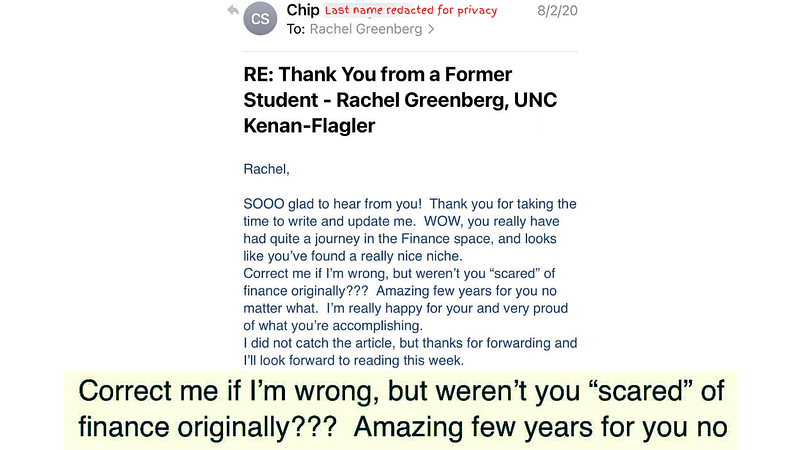
You have to be resilient. And for me, in order to be resilient, I had to be fearlessly positive. I had to know that nothing mattered, so everything mattered. And the funny thing is, years later, when I was asked to speak at my old business school, I emailed that professor to give him an update on my career and my companies. He remembered just how scared I was. I’m including his email below:
How to ensure your success? Be fearlessly positive enough to be resilient.
Mind Cafe’s Reset Your Mind: A Free 10-Day Email Course
We’re offering a free course to all of our new subscribers as a thank you for your continued support. When you sign up using this link, we’ll send you tips on how to boost mental clarity and focus every two days.


