
When You Have a Million Things on Your To-Do List But Barely Get Anything Done
How to simplify and get stuff done.
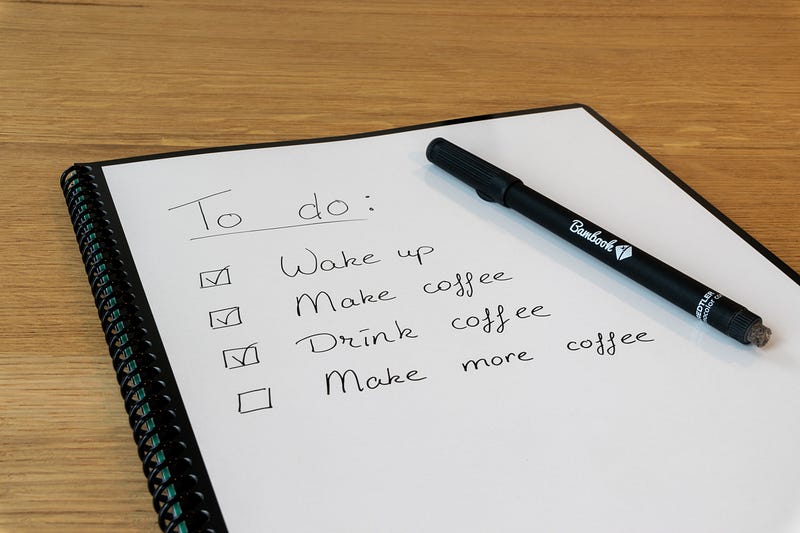
We all might know the feeling: when you have a million things to do on your list, and you feel like you have no time whatsoever to finish all of them.
In fact, there are so many things on your to-do list, some even very important, that you end up overwhelmed. As a result, you might end up only doing a few, or even worse: you don’t finish any of them.
Now, I can imagine that none of us like feeling this way. I know I don’t.
It’s frustrating, counterproductive, and energy-draining.
Why do we pile up our to-do lists?
Well, often we find ourselves writing down every single thing that we want to finish, even if those things are small and take very little time to accomplish.
It makes sense that we do this — as we want to declutter our minds from all our (seemingly endless) responsibilities.
Don’t get me wrong, I think brain-dumping all the clutter on paper is an extremely valuable and healing practice.
However, if we end up using this massive ‘brain-dump’ list as our actual to-do list, we risk giving ourselves even more stress than we initially experienced.
Your time and your energy are two of your most precious resources. Use them wisely.
How can we diminish the stress from our endless to-do list — and actually get stuff done?
Well, for starters we can start slowly. Slow, steady and determined actions are key here.
You know what they say right — slow and steady wins the race.
With this I mean to slowly work your way through all your to-dos.
I understand that you want to just get everything done now, but that will just tire you out and leave you frustrated when you notice you can’t check off everything at once liked you’d hoped to do.
Slowly ticking off items off your to-do list, by taking small steps everyday, will give you massive achievement in the long run.
So how can you slow down, when you have a gazillion things piled up and your head is still racing trying to fit it all into your day?
The magic number
Well — I’d say circle the three things that are of utmost importance and that need to be done on that day.
Say, you have people coming over at your house tomorrow. You want to tidy up your place, and get food and drinks. Besides that, you have obligations at work, and you might also want to do something for yourself for self-care purposes.
Divide and conquer — list three things that you absolutely need to do today, that will give you the maximum energy and efficiency for the day — and for tomorrow.
So that can be, designating a certain amount of time to finish work, setting a timer to tidy up your place and plan some self-care practice in for the evening. Then the next day, you can quickly do some groceries, get work done and have your people over.
The key here is to do as little as possible — with the maximum amount of payout.
Aka: work smarter, not harder.
Track your time
For those of you (like me) who lose track of time whilst cleaning/working/etc., I suggest setting a timer whilst you work to complete a task— so can take back control of your time.
This will also force you to finish up your task within the given time, or at least as much as possible within the set time frame.
According to Parkinson’s Law, “work expands so as to fill the time which is available for its completion”. This means that the time you give yourself to complete a task, will usually be the time in which you can achieve the task.
Meaning, if you give yourself six hours to complete a task, it will be done in six hours. If you give yourself four hours, it will most likely be done in four.
We often stretch our time, filling it with unnecessary tasks, while we can often finish our main tasks in less time if we are fully dedicated to it.
Some tasks really do take the metaphorical six hours to be completed, but most can be done in less if you use your time as effectively as possible.
To get maximum efficiency and productivity out of your workday, I highly recommend using the 52–17 method. I talk about that some more in this article:
Do the hardest thing first
Many articles have already talked about this, but I personally still find this a really good one.
Do the hardest thing on your list first.
This refers to the task that takes the longest time, the most effort, the most creativity or the most energy.
When you accomplish this, you can move on to the task that is the hardest after that.
I personally find this really effective, because you will most likely have more energy at the beginning of your day as opposed to later on the day.
Also, it gives you a satisfied feeling having completed the hardest thing on your list — giving you more motivation to check off the rest of your list.
However, this all depends on how you work and how you are as a person. If you are an evening person, you might get energy later on in the day. So then it might be more beneficial for you to to the hardest thing later on.
There are pros and cons to this of course, and you might also like starting off the day with the simple tasks to build a momentum of achievement.
Try both and see which approach works best for you.
Conclusion
So, let’s recap.
We all have so much on our plates, and it can be quite overwhelming. This overwhelming feeling might demotivate us, making us even less productive, and leaving us feeling miserable as a result.
And no one wants that.
So, we have a couple of steps that could help in this situation.
1. Determine the three most vital things to do that day.
2. Determine a time frame in which you want to achieve these things. And set a timer.
3. Do the hardest thing first.
If it turns out you end up finishing these three things quicker than you thought — and you have so much time and energy left — you might think about adding a few smaller ones.
However, try not to overdo it and completely deplete your built-up energy reserves. Remember — tomorrow is another day, and you need energy for that day too!
Also, having more energy left might be well spent elsewhere — such as taking care of yourself, spending time with your family and/or partner, meeting up with friends, picking up that book, spending time on your long-lost hobby.
Of course, this is all advice. Try it out for yourself, see what works for you, tweak it, try it again, and make it your own.
I hope these tips help you in any way, or at least provoke some thought in you.
As always, thank you so much for reading. If you have any questions or comments, please let me know!
Feedback and suggestions are also always welcome.
Till next time!
With love,
J
P.s. If you liked the content and would like to read more whilst supporting me as a writer (at no additional cost to you), use this affiliate link to become a Medium member!