avatarCedric Boogaerts

Summary

The article discusses the potential for Bitcoin to reach $100,000, examining the stock-to-flow model and its historical accuracy in predicting Bitcoin's price, while also considering the impact of halving events and the possibility of a prolonged 'crypto winter.'

Abstract

The article titled "When Will Bitcoin go to 100.000?" explores the future price trajectory of Bitcoin, which is currently experiencing a bear market, being over 40% below its all-time high. It introduces the stock-to-flow model, commonly used for predicting the price and scarcity of resources like gold, and applies it to Bitcoin. Given Bitcoin's limited supply of 21 million coins and the decreasing rate of new coin production due to halving events every four years, the model suggests Bitcoin's price could reach 1 million by 2028. However, the model does not account for external factors such as politics, economic changes, or new regulations. The article also addresses concerns about a potential 'crypto winter,' a period of stagnant or declining cryptocurrency prices, and advises long-term investors to consider dollar-cost averaging during such times. Short-term investors are encouraged to closely monitor market trends. The author concludes by reminding readers that they are not a financial advisor and that personal research is crucial before making investment decisions.

Opinions

  • The stock-to-flow model has been a reliable predictor of Bitcoin's value, suggesting significant future growth.
  • Bitcoin's scarcity, due to its capped supply and the halving process, is expected to drive its price up substantially.
  • The next Bitcoin halving events in 2024 and 2028 are anticipated to positively influence its price.
  • Despite the model's accuracy, it does not consider unforeseen political, economic, or regulatory changes that could affect Bitcoin's price.
  • There is a concern among Bitcoin experts about the onset of a 'crypto winter,' which could lead to a prolonged period of low prices.
  • Long-term investors are advised to dollar-cost average during bear markets or crypto winters to potentially increase their portfolio value.
  • Short-term investors are urged to conduct thorough market analysis before making investment decisions.
  • The author emphasizes the importance of personal research and due diligence before investing in Bitcoin, as the article does not constitute financial advice.

When Will Bitcoin go to $100.000?

Photo by Kanchanara on Unsplash

Bitcoin is over 40% of its all-time high of $68 000. The cryptocurrency is officially in a bear market. Does the future outlook look bright?

The stock-to-flow model

The stock-to-flow model is a model used to predict the future price and the scarcity of a resource. To calculate it, take the number of resources held in reserve and divide it by the annual production of the resource.

The model is often used on gold. According to the World Gold Council, there is a global proven reserve of 190 000 tons of gold. The annual production varies from 2500 tons to 3500 tons. If we divide 190 000 by 3500, we get 54. What does this mean? This suggests that it would take 54 years in order to double the total supply of gold. The higher the number is, the more scarce the resource is.

With bitcoin, the total supply is limited to 21 million coins. Currently, 0,7 million coins are mined per year. This gives it a stock to flow of 25. But every 4 years, the miners rewards are cut in half. This process is called the bitcoin halving. The last halving were in 2012, 2016, and 2020. In 2016 the first major rally began which ended in late 2017, the same happened in 2020. The next halvings will be in 2024 and 2028.

The model has closely predicted the value of bitcoin in the past decade. The model implies that by 2028, the price of bitcoin should be around $1 000 000. This would represent a 2500% upside.
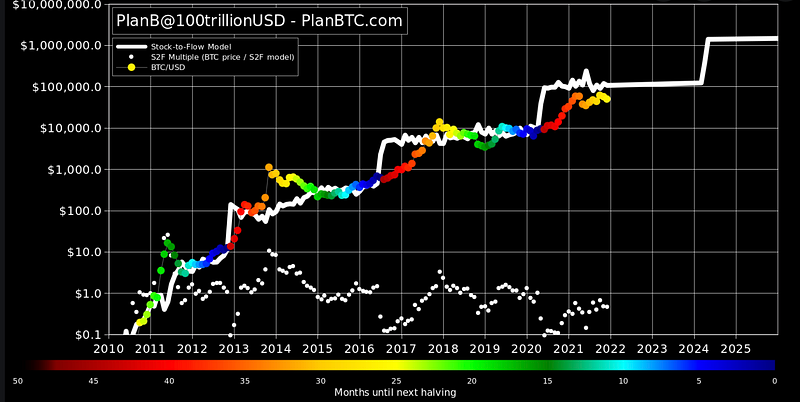
Image Source

While the model is a great long-term indicator, it doesn’t take politics, the economy, or regulations into consideration because we are looking so far into the future.

Because the next halving is so long into the future, bitcoin experts are worried about a crypto winter. A crypto winter can be defined as a substantial drop in all cryptocurrency prices without it recovering for a long period of time. The last crypto winter was from 2018 to 2020, when the price almost didn’t move.

Final Thoughts

If you believe in bitcoin over the long term, it’s best to dollar cost average. Crypto winters are great times to grow your portfolio while the price is still relatively low. For the short-term investors, I would look closely at the charts and dive even deeper into this.

Disclaimer: I am not a financial advisor. Do your own research before making a financial decision.

You might like:

Blockchain
Crypto
Bitcoin
Money
Economy
Recommended from ReadMedium