avatarJ.J. Pryor

Free AI web copilot to create summaries, insights and extended knowledge, download it at here

8318

Abstract

American homes having some sort of air conditioning on-premise, you might have come across many of the following types of AC units out there.</p><h2 id="44fc">Split-system AC units</h2><p id="b38e">These forms of air conditioning have the cooling coil located inside the house, with the noisy heating coil located outside.</p><p id="c4af">They’re quieter, more efficient, but also pricier than the single system counterparts.</p><p id="68f0">They include the following types of <a href="https://learnmetrics.com/air-conditioner-types/">air conditioning units</a>:</p><p id="4a9a"><b>1. Central AC</b></p><ul><li>Price ranges from <a href="https://www.homeadvisor.com/cost/heating-and-cooling/install-an-ac-unit/"><b>3,811 — 7,472</b></a></li><li>For maximum comfort throughout the home</li></ul><p id="0fe0"><b>2. Wall and floor mounted AC units</b></p><ul><li>Price ranges from 500 to 4,000</li><li>Quieter than stand-alone AC units</li></ul><p id="20cf"><b>3. Ceiling mounted AC</b></p><ul><li>Price ranges from 800 up to 10,000</li><li>Powerful units usually found in offices</li></ul><p id="f26a"><b>4. Split-system portable AC</b></p><ul><li>Price ranges from 250 to 1,000</li><li>Stronger version of portable AC units</li></ul><h2 id="fa39">Stand-alone AC units</h2><p id="f613"><b>1. Portable AC units</b></p><ul><li>Price ranges from 150 to 900</li><li>A popular model for smaller homes and apartments</li></ul><p id="a67b"><b>2. Window AC units</b></p><ul><li>Price ranges from 150 to 800</li><li>Often seen in Europe</li></ul><p id="ee80"><b>3. Wall-mounted AC units</b></p><ul><li>Price ranges from 200 to 1,000</li><li>Suitable for buildings that don’t have permission to place external units</li></ul><p id="d1bd"><b>4. Ground-mounted AC units</b></p><ul><li>Price ranges from 300 to 900</li><li>Aren’t as popular anymore</li></ul><p id="a384"><b>5. Spot cooler AC units</b></p><ul><li>Prices range from 800 to 5,000</li><li>Huge industrial-size mobile air conditioners</li></ul><h1 id="0a5a">How does air conditioning work?</h1><p id="fbdc">In its simple form, air conditioners work based on using a refrigeration cycle.</p><p id="a844">This requires 4 different components.</p><ol><li><a href="https://en.wikipedia.org/wiki/Condensing_coil">A condensing coil</a></li><li><a href="https://en.wikipedia.org/wiki/Thermal_expansion_valve">An expansion valve</a></li><li><a href="https://en.wikipedia.org/wiki/Evaporator_coil">An evaporator coil</a></li><li><a href="https://en.wikipedia.org/wiki/Gas_compressor">A compressor</a></li></ol><figure id="3640"><img src="https://cdn-images-1.readmedium.com/v2/resize:fit:800/0*H9cNOHXYxKVqvrZ8.png"><figcaption><b>The refrigeration cycle — <a href="https://en.wikipedia.org/wiki/en:public_domain">Public domain</a></b> by its author, <a href="https://commons.wikimedia.org/wiki/User:Ilmari_Karonen"><b>Ilmari Karonen</b></a>.</figcaption></figure><p id="c94b">Here is a much more in-depth <a href="https://en.wikipedia.org/wiki/Heat_pump_and_refrigeration_cycle">explanation of the refrigeration</a> process on Wikipedia.</p><h1 id="8029">Does air conditioning use gas?</h1><p id="1e26">Gas-powered AC units used to be quite popular in the U.S. but slowly turned towards electric units for cost efficiency and savings.</p><p id="6cb3">There is a <a href="https://allamericanhc.com/blog/gas-vs-electric-air-conditioning">small resurgence in using gas</a> as a power source for multi-zone units. But this can be extremely costly if you don’t already have a natural gas line hooked up to your house.</p><p id="f6f2">An interesting plus-side of using gas power AC units — they can cool you even in a power outage. So people that live in stormy, hot places like Florida and New Orleans might want to consider this kind of air conditioning instead.</p><h1 id="92b7">Does car air conditioning use gas?</h1><p id="de77">Yes, as it requires power from the alternator. (Unless of course, you’re driving an electric vehicle.)</p><p id="a8e9">So, while you’re driving down the city road, you should be aware that a small amount of gas is going towards the automotive’s air conditioning.</p><p id="a4d2">Interestingly, though, there are times when it is more fuel-efficient to have the AC on rather than off.</p><p id="6add">This occurs while you’re driving down the highway at high speeds.</p><p id="44ae">If you have the windows completely open keeping you cool instead of the AC, this actually <a href="https://www.toyotaofdowntownla.com/does-car-ac-use-gas/#:~:text=Yes%20%E2%80%94%20like%20many%20of%20your,is%20powered%20by%20the%20engine.&amp;text=However%2C%20in%20some%20situations%2C%20using,efficient%20than%20not%20using%20it.">uses more fuel</a> than simply having the windows up and the AC on!</p><h1 id="5430">Can air conditioning make you sick?</h1><p id="685c">Air conditioning, especially in the office, can make you show signs of respiratory illness if the system is not well maintained. There have been several studies on the subject, each noting slight differences in results.</p><p id="30d6">This article is a great resource that talks about the potential effects of air conditioning in buildings and <a href="https://academic.oup.com/ije/article/33/5/1123/624014">why AC can make people sick</a> in some situations.</p><p id="889c">The cooling components and other parts of a central AC system that get wet and aren’t cleaned properly can become a breeding ground for bacteria.</p><p id="d445">As long as the AC systems are well maintained and properly cleaned, with UV light, for example, the risks are very low.</p><h1 id="4ad7">How to save money on my AC bill?</h1><p id="204b">There are a few different ways to save money with your air conditioning units. They can be an expensive addition to your monthly electricity bills, so any cost-saving measures can go a long way over time.</p><p id="fdd5">The <a href="https://en.wikipedia.org/wiki/United_States_Department_of_Energy">Energy Department of America</a> talks about heat loss at length in this article about <a href="https://www.energy.gov/energysaver/spring-and-summer-energy-saving-tips">saving money on your bills</a> every summer. And for good reason — people can save massive amounts of money with a few tweaks.</p><p id="d675">Especially when dealing with heat loss and air conditioning.</p><h2 id="a652">Invest in a digital thermostat</h2><p id="fd49">Catch up to the modern age with a digital thermostat. Not only will it send you real-time information right to your phone, but many units can monitor electricity usage throughout the home.</p><p id="f6fd">As for air conditioning, digital thermostats are able to help you optimize temperatures and when to use the AC itself. These energy savings quickly add up to pay for the purchase typically within a year.</p><p id="a1ea">Here are 2 of the most popular digital thermostats today:</p><ol><li><a href="https://www.amazon.com/Nest-T3007ES-Thermostat-Temperature-Generation/dp/B0131RG6VK/ref=sr_1_3?dchild=1&amp;keywords=digital+thermostat&amp;qid=1598265830&amp;sr=8-3">Google Nest Learning Thermostat</a>225 — Rated 4.5 Stars</li><li><a href="https://www.amazon.com/Honeywell-RTH9585WF1004-Programmable-Thermostat-Required/dp/B075BF6V58/ref=sr_1_5?dchild=1&amp;keywords=digital+thermostat&amp;qid=1598265830&amp;sr=8-5">Honeywell Home WiFi Smart Thermostat</a> — 199 — Rated 4.5 Stars</li></ol><h2 id="0f5c">Perform yearly maintenance</h2><p id="87cc">Performing regular or yearly maintenance on your AC unit will not only make the air cleaner, but it will save you money in the long run.</p><p id="830e">You can either hire a certified <a href="https://en.wikipedia.org/wiki/Heating,_ventilation,_and_air_conditioning">HVAC professional</a> or learn how to do it yourself (safely, of course!).</p><p id="3e1f">Look down further for a section on this subject.</p><h2 id="773d">Purchase a super-efficient AC unit</h2><p id="3822">One of the <a href="https://www.carrier.com/carrier/en/worldwide/news/news-article/carrier_launches_the_most_efficient_air_conditioner_you_can_buy_in_america.html#:~:text=The%20new%20Carrier%209%2C000%20BTUh,can%20buy%20in%20North%20America.">most efficient modern AC units</a> is made by <a href="https://en.wikipedia.org/wiki/Carrier_Global">Carrier Global</a> (yes, the same co

Options

mpany from the inventor of the AC!).</p><p id="b674">They sell their products through dealers so you’ll have to check out their product page for <a href="https://carrier.com.ec/product_detail.cfm?ln=en&amp;product_id=268&amp;cat_id=124&amp;parent_id=5">more details</a>.</p><p id="5dbf">For air conditioner efficiency, it helps to look at 2 different metrics in the U.S. — SEER rating and Energy Star certification.</p><h2 id="5095">What does SEER mean?</h2><p id="95dc">SEER stands for <a href="https://en.wikipedia.org/wiki/Seasonal_energy_efficiency_ratio">Seasonal Energy Efficiency Ratio</a>. It’s typically a rating given to an air conditioning unit to understand the total electrical energy used by the appliance.</p><p id="4240">The exact formula is:</p><blockquote id="6182"><p>The cooling output of a unit during a typical ‘cooling-season’, divided by the total electrical energy input during the same period of time.</p></blockquote><p id="65f2">The <a href="https://en.wikipedia.org/wiki/Seasonal_energy_efficiency_ratio">SEER</a> rating of a unit is the cooling output during a typical ‘cooling season ‘divided by the total electric energy input during the same period.</p><p id="0021">Here’s a nifty <a href="https://hvacdirect.com/seer-efficiency-savings-calculator.html"><b>SEER calculator</b></a> that shows how much money you can save when upgrading or comparing different AC units.</p><h2 id="2b49">What is Energy Star?</h2><p id="76a8"><a href="http://ENERGY STAR® is the government-backed symbol for energy efficiency, providing simple, credible, and unbiased information that consumers and businesses rely on to make well-informed decisions">Energy Star</a> is an organization run by the Environmental Protection Agency and Department of Energy that partners with industry companies to come up with standards for electricity efficiency and savings.</p><p id="9f14">In 2018, the organization claims to have helped create over 35 billion in energy savings in that year alone. Quite substantial!</p><figure id="94e4"><img src="https://cdn-images-1.readmedium.com/v2/resize:fit:800/0*bvyxQ-DLdB32pZge.png"><figcaption>Public Domain from EPA</figcaption></figure><p id="79d9">Their <a href="https://en.wikipedia.org/wiki/Energy_Star">Energy Star label</a> is currently on over 75 different kinds of products throughout the US and other partner countries.</p><h2 id="d216">The best efficient air conditioners</h2><p id="0c74">Here are several of the top-selling <a href="https://www.energystar.gov/">Energy Star</a> certified air conditioners with high SEER ratings:</p><ul><li><a href="https://www.amazon.com/PIONEER-Air-Conditioner-Pioneer-Heatpump/dp/B01DVW6BAG/ref=sr_1_1?dchild=1&amp;keywords=air+conditioner&amp;qid=1598266556&amp;refinements=p_n_feature_seven_browse-bin%3A14554157011&amp;refresh=2&amp;rnid=14554158011&amp;s=home-garden&amp;sr=1-1">Pioneer Air Conditioner Mini Split Heatpump</a> — 12000 BTU-208/230 V — 4.5 Stars — 939</li><li><a href="https://www.amazon.com/Friedrich-CP15G10B-Window-Conditioner-ENERGY/dp/B00GM32L1U/ref=sr_1_1_sspa?dchild=1&amp;keywords=air+conditioner&amp;qid=1598266596&amp;refinements=p_n_feature_ten_browse-bin%3A14554163011%2Cp_72%3A1248915011&amp;refresh=2&amp;rnid=1248913011&amp;s=home-garden&amp;sr=1-1-spons&amp;psc=1&amp;spLa=ZW5jcnlwdGVkUXVhbGlmaWVyPUEyWk81QjJWWENYUEJLJmVuY3J5cHRlZElkPUEwMjEzMTYwMVRZUkxLWkdOSFJIQSZlbmNyeXB0ZWRBZElkPUEwMjM0MDI4MThTQlMyQ0kyM1BKWiZ3aWRnZXROYW1lPXNwX2F0ZiZhY3Rpb249Y2xpY2tSZWRpcmVjdCZkb05vdExvZ0NsaWNrPXRydWU=">Friedrich Chill Series CP15G10B Room Air Conditioner</a> — 15,500 BTU, 115v — 4.0 Stars — 729.99</li><li><a href="https://www.amazon.com/FFRE0833S1-Window-Mounted-Mini-Compact-Conditioner-Temperature-Sensing/dp/B01B4XUQI2/ref=sr_1_2?dchild=1&amp;keywords=air+conditioner&amp;qid=1598266596&amp;refinements=p_n_feature_ten_browse-bin%3A14554163011%2Cp_72%3A1248915011&amp;refresh=2&amp;rnid=1248913011&amp;s=home-garden&amp;sr=1-2">Frigidaire FFRE0833S1 8,000 BTU 115V Window-Mounted Mini-Compact Air Conditioner</a> — 4.0 Stars — 379</li></ul><h1 id="0207">What are the biggest air conditioning companies?</h1><p id="bc2a">Interestingly enough, the biggest air conditioner manufacturer is still <a href="https://www.carrier.com/carrier/en/worldwide/">Carrier Global</a> — the company that the inventor of AC founded!</p><p id="7ee8">Here is a quick list of the largest AC unit manufacturers:</p><ol><li><a href="https://en.wikipedia.org/wiki/Carrier_Global">Carrier Global</a> — Based in USA</li><li><a href="https://en.wikipedia.org/wiki/Daikin">Daikin Industries</a> — Based in Japan</li><li><a href="https://en.wikipedia.org/wiki/LG_Corporation">LG</a> — Based in South Korea — Interestingly, used to be called “Lucky-Goldstar”</li><li><a href="https://en.wikipedia.org/wiki/Samsung">Samsung</a> — Based in South Korea</li><li><a href="https://en.wikipedia.org/wiki/Haier">Haier</a> — Based in China</li><li><a href="https://en.wikipedia.org/wiki/Midea_Group">Midea</a> — Based in China</li></ol><h1 id="e20a">How to do air conditioner maintenance?</h1><p id="fac6">It’s important to remember to occasionally perform maintenance on your AC unit for several reasons:</p><ol><li>Makes sure the unit and system has a longer lifespan</li><li>Cools your home faster and better</li><li>Makes the AC units more efficient, saving on energy costs</li><li>Helps keep the air-conditioned air cleaner and less prone to spreading germs</li></ol><p id="b044">Here’s a great video on how to do DIY maintenance on your air conditioner!</p> <figure id="4368"> <div> <div> <img class="ratio" src="http://placehold.it/16x9"> <iframe class="" src="https://cdn.embedly.com/widgets/media.html?src=https%3A%2F%2Fwww.youtube.com%2Fembed%2FMMY0Zi-sFPI%3Ffeature%3Doembed&amp;display_name=YouTube&amp;url=https%3A%2F%2Fwww.youtube.com%2Fwatch%3Fv%3DMMY0Zi-sFPI&amp;image=https%3A%2F%2Fi.ytimg.com%2Fvi%2FMMY0Zi-sFPI%2Fhqdefault.jpg&amp;key=a19fcc184b9711e1b4764040d3dc5c07&amp;type=text%2Fhtml&amp;schema=youtube" allowfullscreen="" frameborder="0" height="480" width="854"> </div> </div> </figure></iframe></div></div></figure><p id="fce0">The video recommends that you do the following 8 steps every year to maintain your air conditioner:</p><ol><li>Outdoor unit — Clear all debris around the unit, keeping a 2 foot diameter</li><li>Outdoor unit — Rinse your condenser coils (making sure all electricity is disconnected!)</li><li>Outdoor unit — Perform a visual inspection to see if anything isn’t pristine — Is anything blocked, dirty, or broken?</li><li>Indoor unit — Check your filters and replace them if needed</li><li>Indoor unit — Turn off the humidifier during the summer, if you have one</li><li>Indoor unit — Check the drain line</li><li>Thermostat — Double check the room’s temperature (with a thermometer) against the thermostat</li><li>Thermostat — Schedule an annual checkup for your AC with an HVAC expert</li></ol><h1 id="b0f9">Air-conditioned dog houses</h1><p id="4f8a">To finish off this look at air conditioning in the modern age, I thought I’d include one of the strangest examples I found.</p><p id="26b7">Do you have a pet dog at home? Maybe he’d like his own air-conditioned dog house!</p><p id="3ff9">Well, strangely enough, here’s a full video on how to make one yourself!</p> <figure id="5d17"> <div> <div> <img class="ratio" src="http://placehold.it/16x9"> <iframe class="" src="https://cdn.embedly.com/widgets/media.html?src=https%3A%2F%2Fwww.youtube.com%2Fembed%2F0_puKGHaWZ4%3Ffeature%3Doembed&amp;display_name=YouTube&amp;url=https%3A%2F%2Fwww.youtube.com%2Fwatch%3Fv%3D0_puKGHaWZ4&amp;image=https%3A%2F%2Fi.ytimg.com%2Fvi%2F0_puKGHaWZ4%2Fhqdefault.jpg&amp;key=a19fcc184b9711e1b4764040d3dc5c07&amp;type=text%2Fhtml&amp;schema=youtube" allowfullscreen="" frameborder="0" height="480" width="854"> </div> </div> </figure></iframe></div></div></figure><p id="f0f0"><a href="undefined">J.J. Pryor</a></p><p id="0ad8"><b>Thanks for reading! Please consider following my<a href="https://jjpryor.substack.com/"> free newsletter</a> to keep up with my crazy shenanigans.</b></p></article></body>

Who Invented Air Conditioning? And 13 Other Fun Facts About AC

Everything you wanted to know about the wonderful invention of AC
Photo by Kaboompics .com from Pexels

“I love air conditioning.” — Everyone

Who doesn’t love that first step into an air-conditioned room after trodding down a road under the scorching August sun? I know I always look forward to it.

Living in the tropics for so long now has also help me grow an even bigger appreciation for air conditioning technology. But I never stopped to think what was behind the appliance.

Even more importantly, I never stopped to find out who was the mystery man that I was constantly thanking on a daily basis here.

So I decided to look into the history of air conditioning — and to share the interesting story with you!

Table of contents

  1. What is air conditioning?
  2. What year was air conditioning invented?
  3. Who invented air conditioning?
  4. What’s the history of air conditioning?
  5. What types of air conditioners are there?
  6. How does air conditioning work?
  7. Does air conditioning use gas?
  8. Does car air conditioning use gas?
  9. Can air conditioning make you sick?
  10. How to save money on my AC bill?
  11. What are the biggest air conditioning companies?
  12. How to do air conditioning maintenance?
  13. How to do air conditioner maintenance?
  14. Air-conditioned dog houses — for fun

What is air conditioning?

Air conditioning, or as many people call it, AC, is when a machine is able to remove hot air and moisture from one space and moves it to another.

Most people will have one in their cars, a large circulated central air conditioning unit in their house, or 1–3 small air conditioning units in their apartments.

Air conditioners almost always have a fan that helps disseminate the cold air to the desired space.

We’ve come to expect our malls and restaurants to all be at a perfect temperature.

And in our hot summers, these businesses have an even bigger need for efficient air conditioning. Could you imagine trying to eat lunch in 95°F weather?

No thanks!

What year was air conditioning invented?

The modern electrical air conditioning unit was invented on July 17, 1902.

Who invented air conditioning?

The inventor of the first electrical air conditioning unit was Willis H. Carrier.

We owe our cool indoor summers to this great man, that’s for sure.

A Cornell graduate of engineering, Willis Carrier first delved into playing with the idea of heat transfer while working for a company called the Sackett-Wilhelms Lithographing & Publishing Company in Brooklyn.

While inventing the first version of an air conditioner in 1902, he was later awarded a patent after spending a few years refining the technology.

The name of the 1906 patented device? The catchy title of ‘Apparatus for Treating Air.’

Doesn’t quite roll off the tongue as easy as AC, does it?

Willis was able to make a breakthrough in the engineering of air conditioning as he focused on an area previously ignored — humidity control.

He later went on to make the ‘Magna Carta of psychometrics’ in 1917 — a broad paper explaining how dew-point temperature, absolute humidity, and relative humidity all interact with each other.

He and some of his colleagues later went on to create a company to exclusively create these machines for consumers and businesses.

The Carrier Corporation seemed to do okay but with The Great Depression and World War 2 later on, the company had significant hurdles in gaining popularity.

Fortunately for the company, the post-war economic boom started a surge in sales.

Another side effect of air conditioning? It began a rise in people moving to the hottest parts of America — the so-called Sun Belt.

People were much more willing to go lay on beaches in the hot sun now that they had a cooled room to go back to after.

As for the Carrier Corporation? The company still exists — and it’s huge! They have over 50,000 employees and was worth over $18 billion as of this year.

Keeping people cold is good business!

What’s the history of air conditioning?

People have always looked for different ways to keep cool during hot weather.

  • Ancient Egyptians and Persians were thought to hang moist reeds in their windows. The blowing air helped humidify and slightly cool the in-doors in the dry desert weather.
  • Chinese inventor Ding Huan is credited with creating the first mechanical fan. He created a huge one for the emperor at the time — that was manually powered by prisoners!
  • The first form of cooling was the act of storing large ice blocks in the winter for use in the hot months later on. This practice first started in the late 1600’s in Europe.
  • In the same century, Cornelis Drebbel took a crack at air conditioning by mixing stored snow (from the winter) with salt, and potassium nitrate to produce ice crystals.
  • In 1758, the famous Benjamin Franklin and his colleague, John Hadley, performed successful experiments with rapid evaporation. They used massive bellows and a mercury thermometer to cool it down to below freezing.
  • Michael Faraday (of ‘Faraday Cage’ fame) found in 1820 that using compressed liquid ammonia would cool down the ambient temperature when evaporating.
  • In 1842, a medical doctor from Florida used new compression technology to create the first ice-making machine. Dr. John Gorrie did win a patent for his imperfect technology, but his dreams of using the same idea to cool buildings never took off as his company failed.
  • The Australian James Harrison refined the technology to produce massive amounts of ice. In 1851, he set up the first machine on a riverbank. After a few years of refining, his ice-making machines could produce over 6,600 lbs of ice a day!
  • Willis H. Carrier invented the first modern version of air conditioning in 1902.
  • In 1914, Charles Gilbert Gates was the proud owner of the first private home to have air conditioning.
  • American Robert Sherman invented a portable air conditioning unit in 1945. This is the style that most people have in their apartments and homes now.

What types of air conditioner units are there?

Most air conditioners that we see and use are today are one of two varieties:

  1. Split-system Air Conditioning units — with 2 devices
  2. Stand-alone Air Conditioning units — with 1 device

With over 2/3rds of American homes having some sort of air conditioning on-premise, you might have come across many of the following types of AC units out there.

Split-system AC units

These forms of air conditioning have the cooling coil located inside the house, with the noisy heating coil located outside.

They’re quieter, more efficient, but also pricier than the single system counterparts.

They include the following types of air conditioning units:

1. Central AC

2. Wall and floor mounted AC units

  • Price ranges from $500 to $4,000
  • Quieter than stand-alone AC units

3. Ceiling mounted AC

  • Price ranges from $800 up to $10,000
  • Powerful units usually found in offices

4. Split-system portable AC

  • Price ranges from $250 to $1,000
  • Stronger version of portable AC units

Stand-alone AC units

1. Portable AC units

  • Price ranges from $150 to $900
  • A popular model for smaller homes and apartments

2. Window AC units

  • Price ranges from $150 to $800
  • Often seen in Europe

3. Wall-mounted AC units

  • Price ranges from $200 to $1,000
  • Suitable for buildings that don’t have permission to place external units

4. Ground-mounted AC units

  • Price ranges from $300 to $900
  • Aren’t as popular anymore

5. Spot cooler AC units

  • Prices range from $800 to $5,000
  • Huge industrial-size mobile air conditioners

How does air conditioning work?

In its simple form, air conditioners work based on using a refrigeration cycle.

This requires 4 different components.
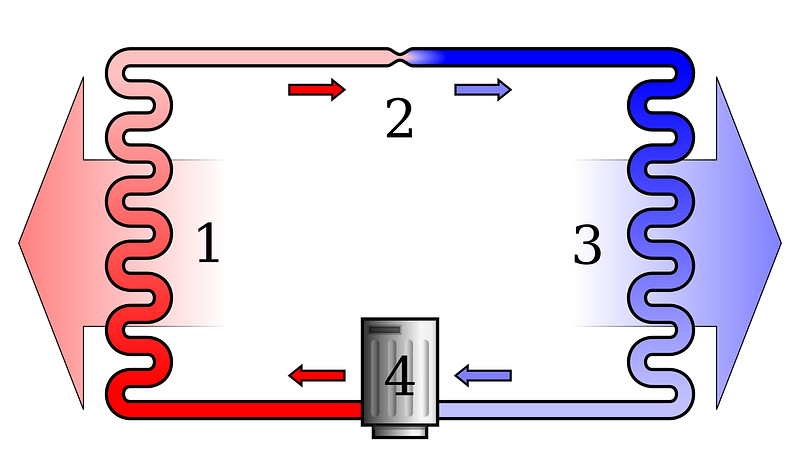
  1. A condensing coil
  2. An expansion valve
  3. An evaporator coil
  4. A compressor
The refrigeration cycle — Public domain by its author, Ilmari Karonen.

Here is a much more in-depth explanation of the refrigeration process on Wikipedia.

Does air conditioning use gas?

Gas-powered AC units used to be quite popular in the U.S. but slowly turned towards electric units for cost efficiency and savings.

There is a small resurgence in using gas as a power source for multi-zone units. But this can be extremely costly if you don’t already have a natural gas line hooked up to your house.

An interesting plus-side of using gas power AC units — they can cool you even in a power outage. So people that live in stormy, hot places like Florida and New Orleans might want to consider this kind of air conditioning instead.

Does car air conditioning use gas?

Yes, as it requires power from the alternator. (Unless of course, you’re driving an electric vehicle.)

So, while you’re driving down the city road, you should be aware that a small amount of gas is going towards the automotive’s air conditioning.

Interestingly, though, there are times when it is more fuel-efficient to have the AC on rather than off.

This occurs while you’re driving down the highway at high speeds.

If you have the windows completely open keeping you cool instead of the AC, this actually uses more fuel than simply having the windows up and the AC on!

Can air conditioning make you sick?

Air conditioning, especially in the office, can make you show signs of respiratory illness if the system is not well maintained. There have been several studies on the subject, each noting slight differences in results.

This article is a great resource that talks about the potential effects of air conditioning in buildings and why AC can make people sick in some situations.

The cooling components and other parts of a central AC system that get wet and aren’t cleaned properly can become a breeding ground for bacteria.

As long as the AC systems are well maintained and properly cleaned, with UV light, for example, the risks are very low.

How to save money on my AC bill?

There are a few different ways to save money with your air conditioning units. They can be an expensive addition to your monthly electricity bills, so any cost-saving measures can go a long way over time.

The Energy Department of America talks about heat loss at length in this article about saving money on your bills every summer. And for good reason — people can save massive amounts of money with a few tweaks.

Especially when dealing with heat loss and air conditioning.

Invest in a digital thermostat

Catch up to the modern age with a digital thermostat. Not only will it send you real-time information right to your phone, but many units can monitor electricity usage throughout the home.

As for air conditioning, digital thermostats are able to help you optimize temperatures and when to use the AC itself. These energy savings quickly add up to pay for the purchase typically within a year.

Here are 2 of the most popular digital thermostats today:

  1. Google Nest Learning Thermostat — $225 — Rated 4.5 Stars
  2. Honeywell Home WiFi Smart Thermostat — $199 — Rated 4.5 Stars

Perform yearly maintenance

Performing regular or yearly maintenance on your AC unit will not only make the air cleaner, but it will save you money in the long run.

You can either hire a certified HVAC professional or learn how to do it yourself (safely, of course!).

Look down further for a section on this subject.

Purchase a super-efficient AC unit

One of the most efficient modern AC units is made by Carrier Global (yes, the same company from the inventor of the AC!).

They sell their products through dealers so you’ll have to check out their product page for more details.

For air conditioner efficiency, it helps to look at 2 different metrics in the U.S. — SEER rating and Energy Star certification.

What does SEER mean?

SEER stands for Seasonal Energy Efficiency Ratio. It’s typically a rating given to an air conditioning unit to understand the total electrical energy used by the appliance.

The exact formula is:

The cooling output of a unit during a typical ‘cooling-season’, divided by the total electrical energy input during the same period of time.

The SEER rating of a unit is the cooling output during a typical ‘cooling season ‘divided by the total electric energy input during the same period.

Here’s a nifty SEER calculator that shows how much money you can save when upgrading or comparing different AC units.

What is Energy Star?

Energy Star is an organization run by the Environmental Protection Agency and Department of Energy that partners with industry companies to come up with standards for electricity efficiency and savings.

In 2018, the organization claims to have helped create over $35 billion in energy savings in that year alone. Quite substantial!

Public Domain from EPA

Their Energy Star label is currently on over 75 different kinds of products throughout the US and other partner countries.

The best efficient air conditioners

Here are several of the top-selling Energy Star certified air conditioners with high SEER ratings:

What are the biggest air conditioning companies?

Interestingly enough, the biggest air conditioner manufacturer is still Carrier Global — the company that the inventor of AC founded!

Here is a quick list of the largest AC unit manufacturers:

  1. Carrier Global — Based in USA
  2. Daikin Industries — Based in Japan
  3. LG — Based in South Korea — Interestingly, used to be called “Lucky-Goldstar”
  4. Samsung — Based in South Korea
  5. Haier — Based in China
  6. Midea — Based in China

How to do air conditioner maintenance?

It’s important to remember to occasionally perform maintenance on your AC unit for several reasons:

  1. Makes sure the unit and system has a longer lifespan
  2. Cools your home faster and better
  3. Makes the AC units more efficient, saving on energy costs
  4. Helps keep the air-conditioned air cleaner and less prone to spreading germs

Here’s a great video on how to do DIY maintenance on your air conditioner!

The video recommends that you do the following 8 steps every year to maintain your air conditioner:

  1. Outdoor unit — Clear all debris around the unit, keeping a 2 foot diameter
  2. Outdoor unit — Rinse your condenser coils (making sure all electricity is disconnected!)
  3. Outdoor unit — Perform a visual inspection to see if anything isn’t pristine — Is anything blocked, dirty, or broken?
  4. Indoor unit — Check your filters and replace them if needed
  5. Indoor unit — Turn off the humidifier during the summer, if you have one
  6. Indoor unit — Check the drain line
  7. Thermostat — Double check the room’s temperature (with a thermometer) against the thermostat
  8. Thermostat — Schedule an annual checkup for your AC with an HVAC expert

Air-conditioned dog houses

To finish off this look at air conditioning in the modern age, I thought I’d include one of the strangest examples I found.

Do you have a pet dog at home? Maybe he’d like his own air-conditioned dog house!

Well, strangely enough, here’s a full video on how to make one yourself!

J.J. Pryor

Thanks for reading! Please consider following my free newsletter to keep up with my crazy shenanigans.

History
Technology
Culture
Health
Sustainability
Recommended from ReadMedium