
When War and Climate Crisis Collide — From Gaza and Beyond
The grueling loop where one exacerbates the other
My desk is facing a window with a glass door that is currently open. The tender breeze of an approaching summer fills the room, and from time to time, my mind and eyes get lost in the stunning Patagonian background of still-snowed peaks and the lake’s calm waters.
I am an extremely lucky person. Not even my country, Argentina, in the undesired top-3 ranking of highest inflation rates worldwide, has brought increased violence to the streets. And a steady job keeps my mind away from the basic needs (water, food, roof, and peace), also abundant in this corner of the Earth.
On the contrary, living in conflict zones not only exposes people to the horrors of war but thrusts them into the harsh reality of the climate crisis. Unsurprisingly, 14 out of the 25 countries most vulnerable to climate change, as per the Notre Dame Global Adaptation Initiative rankings, are shackled by ongoing instability, hindering their ability to confront environmental challenges. This list includes the Central African Republic, Sudan, Afghanistan, Somalia, and the Democratic Republic of the Congo. Argentina is in the middle of the pack, at 71st place. Palestine, though, is not even ranked despite the ominous signs that the Gaza Strip is hurtling toward a treacherous intersection of armed conflict and an escalating climate crisis.
While a direct correlation between climate change and conflict may not exist, nations at war face a double crisis, as their internal violence undermines their ability to tackle the cascading impacts of climate change. The climate crisis, in turn, adds fuel to existing tensions, transforming resource disputes into volatile flashpoints, entering a grueling loop where one exacerbates the other.
And even with the agreed four-day truce — unfortunately, far from a guarantee that the pause in fighting will hold — the violence ravaging Gaza once again targets a population left more exposed and vulnerable than ever. Their risk level may be off-chart at this point.
Worldwide Patterns of Climate Crisis and Conflict
The tandem impact of climate change and conflict extends beyond mere displacement, escalating resource strain and intensifying existing tensions.
A 2020 report from the International Committee of the Red Cross (ICRC) underscores the extensive devastation caused by the interconnected ripple effects of conflict and climate change.
→ Central African Republic
Instability in the Sahel and Lake Chad regions has driven cattle herders and farmers to flock to the Central African Republic for greener pastures, adding a new layer of tension to a country already grappling with over 60 years of instability and rampant food insecurity. Traditional migratory routes for herders have been disrupted by armed violence, leading to settlements near villages or fields, sparking competition with locals for space and resources.
→ Sudan
As Will Lockett explained here, Darfur, a region in northwest Sudan, experienced severe desertification in the late 1990s and early 2000s. The Sahara desert moved southward at one mile per year, resulting in extreme desertification and a drastic decrease of up to 30% in annual rainfall. Without human intervention, such extreme desertification would not have occurred. The impact was significant, dividing Darfur into two distinct regions: the predominantly Arab ethnic population of nomadic pastoralists in the north and the predominantly ethnic-African population of smallholder agriculturalists in the south. On February 20, 2017, famine was declared in South Sudan, the world’s youngest nation. The combined effects of civil war and drought have left nearly 5 million people in the country food-insecure, representing over 40 percent of the population.
→ Somalia
Decades of conflict have compounded the challenges faced by Somalia, one of the world’s most climate-vulnerable countries. A UN report in July 2023 revealed that over 3.8 million people are displaced in Somalia due to conflict, drought, and floods, exacerbating tensions over land issues and disputes, as highlighted in a World Bank report. In South-Central Somalia, returnees often find their land occupied by others, leading to clashes and mass displacement.
→ Ukraine & Russia
According to the UN, armed conflict and climate change are the primary drivers of food insecurity. And this is more than just an African-based problem. The war between Russia and Ukraine serves as a stark example. Ukraine alone contributes about 15 percent of the world’s wheat production, and Russia and Ukraine collectively account for 80 percent of the world’s sunflower production. The war has led to a shortage of these essential crops, spiking global food prices.
Armed conflict not only devastates human lives but also wreaks havoc on a country’s natural environment. As highlighted by the ICRC, over 80 percent of conflicts occur in biodiversity hotspots, supporting half of the world’s plants and rare species. Environmental degradation contributes to climate change and diminishes a population’s adaptive capacity. The destruction of green areas, such as forests, releases substantial amounts of greenhouse gases, further compromising the planet’s ability to absorb them.
And Gaza is the utmost example.
War(ming) Zone
November 17, 2023, was the first day the global temperature exceeded 2°C above pre-industrial levels. A day later, again. One of those milestones you never want to reach, and even less, two days in a row.
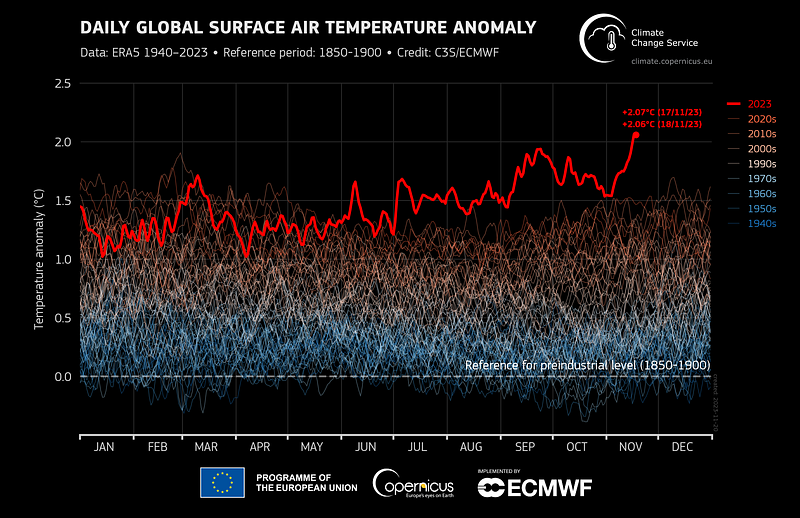
Unfortunately, this event went largely unnoticed as the world’s attention remained fixated on the ongoing horrors in Gaza.
First and foremost, we need a prolonged ceasefire in Gaza because of the humanitarian catastrophe unfolding there. But beyond the unforgiving impact of the conflict, our heating planet cannot afford to have its attention endlessly diverted from addressing climate change. 2023 will be the warmest year on record. And this isn’t just another apocalyptic prediction. It’s a stark reality, proven by empirical data.
The pressing need to address climate change, with a call from the IPCC to cut emissions in half within the next six years, demands a resolution to obstacles hindering global action. Prominent among them is the unresolved conflict between Israel and Palestine. The “sacred land” is on the brink of transforming into an uninhabitable desert. Because the region is currently warming at twice the global average rate, with the average number of high fire-risk days per year increasing by 2.5 times. Large parts of the coast are projected to disappear due to rising sea levels of the Mediterranean, warming much faster than the rest of the world.
The Outlook for Gaza is Even More Dire
Even before the latest outbreak of the conflict between Israel and Hamas on October 7, international organizations had been sounding the alarm about the perilous state of infrastructure and sanitation in the Gaza Strip, home to 2.2 million people. With a mere 365 square kilometers of land — a 41 km by 6–12 km rectangle — Gaza is home to 2.2 million people, translating to a population density of approximately 6,000 individuals per square kilometer and 5th worldwide in population density.
My hometown, Bariloche, covering two-thirds of Gaza’s extent with 220 square kilometers, is one of Patagonia’s most densely populated cities, accommodating around 146,000 people. This results in about 663 people per square kilometer, ten times less than Gaza. And even like this, it feels overpopulated. But then, you transcend the invisible margins of the city and dive into the real Patagonia, which, as a whole, has a density of 2 (no typo here) lost souls per square kilometer and plenty of natural resources. As I said before, I am a very lucky person.
Yes, there’s no doubt that the primary driver of vulnerability in Gaza is conflict. But the compounding impacts of climate change, including rising temperatures, diminishing precipitation, escalating sea levels, and more frequent extreme weather events, exacerbate people’s vulnerability.
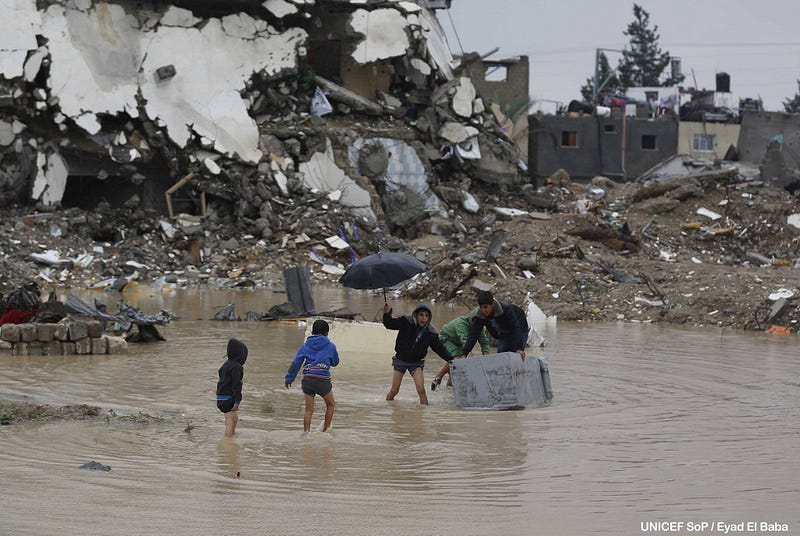
In recent years, intense floods wreaked havoc in Gaza, damaging hundreds of buildings and rendering entire drainage systems inoperable, displacing numerous residents. Facing severe restrictions on basic needs, the local population lacks the means to cope with another extreme weather event.
An MIT study predicts a 10% to 30% decrease in average annual precipitation by 2100, coupled with a 3 to 5-degree Celsius temperature increase, impacting agricultural productivity and food supply and causing price instability and shortages. And these environmental sufferings are exacerbated by the political conflict, with Israel manipulating water sources to subjugate the region.
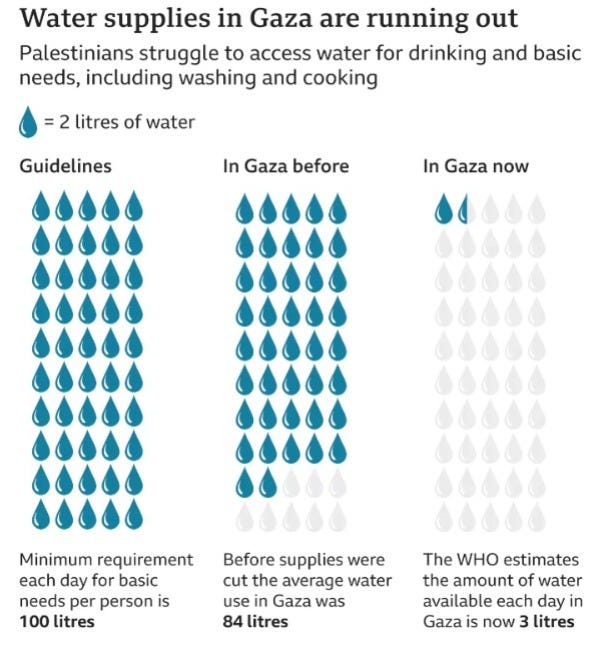
The World Health Organization (WHO) noted the lower limit of water per person per day is 100 liters (26 gallons). The average Israeli consumes 369.5 liters of water per day. Even before the current siege began, the average consumption was 45 liters in Gaza, 50 in Jerusalem and the West Bank, and 20 in some areas under Israeli control. Now, it is estimated to be at 3 (!) agonizing litres a day of water for drinking and basic needs.
Aggravating the situation and as reported by the Times, the Jordan River’s flow is less than 10% of its historical average, and the Yarmouk River, a significant tributary, is greatly diminished. The Dead Sea, fed by these rivers, is disappearing.
The aftermath is straightforward: over 660,000 Palestinians living in Jerusalem and the West Bank have insufficient access to water, while 1 million in Gaza suffer from water scarcity. Water scarcity in Gaza has led to drastic measures, with 97% of the population relying on unregulated private water sources and households spending one-third to half of their income on water. All while the land is a battleground and at risk of becoming a barren wasteland.
While Palestine might envision freedom “from the river to the sea,” the drying river and warming sea threaten the viability of such aspirations. One evident adaptation strategy is to move in search of more fertile land or water. That is not an option here. Because, simply put, there is no place to run from climate or conflict in Gaza.
Conflict Shifts Priorities and Impacts Climate Action: Will COP28 be of Any Use?
Even under optimal conditions, addressing climate change requires a profound societal, economic, and cultural transformation. In conflict zones, where the focus is survival, authorities are ill-equipped to prioritize climate-related challenges and inadequately prepared to respond to lesser adversities. The consequences of war extend beyond the visible destruction of infrastructure and services, impacting institutions, economic stability, and societal cohesion.
And despite being among the most climate-vulnerable, conflict-ridden countries face a funding gap for climate action, according to the International Committee of the Red Cross (ICRC), as their weakened institutions struggle to access or apply for funding.
Meanwhile, ICRC is applying to Gaza’s resilience amid current challenges, exploring solutions such as ensuring water points function independently of electricity. It is, of course, too much to ask for people who are striving for survival in a city constantly bombed where citizens are held hostage (and fortunately, now being released) to put the long-term ahead of the short-term.
So, after the world watched Israel explicitly committing war crimes, cutting off essential resources to the two million people trapped in the world’s biggest open-air prison, a.k.a. Gaza, the world is supposed to gather in Dubai to try and take the next halting steps towards dealing with this crisis. COP28 begins on Thursday, November 30, and will be run by Sultan Al Jaber from petrostate UEA and the chief executive of the national oil company Adnoc.
If you already thought that the conference was damaged by deep conflicts of interest threatening a successful outcome, leaked documents revealing that COP 28 president Sultan Al Jaber has secretly used the climate summit role to push oil trade with foreign government officials has made the situation even more pathetic.
And, apart from this surreal nepotism, the conference’s attention will unavoidably divert to the war between Israel and Hamas because it is in the middle of an energy-rich region. Instead of propelling countries away from fossil fuels, conflict has the opposite effect, inducing countries to secure their oil and gas supplies rather than transitioning toward greener sources. In this context, defense stocks have rallied, and oil prices inched up, fearing a Yom Kippur War 2.0 where the Arab oil embargo roiled energy markets.
In the backdrop of these geopolitical crises, the Earth’s thermostat continues to rise, with distressing occurrences like thousands of fish washing up dead in the Gulf of Mexico due to overheated waters, unpredictable tropical storms escalating into category 5 hurricanes, and alarming glacier melt rates. Each day these conflicts between nations extend is another day we ignore climate change for the world. On the contrary, we find ourselves captivated by sadistic injustices, unable to look away from the sick, short-term fascination with the violent and tragic.
The dual specter of war and climate crisis should serve as a stark reminder that the status quo is unsustainable. The imperative for systemic change has never been more apparent — our planet doesn’t care for our politics or conflicts; it’s steadily crumbling beneath the weight of our fossil fuel addiction. The countless studies on climate change should urge world leaders to take immediate action and prevent us from carelessly plunging into a self-made apocalypse.
The writing on the Western Wall is already too clear.
And too hot.
Thank you for your thorough reading and support! If you crave more insights into climate change, scientific progress, and geopolitics with a Patagonian twist, subscribe to the newsletter Antarctic Sapiens and dive into thought-provoking content weekly.


