
When to Say No: 3 Practical Lessons from Robin Roberts
Even if an opportunity seems great, you might want to think long and hard before saying “yes”
_(cropped).jpg)
I first heard Robin Roberts’s name in May 2015, the year two of my nieces graduated from two different colleges in Boston. Both graduations took place on the morning of the same day, and a few of us were placed in the situation of having to choose which one to go to.
I went to my Boston College niece’s graduation, where the commencement speech, which was instantly forgettable, was given by a Jesuit priest. When we all got together in the evening for a joint celebration of both nieces’ graduations, my sister raved about the wonderfully uplifting speech delivered at my Emerson niece’s event by one Robin Roberts.
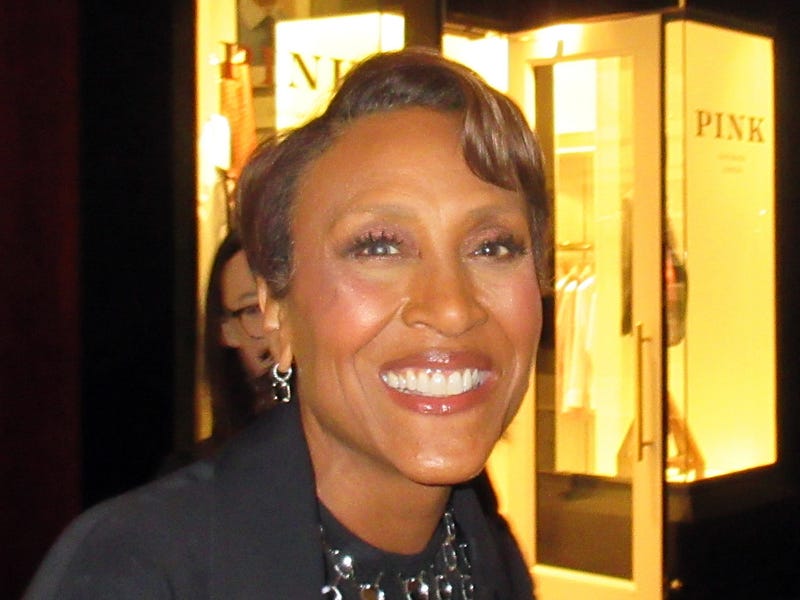
The name didn’t say anything to me, but when I saw her picture, I instantly recognized her as a TV news personality. Though I’d never seen her doing the news, I knew her face because Robin Roberts’s celebrity goes beyond broadcasting. I suspect I’d seen her likeness on billboards, on magazines at the checkout counter or the doctor’s waiting room, or perhaps when she’d been a guest on a show I do watch.
I recently finished Roberts’s MasterClass, Effective and Authentic Communication, which contains many engaging lessons and exciting stories from Roberts’s life not only about communication but also about how to evaluate opportunities.
One thread running through a few of the lessons is when to say no, which, of course, goes hand in hand with the opposite decision, when to say yes. Following are three questions to ask yourself when deciding between yes and no.
Does the opportunity match your goals?
Robin Roberts’s childhood dream was to be a professional athlete. Though basketball got her a college scholarship, her athletic skill didn’t match her dream, so she decided to be a sports journalist instead.
After college, Roberts had a choice between two jobs: one was a part-time gig as a sports news anchor for a small Mississippi network and the other a full-time position as a (generic) news anchor for a larger network. The latter offer came with benefits, a higher paycheck, and more prestige than the former, so Roberts was strongly tempted to take it. The thing is, it didn’t move her in the direction of sports journalism and her ultimate dream: working at ESPN.
She said no. While on the surface a less alluring job, the part-time position was a chance to grow her skills set in her true area of interest.
Whether it's your career or personal pursuit, it’s always mighty tempting to go for the opportunity that offers the most money, status, or anything that may flatter our ego. So we find ourselves compromising and neglecting our goals, often needlessly.
In such cases, saying no is hard, but saying yes may be a colossal mistake.
Are you prepared to be as successful as you need to be in the role you’re being offered?
Several years into her career as a sports news anchor, ESPN offered Robin a job. After some soulsearching, she turned it down. She felt she didn’t have enough experience yet for ESPN. Moreover, in her estimation, she also wasn’t ready simply because she was Robin Roberts, a black woman.
She doesn’t reveal this with resentment, but with admirable realism. As she tells it, she was going to be the first black female sports journalist at ESPN. She felt the “margin of error” allowed in her performance was minimal, compared to the average male journalist.
She wanted to be the first successful, not just the first, black female sports journalist at ESPN. She said no because she wanted to be fully prepared to become such a first.
We may not ever be in a situation like the one Roberts faced, but the lesson is relevant for many decisions. You must ask yourself, honestly, if you have the level of skill necessary for a specific role in a specific company and environment. If the answer is no, it’s probably better to say no, and work on getting to that next level.
That’s what Roberts did. A few years later, she was again offered a job at ESPN. She was indeed the first successful black female anchor for the network.
Is your response based mostly on fear?
Despite having declined news anchor positions before, Robin Roberts eventually did say yes to ABC’s Good Morning America.
Why did she do it if she had the job of her dreams? As it happened, she was ready for a change and a new challenge. We all run the risk of becoming too comfortable with the status quo, especially when it’s a great status quo. The comfort zone is a place that’s hard to leave. It offers stability, security and predictability.
If you want to live the most you can live, and grow throughout your life, then you must venture beyond your comfort zone every now and then. Fear often prevents us from doing so, even when the risk is worth taking. Fear is not a bad thing of course, but it must be confronted honestly.
Final Thoughts
“Things that are bad for us can become habits. Things that are good for us can become habits as well.”
To me, these are two of the best lines in Robin Roberts’s MasterClass. We can help ourselves and others immeasurably by keeping this lesson in mind.
I know people whose default answer is no. It’s like a habit. We shouldn’t reject or embrace opportunities out of habit. Rather, we must get into the habit of pondering, honestly, when to say no.