
When to Invest During a War
Does history’s “Buy the Invasion” strategy still work?

A lot has happened this past week. As a result, the market continued its volatile stretch.
Markets plummeted Wednesday and into Thursday on the news of Russia invading Ukraine. Surprisingly, Thursday did a complete U-turn. While Thursday morning futures were negative, the market managed to squeeze out a solid gain on Thursday. That momentum carried over to Friday, as the S&P 500 was up over 2%.
Futures are again looking negative heading into Monday. While the latest news is that Ukraine and Russian officials have agreed to meet to talk, this turmoil may continue for a long time.
Most countries are on edge with how this situation will play out, and with that, it's important to look at history to see how markets reacted to war.
Previous Wars
I am not a historian or politician — so I have no insight on what will happen between Russia and Ukraine any more than the next person.
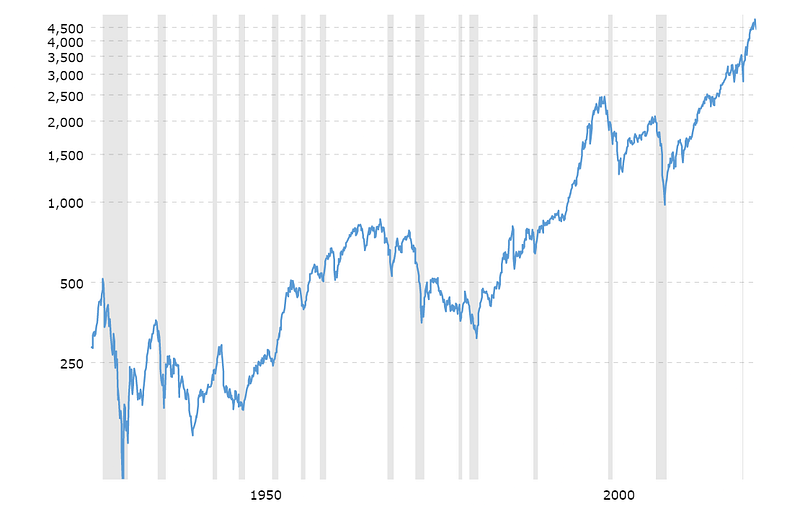
With that said, below is a chart of the S&P 500 since 1928.
WWII
WWII began in September 1939, the United States officially entered the war in December 1941, and the war ended in September 1945.
There was not much movement during the beginning months of the war. But the market was down in 1940 and 1941, bottoming in April 1942. July 1941 to April 1942 was a free fall — with the market falling over 30%. Pearl Harbor, which prompted the United States to enter the fighting, was in the middle of this slide in December 1941.
Korean War
The Korean War was fought between June 1950 and July 1953.
The S&P 500 did react negatively to the start of the war — falling from May to July of 1950. But the slide was only 6%
Vietnam War
The Vietnam War was fought from November 1955 to April 1975, with the United States involved in combat from March 1965 to March 1973.
There was no downward movement in 1955 but a small reaction in 1965 as the market tumbled 5% from April to June.
The Worst is the Beginning
Without having lived through these wars, it is difficult to know how much of an impact the Korean and Vietnam War announcements had on the poor market returns versus other factors.
It is also worth noting that the bottom for the market in WWII was during 1942 — the middle of the war — and for the Korean War, the bottom was in the early months. The market started to improve before the war did. The Vietnam War is a different story, as there were other factors in the economy at the time. So unfortunately, the S&P was lower in March 1973 than March 1965.
One other notable event is the terrorist attacks on September 11, 2001. The S&P fell more than 14% in the first week after the attacks.
One note: I decide to exclude the dates of the Gulf, Iraq, and Afghanistan War when looking at this.
There are several charts provided via Fundstrat that show buying the S&P 500 at the start of a war has usually been profitable. “Buy the invasion” is the takeaway.
Markets did take a tumble in the middle of last week as the invasion began. It looked to be a good time to slowly put some cash to use. But because we do not know how this war will play out, it's best not to go overboard. Keeping some cash on the sidelines can be beneficial.
New Territory for Investors
Most investors of today have never lived through a full-scale war. What will be the full economic implications of this? How will investor psychology be impacted and, in turn, impact stock prices?
Another item to consider is that hindsight is 20/20. We never know when the fighting in Ukraine will end. It could go on for days, weeks, months, or even years. And who knows how many other countries get involved.
Since it is impossible to predict the future, I am going to take advantage of the market volatility as best I can — and hope markets don't turn too sour. Any day the S&P 500 is down more than 2%, I will buy-in. And any two consecutive days a stock I already hold is down more than 7% combined, I will add to that position.
I am not confident in the market in the next few months. But I’m also not too worried. Most stocks, especially tech, are already down big for 2022. The S&P is down 8% YTD. Market’s don't like uncertainty — and that is exactly what the Ukraine situation is giving us.
Until we know more, it is hard to know where the market will go. I expect the volatility to continue; maybe that’ll cause the market to move sideways for an extended time.


