
WRITING PROMPT RESPONSE
When They Have this Split Pita Lamb Stew, Who Cares about the Terra-cotta?
It’s the city’s own joy. No one can take it away
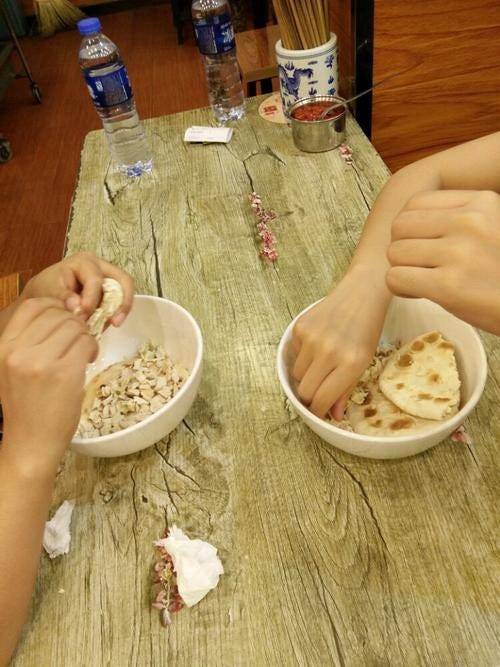
Xi’an’s fame mostly comes from Terra-cotta. But for many locals, the underground army is a distant pride, while Xi’an food a selfish joy. The list of Xi’an food is a long one, but the top pick sees no competition.
It’s YRPM.
Okay, read after me, Yang Rou Pao Mo. Never mind the translation; you will know it soon.
It’s a Halal food or Muslim food. Modern life has changed ethnic food a lot. But Xi’an’s over two million Muslim population, called Hui, assures that some traditions and tastes will survive the time.
Be prepared that you are one of the chefs (sounds weird? reading on!)making this feast. Sitting down in the restaurant, you will receive a large bowl, called “ocean bowl,” and two unleavened flatbreads, or buns. They call the bun “Mo” or “dead Mo” as it’s non-fermented, stiff, and inedible yet. It falls into the category of naang or pita in Islamic food but is smaller and half-baked — no sticky, no messy, after boiled in mutton soup. Then comes the labor work. You need to finger split the stiff bun into small granules(now you see, chef?). How small? Technically, the smaller, the better. Practically, it depends on how patient and hungry you are. How long you have to stay on the labor work? Well, watch the life of a typical YRPM fan in downtown Xi’an.
Early morning, he goes to the breakfast store to have a bowl of Hulatang –a batter-like dark spicy soup. On the way to the tea house, he stops by a YRPM restaurant and picks up one ocean bowl and two pieces of bun. Listening to the rowdy local opera, Qingqiang, for four hours or so, he never stops splitting the bun unless he comes up singing himself. Checking out the tea house, he goes back to the YRPM restaurant. In five minutes, the final product of his labor is put on the table. Soup is soup, and bites are bites. They never mess up. On the top are slices of mutton or beef, bean vermicelli, and minced scallions. A tiny plate is served with pickled sweet garlic and chili sauce. Should he pre-announced, a few coriander leaves will be added.
While he is splitting the buns, the restaurant kitchen is no less busy. The mutton broth, in an ocean pot, starts to heat the night before. Long time simmering is a broad recipe of thick soup in East Asia, but the Muslim chefs have their well-kept secrets. When it’s ready, the soup remains clear with a slight aura between green and yellow. It’s still clear even after the split-bun boiling –soup is soup, bites are bites. The broth is supposed to wake up the dead bun but never intrude.
They say the taste of the mutton soup is penetrating. So true for YRPM. That’s why the reviews on it are so polarizing. Those who hate it keep a social distance from it. For those who love it, it’s a ritual. The meat itself — two or three slices of mutton, is served in a mellow posture. They crumble right into your mouth — the chewing never catches up with its dissipation. They might lose a bit of sense of roughness; this is where the transparent bean vermicelli steps in — crispy and brisk.
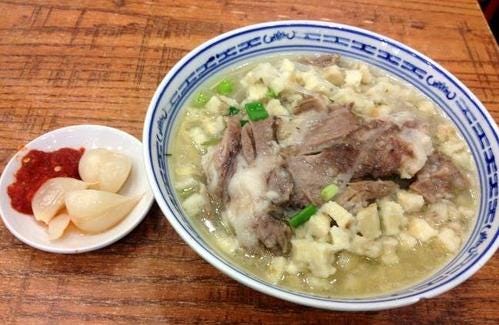
Overwhelmed by the mutton flavor? The sweet pickled garlic comes to the rescue –a strong smell to kill another strong smell. Old fans hate the glaring red chili sauce –they believe only the sweet garlic is the best match. But it’s increasingly popular among younger generations –it spices up not only the flavor but also the look of the broth. In some old-fashioned restaurant, therefore, the waiter would come to tell you, “If you want to add the sauce, don’t stir it. One bite of Mo, one bite of sauce. Do it correctly, and you can see the clear soup even at last swallow.”
Chinese food looks to three essentials: appearance, smell, and taste. YRPM has done the extreme on all three fronts — goodly or badly. Whether like it or not, without having an ocean bowl of YRPM, you’ve never come to Xi’an.
Fun stories:
— How it was promoted. Hundreds of years ago, a king, when he was still a pauper, almost starved to death. Enticed by an incredible smell, he came to a YRPM restaurant. But he had no money. Lying outside, he took his last food — two pieces of dead Mo and tried to swallow with the smell. The kind restaurant owner found him. He asked the king to split the bread into pieces and cooked it with hot mutton broth. Hooray, the king had the best meal of his life. He promoted it across the country after he became the king.
— The split work is so important that the master chef in the kitchen alters the boiling process according to the granule quality. Too big or too uneven? It must be a tourist; haste cooking is served. Small and uniform, a regular customer, cooking with care. Sometimes he even knows the customer’s name by the look of the granule so that he can cook with his/her recipe. Now, most restaurants have installed machines to shred the bread. But labor work is always there.
— YRPM is so local that some fans believe any cooking out of the town loses its flavor. The same theory that you can’t have a home country meal in a foreign land. But how amazing that YRPM only stays in the city, a square of about 20mils. It’s the city’s selfish joy. No one can take it away.
#localdelicacies

Sign up for our newsletter to stay informed with up-to-date curations from our editors:👇
We now offer exclusive writing services for our members. Discover how you can take advantage of our editing services and more.