
When the Worst Has Happened, You Are Finally Free
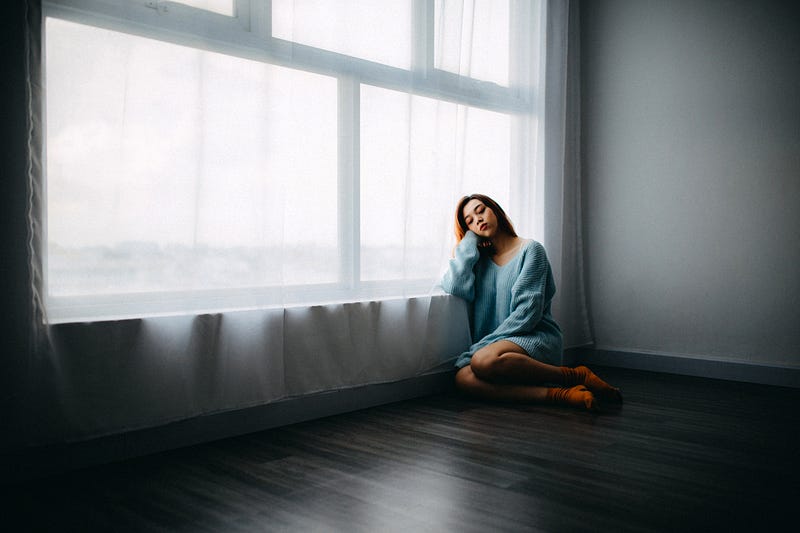
You can make a home even in isolation.
Society exists for a reason.
People, left to their own devices, usually come to blood. Mao Zedong may be right about all political power curling like cordite from the obscene mouth of a gun. But there are less bloody ways to keep each other in line.
Shunning. Isolation. The silent treatment. If you want to hurt, if you want to kill, all you need to do is shut off all contact. Nothing grows in the spotless void of space. Nothing punishes like isolation.
But solitary confinement is usually temporary. The logic behind a prison’s perks — the library, the TV, the commissary — is that you need something to take away. When you ain’t got nothin’, you got nothin’ to lose.
When a person truly has nothing, they are finally free.
My dad warned me about the rain.
It was raining when he said it, the water mixing with the heavy clay soil and running in milky rivers down the cracked slope of an English construction site. The big house stood unfinished at the end of the slippery driveway, its windows and doors gaping stupidly at the downpour.
We were the only two men on site. We sat together in the double garage that was his office and listened to the weather.
“There’ll be lots of this there,” he said. He was right. In Canada’s Pacific Northwest, we are mostly spared the bitter cold the rest of the country is known for. The trade-off is rain. Lots and lots of rain.
Recently, I read Rachel Cusk’s essay Coventry. The central image comes from an English idiom. To send someone to Coventry is to ignore them. To shun them. To seal a person up in a prison without walls, a see-through bubble of silence that follows its victim everywhere.
In our current era of empty streets and shuttered windows, it feels sometimes like the whole world is Coventry.
Isolation kills.
Humans are social creatures to a fault. We are made to be around each other. Alone, our outlines begin to blur like fuzzy-headed actors on a degraded videotape. We define ourselves by what’s around us as much as what’s within us. I end where you begin.
We feel for those who are alone. We consider dying alone to be an especially bitter flavor of tragedy. As though there were any other way to die.
And yet, even before the crisis du jour, we were living in an increasingly lonely world. The more means we have to communicate, the worse we seem to be at it. A 2010 study by AARP found that 43% of adults aged 45 to 49 describe themselves as lonely. Back in the 1980s, only 20% made the same claim.
Half of Americans over eighty-five live alone. And for younger people who are traditionally more mobile, chasing careers around the country and around the world, the stats aren’t much better.
Isolation leads to a 29% increase in the risk of heart disease and a 32% increase in the risk of stroke. Another study suggests that isolated individuals have a 30% higher chance of dying within seven years.
Outside of the dehumanizing rape we like to joke about, the harshest punishment available in the toughest prisons of Western nations is isolation. And the blustering bigots who fulminate about prisons being holiday camps have usually never been to one.
Spend a full twenty-four hours in the Hole, then get back to me. Isolation can trigger psychosis, schizophrenia, and suicidal impulses. Being alone can break anyone.
But solitude has its own dark gravity.
That’s exactly what I was seeking when I decided to leave the place I grew up in. After 20 years spent living in my father’s house, in Coventry, I was ready for more isolation, not less. And he gave me a job on his construction site to try and help me earn some money before I went away forever.
My dad never believed in handouts. He always insisted that a man has to earn his keep in this world. He was right about that, too.
It’s called underground endurance.
The current record for the longest solo stay in a cave is held by Milutin Veljkovich. On 24 June 1969, he was sealed into Samar Cave in Serbia with one thousand packs of cigarettes, a dog, a cat, and some chickens. He stayed in there for 463 days.
Milutin wasn’t completely isolated. He had a radio to communicate with the outside world. Still, hallucinations plagued him, the mind inventing something to work on in the otherwise featureless darkness. Being so profoundly alone is no picnic.
The wet stone on the concrete streets hit some hidden mark in my heart.
It’s always different, but it’s always the same. The same rain here as it is there, the rain that feeds fat-leaved weeds as they reach toward a slate-colored sky. I was born in Coventry, metaphorically and literally. I lived in Coventry, in isolation, in the sullen silence of decomposing dreams, until I forgot to be afraid.
In her essay, Cusk doesn’t know the origin of the expression ‘sent to Coventry’. I do. Because I was born there.
If other people don’t see you, do you really exist? That’s the threat of Coventry. But when I close my eyes, I cease to exist anyway. All that’s here is a projection of the world on the back of my skull, distorted by an echoing curve of bone. What we see now, if we bother to look at it, is a world without ourselves.
It’s utterly gorgeous.
In 1951, workers opened Babie Doly cave in Poland.
Two strange men came stumbling out.
In 1945, there were six of them. Six German soldiers who were looting a storehouse when the tunnel that led to it was dynamited. The storehouse contained enough food and supplies to keep them alive. Still, two of the six men killed themselves soon after becoming trapped. Two others died of… something else.
And when the surviving two soldiers emerged, blind and bearded and gibbering nonsense, one of them died on the spot. He had a heart attack the minute the sun reached his useless milky eyes.
Rachel Cusk knows a different Coventry than I do.
The metaphor, not the metropolitan area. The symbol, not the city. But when she says that freedom means living in Coventry forever, she’s absolutely right.
Some isolation is voluntary. I think of the perfect solitude that awaited me in Vancouver, where the rain is still falling, just as my father said it would. Some isolation is enforced.
But all of it is a test of who we are. How we define ourselves in the absence of others. How we find and fabricate meaning in the bombed-out shells of our hearts.
I’ve been so alone that the walls started to talk, the way they did to Milutin Veljkovich. I’ve been so alone that the darkness looked like light. In Coventry, the worst has already happened.
All that’s left to do, as the sky falls like drips of molten glass into the hollowed-out husk of a ruined cathedral, is to rebuild. The silence exists for us to fill it. What else could it possibly be for?


